White-vented Euphonia
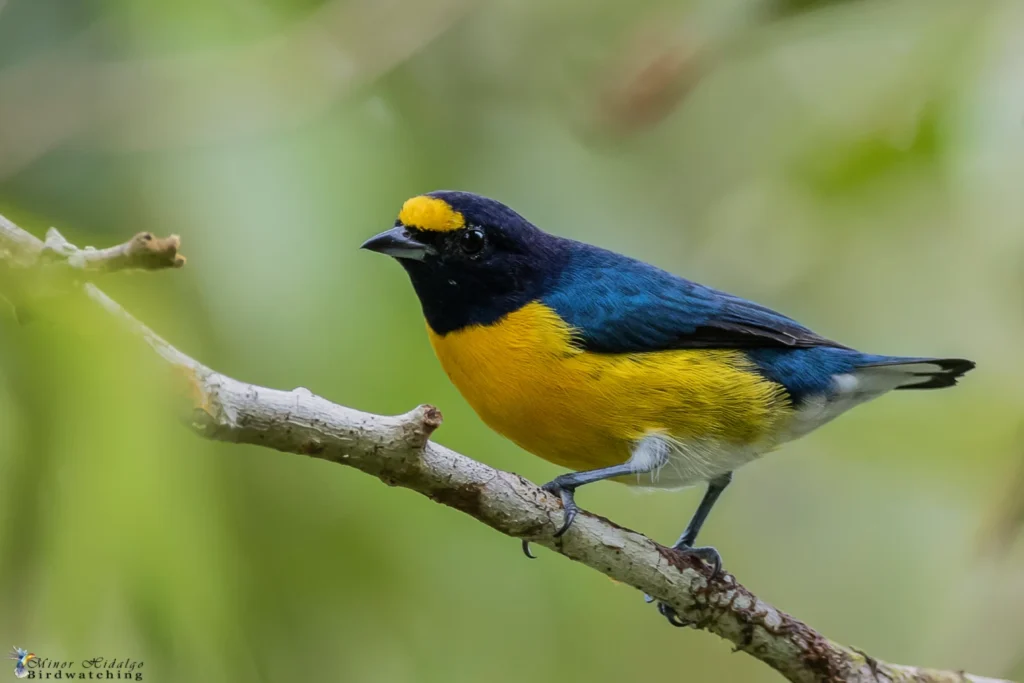
The White-vented Euphonia is a tiny, colorful bird that birders can easily overlook among the more conspicuous songbirds of Costa Rica. Adult males are striking, with a glossy blue-black back, bright yellow forehead and chest, and the white vent that gives the species its name. Often high in fruiting trees, it can be surprisingly hard…

Euphonia minuta
Scientific Name
Fringillidae
Family
Passeriformes
Order
Euphonia minuta humilis
Subspecies. Costa Rica (resident subspecies)
Range and Habitat of White-vented Euphonia
Geographic Range
A broad range from southern Mexico through Central America and into large portions of South America.
Migratory Patterns
In Costa Rica the subspecies Euphonia minuta humilis is resident year-round rather than a long-distance migrant, although local movements may occur, often following fruiting conditions.
Preferred Habitat
Lowland and foothill forests, forest edges, secondary growth and other wooded areas with fruiting trees. Also occurs in gardens and more open areas when suitable trees are present. Much of its time is spent in the canopy and along forest edges, particularly where small fruits and mistletoe are available.
Altitude Range
Mainly lowland in Costa Rica, from sea level to approximately 1,200 meters (3,940 feet).
Costa Rica Habitat
Primarily a bird of the humid Caribbean slope. Also found locally on the southern Pacific slope, including the Golfo Dulce and Osa Peninsula regions.
Conservation Status
Conservation Status
Least Concern
Population Status
Classified as Least Concern by the IUCN with a large geographic range. There is no reliable estimate of its total population in Costa Rica or globally.
Habitat loss remains a potential concern for this and many other tropical songbirds.
Conservation efforts
In Costa Rica, protected forests, biological reserves and connected areas of natural vegetation help preserve both habitat and the fruiting plants on which these birds depend.
Primary Threats
Habitat loss remains a potential concern for this and many other tropical songbirds.
White-vented Euphonia Identification
How to Identify the Species
Rarity Level:
UncommonBest Viewing Times:
All Day
Size
About 9 to 9.5 cm (3.5 to 3.7 in) long; roughly 8 to 11 g (0.3 to 0.4 oz). One of the smallest birds in Costa Rica.
Plumage
Adult males have glossy blue-black heads and upperparts, a bright yellow forehead and underparts, and a white lower belly and undertail coverts. Adult females are mostly olive above, with a grayer head and yellowish tones below, and share the white lower belly and undertail area.
Distinctive Features
The combination of tiny size, restricted yellow forehead and white vent distinguishes males from similar euphonias. In females, the white lower belly and undertail area is the most useful identification feature.
Sexual Dimorphism
Strongly dimorphic. Males are glossy blue-black and yellow with a white vent; females are olive above with a grayer head and yellowish underparts.
Diet and Feeding Behavior
Primary Diet
- Fruit makes up an important part of the diet, particularly mistletoe berries and other small fruits. May also consume small invertebrates.
Foraging Techniques
- Plucks fruit while perched and may stretch or hang from branches to reach it. After swallowing mistletoe fruit, the birds disperse its seeds to new host trees, making them an important part of the plant's life cycle.
Feeding Times
- Can be found feeding in productive fruiting trees throughout the day.
Behavior Patterns
White-vented Euphonia
Social Structure
Often encountered as pairs or in small groups, and may forage alongside other fruit-eating birds. Their tendency to remain high in vegetation can make them easier to hear than to see.
Song and Vocalization
Short, high-pitched notes and musical calls. Learning its song is helpful when birding the canopy, where such a small bird can easily disappear among the foliage.
Courtship and Mating Ritual
Detailed information about courtship and behavior specifically in Costa Rica is limited, and behavior documented elsewhere in the species’ range should not automatically be assumed to occur in the same way here.
Territoriality
Not well documented specifically in Costa Rica.
Birdwatching Tips
Best Locations for Spotting White-vented Euphonia
The Caribbean slope offers some of the best opportunities. Our guides look for it around Sarapiquí and other Caribbean lowland and foothill locations with suitable forest, edge habitat and fruiting trees. Areas around La Selva and other protected forests provide particularly good habitat. On the southern Pacific slope it can also be found around the Osa Peninsula and Golfo Dulce.
Best Time of the Year
Because the species is resident, there is no single best season, although local fruiting conditions can affect how easily birds are found.
Common Behavior
Look carefully at small birds moving through fruiting trees and the canopy. Listening is equally important; an experienced guide may hear the bird before anyone spots it.
Recommended Gear
Good binoculars are essential. Photographers will appreciate a longer lens, because these birds frequently remain above eye level.
Breeding and Nesting Behavior
Breeding Season
Not well documented specifically in Costa Rica. Observations from elsewhere in the species' range should not be assumed to apply here, and this is an area where more local study is needed.
Nesting Sites
Members of the genus Euphonia generally construct enclosed or dome-shaped nests, but reliable local information for Costa Rica is limited.
Clutch Size
Not well documented specifically in Costa Rica. Observations from elsewhere in the species' range should not be assumed to apply here, and this is an area where more local study is needed.
Incubation Period
Not well documented specifically in Costa Rica. Observations from elsewhere in the species' range should not be assumed to apply here, and this is an area where more local study is needed.
Parental Care
Not well documented specifically in Costa Rica. Observations from elsewhere in the species' range should not be assumed to apply here, and this is an area where more local study is needed.
Did You Know?
Is the White-vented Euphonia a finch or a tanager?
For many years euphonias were considered tanagers and placed in the family Thraupidae. Genetic studies changed that understanding, and euphonias are now classified in Fringillidae, the family that includes many of the world’s finches. A bright yellow and glossy blue-black male looks very much at home among the tanagers, but the White-vented Euphonia is a finch.
Which euphonias are found in Costa Rica?
Costa Rica’s official bird list includes nine species with Euphonia in their English names: Scrub, Yellow-crowned, White-vented, Yellow-throated, Thick-billed, Spot-crowned, Olive-backed, Tawny-capped and Elegant. Eight belong to the genus Euphonia; the Elegant Euphonia is now classified as Chlorophonia elegantissima. Their ranges vary considerably: a Yellow-throated is far more likely in the drier northwest and Pacific, while the White-vented belongs to the humid Caribbean lowlands.
What does a euphonia sound like?
Euphonias generally produce high-pitched, musical whistles, chips and short phrases. Listening is especially useful for the White-vented Euphonia because it feeds high in the canopy, where an experienced guide may hear it before anyone spots it.
Where can you see euphonias in Costa Rica?
Different species occur throughout the country, from the Caribbean and Pacific slopes to the dry northwest and middle elevations. To find the White-vented Euphonia specifically, look in humid Caribbean lowland and foothill habitat around forest edges, fruiting trees and mistletoe. Sarapiquí is a good area, and the species also occurs in humid parts of the southern Pacific slope.