Jabiru
Few wetland birds make an impression quite like the Jabiru. Towering above the marsh with a white body, massive black bill, featherless black neck and vivid red neckband, this enormous stork looks almost prehistoric. For birders hoping to see one in Costa Rica, finding a Jabiru in the northern wetlands is often among the most…

Jabiru mycteria
Scientific Name
Ciconiidae
Family
Ciconiiformes
Order
Range and Habitat of Jabiru
Geographic Range
The Jabiru occurs from southern Mexico through Central America and much of South America, reaching northern Argentina. Particularly large concentrations occur in regions of Brazil, Bolivia and Paraguay.
Migratory Patterns
Not a true long-distance migrant, but it makes seasonal movements in response to changing water levels and food availability. During the dry season, birds may travel considerable distances as wetlands recede and fish become concentrated in remaining pools.
Preferred Habitat
Open freshwater wetlands, including marshes, shallow lagoons, flooded grasslands, river edges and seasonal floodplains, with large trees nearby for nesting.
Altitude Range
Primarily a lowland bird. In Costa Rica generally found below approximately 500 meters (1,640 feet).
Costa Rica Habitat
The best-known areas for Jabiru in Costa Rica are Caño Negro National Wildlife Refuge and the wetlands surrounding Los Chiles, along with Palo Verde National Park and the lower Tempisque River basin in Guanacaste. These areas provide both shallow feeding habitat and large trees suitable for nesting.
Conservation Status
Conservation Status
Least Concern
Population Status
Globally listed as Least Concern by the IUCN. In Costa Rica the Jabiru is considered endangered and has a limited distribution. Earlier research placed the national population at only about 70 to 80 individuals. During the 2026 breeding season, researchers from the Universidad Estatal a Distancia recorded a minimum of 148 Jabirus, including nine active nests and 19 chicks, in the Tempisque and Río Frío watersheds.
Wetland drainage, agricultural expansion, water pollution, disturbance near nests, and the loss of mature nesting trees.
Conservation efforts
Long-term population and nest monitoring, environmental education, protection of important wetlands, and safeguarding of feeding and nesting habitat. Costa Rica also established a national commission to coordinate research and conservation efforts for the species.
Primary Threats
Wetland drainage, agricultural expansion, water pollution, disturbance near nests, and the loss of mature nesting trees.
Jabiru Identification
How to Identify the Species
Rarity Level:
RareBest Viewing Times:
All Day
Size
120-140 cm (47-55 in) tall; wingspan 2.3-2.8 m (7.5-9.2 ft); 4.5-8 kg (10-17.6 lb). Often described as the tallest flying bird in South America.
Plumage
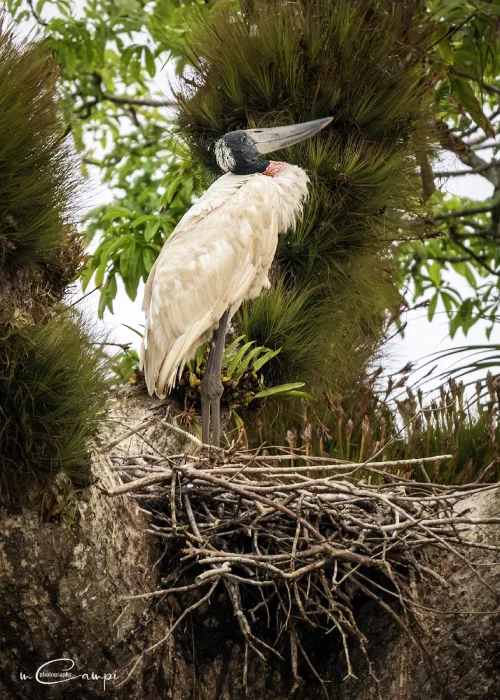
Adult plumage is almost entirely white, contrasting with the massive black bill and bare black head and neck. The neck is featherless. At the base of the neck is a red expandable pouch, which can create the appearance of a swollen neck. Juveniles are duller, with grayish or brownish tones instead of the crisp appearance of an adult.
Distinctive Features
The size alone makes the Jabiru difficult to confuse with anything else in its range. The slightly upturned bill may reach about 30 cm (12 in) long, and the vivid red neckband is a prominent field sign.
Jabiru vs. Wood Stork: both are large white storks found in Costa Rica, but the Jabiru is considerably taller and heavier, with a massive slightly upturned bill, entirely white wings, a bare black neck and the red pouch. The Wood Stork is smaller, with a dark scaly-looking head, a long downcurved bill, and black flight feathers visible in flight and along the folded wings. It lacks the red neckband. Wood Storks are highly social and feed in groups; Jabirus are more often alone or in pairs.
Sexual Dimorphism
Males and females share the same plumage, but males are usually larger than females and may have heavier bills.
Diet and Feeding Behavior
Primary Diet
- An opportunistic predator whose diet consists mainly of fish. It also eats frogs, aquatic insects, crabs, mollusks, snakes, turtles, small mammals and other animals found in shallow water. Large individuals may even take young caimans or crocodiles.
Foraging Techniques
- Walks slowly through the wetland, probing with its bill and locating prey by sight or touch. It may splash or sweep its bill through the water or stir the bottom with its feet to flush hidden animals. Several birds have occasionally been observed working together to drive fish into shallower water.
Feeding Times
- Forages during daylight hours. During the dry season, several birds may gather around shrinking pools where fish are concentrated.
Behavior Patterns
Jabiru
Social Structure
Often seen alone or in pairs, although groups may gather where food is abundant. Despite their enormous wingspan, Jabirus are graceful fliers and regularly use rising warm air to soar above the wetlands.
Song and Vocalization
Generally quiet. Most sounds come from bill-clattering, especially near the nest or during courtship.
Courtship and Mating Ritual
A pair may face one another, raise their heads, clatter their bills and engage in mutual preening.
Territoriality
Not strongly territorial while feeding and may forage near other wading birds. During the breeding season, however, a pair protects the area immediately surrounding its nest.
Birdwatching Tips
Best Locations for Spotting Jabiru
Costa Rica Focus guides regularly search for Jabirus in Caño Negro National Wildlife Refuge, the wetlands around Los Chiles and Medio Queso, Palo Verde National Park, and other productive areas within the Tempisque River basin.
Best Time of the Year
Jabirus can be seen year-round, but December through April often provides the best viewing. As water levels fall, prey becomes concentrated in shallow pools. This period also overlaps with nesting activity, although active nests must be viewed from a respectful distance.
Common Behavior
Most sightings involve birds wading through shallow water, standing near a marsh, or soaring overhead.
Recommended Gear
Bring binoculars and, when possible, a spotting scope, since wetland birds may be far from the road or boat. Photographers should bring a telephoto lens. Sun protection, water and lightweight rain gear are useful for everyone.
Breeding and Nesting Behavior
Breeding Season
In Costa Rica, egg laying and incubation generally occur between October and December, with the first chicks hatching in early January. Young birds are often close to adult size by early April.
Nesting Sites
An enormous platform of sticks built high in the crown of a mature tree near a wetland. Some measure about 2 m (6.5 ft) across and sit more than 15 m (49 ft) above the ground. Nesting trees in Costa Rica include ceiba, gallinazo, Guanacaste and carao. Pairs may reuse the same nest for several seasons, adding new material each year.
Clutch Size
Two to four white or cream-colored eggs.
Incubation Period
Approximately 28 to 32 days, with both parents taking turns warming and protecting the clutch.
Parental Care
Chicks hatch covered in white down and grow quickly. Both parents guard and feed the chicks. Young birds may need approximately 75 to 115 days to fledge and can remain dependent on their parents after leaving the nest.
Did You Know?
Where does the name Jabiru come from?
The name originated in an Indigenous Tupi-Guaraní language and is commonly interpreted as meaning “swollen neck,” referring to the bird’s bare, expandable neck and red pouch. The word passed into Portuguese usage in Brazil before entering English during the 1700s.
What is a Jabiru?
A large wetland bird belonging to the stork family. Its scientific name is Jabiru mycteria, and it is the only species in the genus Jabiru. The traditional pronunciation is “JAB-ih-roo.”
Where do Jabiru live?
In freshwater wetlands from southern Mexico through Central America and much of South America. In Costa Rica it is found primarily in the northern wetlands, particularly around Caño Negro, Los Chiles, Palo Verde and the Tempisque River basin.
What are Jabiru storks related to?
Jabiru storks belong to the family Ciconiidae, the world’s storks. Their relatives in the Americas include the Wood Stork and Maguari Stork. The Jabiru is distinguished by its exceptional size, all-white wings, featherless black neck and red throat pouch.
How big is a Jabiru stork?
A Jabiru stands approximately 120 to 140 cm (47 to 55 in) tall and weighs roughly 4.5 to 8 kg (10 to 17.6 lb). The wingspan can reach 2.8 m (9.2 ft). Males are generally larger and heavier than females.
When is the best time to see a Jabiru in Costa Rica?
Jabirus can be seen throughout the year, but December through April is often best. Falling dry-season water levels concentrate fish in shallow wetlands and make the birds easier to locate. This period also overlaps with nesting and chick-rearing.