Crimson-collared Tanager

Ramphocelus sanguinolentus
Scientific Name
Thraupidae (tanagers)
Family
Passeriformes Oiseaux
Order
R. s. sanguinolentus
Subspecies. SE Mexico to Honduras
R. s. apricus
Subspecies. E Honduras to NW Panama
Range and Habitat of Crimson-collared Tanager
Geographic Range
From southern Veracruz and northern Oaxaca in Mexico south along the Atlantic/Caribbean slope through Belize, Guatemala, Honduras, El Salvador, Nicaragua and Costa Rica to the lowlands and foothills of western Panama, with some Pacific-slope presence in Chiapas and Panama.
Migratory Patterns
Non-migratory; a year-round resident that stays within its home range.
Preferred Habitat
Humid lowlands — shrubby borders, humid evergreen forest edge, second growth and more open wooded habitats, including plantations and degraded forest edges. Usually seen in pairs at middle to upper levels.
Altitude Range
Generally below 1,200 m (about 3,900 ft) — sea level through the foothills.
Costa Rica Habitat
Caribbean (Atlantic) slope, in lowland and foothill humid forest edge, second growth and gardens. Regularly recorded at foothill sites such as Rancho Naturalista at around 900 m (2,950 ft)
Conservation Status
Conservation Status
Least Concern
Population Status
Global population estimated at roughly 500,000–5,000,000 mature individuals. Listed as Least Concern thanks to its very large range; the overall trend is a moderate decline from habitat loss, but well short of any threatened threshold.
Habitat loss driving a moderate population decline, buffered by its tolerance of edge and second-growth habitat.
Conservation efforts
No species-specific measures are required; it occurs in many protected areas and, because it tolerates plantations and degraded forest edge, adapts better to disturbed landscapes than forest-interior species.
Primary Threats
Habitat loss driving a moderate population decline, buffered by its tolerance of edge and second-growth habitat.
Crimson-collared Tanager Identification
How to Identify the Species
Rarity Level:
CommonBest Viewing Times:
Early Morning (Dawn - 8 AM), Afternoon (2 PM - 5 PM)
Size
About 19–20 cm (7.5–8 in) long, weighing roughly 35–45 g
Plumage
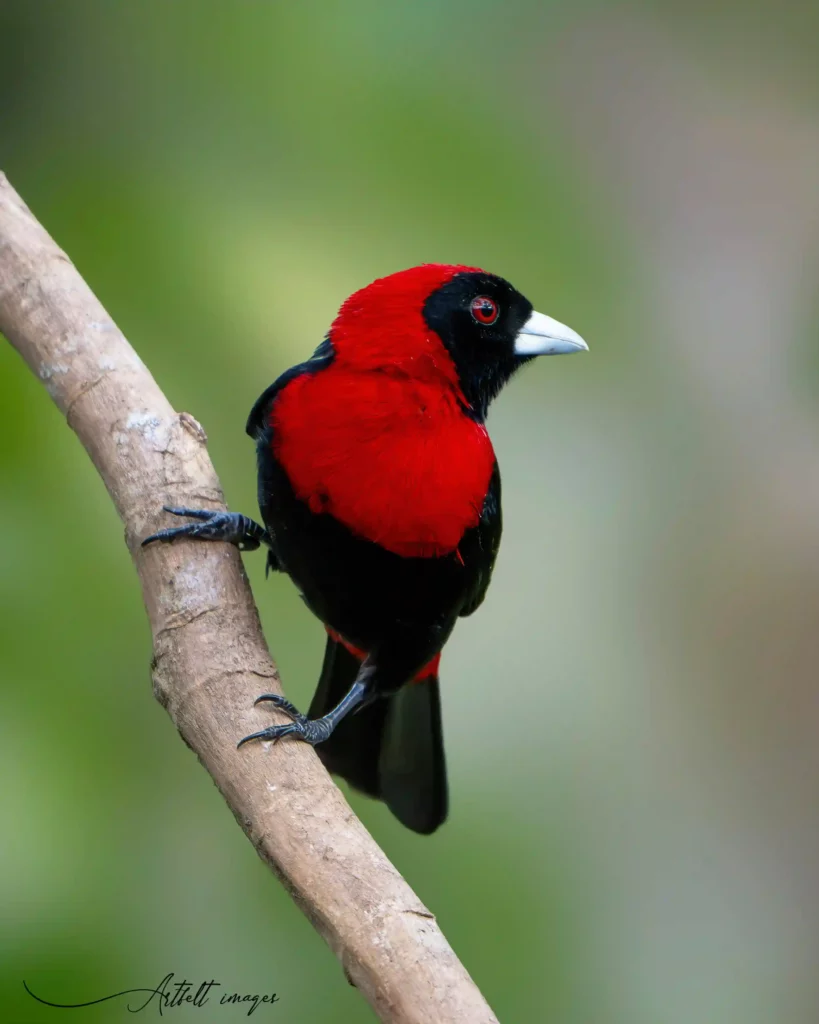
Deep, velvety black over the whole body, broken by a glossy crimson collar across the nape, neck and breast, with the rump and all tail coverts red as well. The bill is a striking pale blue and the legs are blue-gray, while the eyes are crimson — a bird that reads as black-and-red from a distance but rewards a closer look.
Distinctive Features
The whole package is unmistakable: a velvet-black bird with a blood-red collar, a bright bluish-white bill and red eyes. It’s unlikely to be confused with anything else in its range.
Sexual Dimorphism
One of the most monomorphic tanagers in its genus. Females average only marginally duller than males and are often indistinguishable in the field. Age is the easier tell: juveniles show a dull red hood, brown-tinged black feathers, a mottled red-and-black breast and a duller bill.
Diet and Feeding Behavior
Primary Diet
- Mainly fruit, supplemented with insects — arthropods add protein, especially during breeding
Foraging Techniques
- A quiet, methodical bird that forages unobtrusively at all levels in trees and bushes, usually in pairs, working forest edges and second growth and dropping in to fruiting trees and feeders. Bold in color but retiring in habit — the movement usually gives it away before the red does.
Feeding Times
- Most active in the early morning and late afternoon; visits feeders through the day.
Behavior Patterns
Crimson-collared Tanager
Social Structure
Generally found in pairs for most of the year, forming small groups for brief periods after breeding.
Song and Vocalization
High-pitched and sibilant rather than musical. One call, rendered ssi-p, is given both perched and in flight, and the song is a jerky run of two-to-four-note phrases separated by pauses. Compared with other Ramphocelus tanagers, it’s a relatively quiet, understated vocalist.
Courtship and Mating Ritual
Poorly documented; pairs are monogamous and maintain their bond year-round.
Territoriality
Pairs defend a nesting territory but are otherwise unobtrusive and tolerant, including around feeders.
Birdwatching Tips
Best Locations for Spotting Crimson-collared Tanager
Caribbean foothills and lowlands. Reliable at fruit-feeder lodges such as Rancho Naturalista (Turrialba area) and Arenal Observatory Lodge, plus Sarapiquí and other Caribbean-slope gardens.
Best Time of the Year
Resident, so possible year-round; the dry season (Dec–Apr) makes Caribbean-slope travel easier.
Common Behavior
Watch forest edges, second growth and fruit feeders at mid-to-upper levels; it forages unobtrusively, usually in pairs, so movement often gives it away before the color does.
Recommended Gear
8×42 binoculars; for photography, a 400 mm+ lens, though feeder setups allow closer frames.
Breeding and Nesting Behavior
Breeding Season
Mainly the rainy season (roughly April through June).
Nesting Sites
A cup nest of moss, rootlets and strips of large leaves such as banana or Heliconia, placed at middle height in a tree at a forest edge.
Clutch Size
Usually two eggs, pale blue with blackish spots.
Incubation Period
Poorly documented for this species; incubation is by the female.
Parental Care
Female builds the nest and incubates; both adults feed the nestlings.
Did You Know?
The name origin
The species name sanguinolentus is Latin for “bloodied,” a nod to its red plumage.
Distant relatives
Crimson-collared Tanager’s closest cousin lives on another continent. A genetic study found it’s less closely related to the other Ramphocelus tanagers than they are to one another, and its nearest relative is the Masked Crimson Tanager — an Amazonian bird — which is partly why it’s sometimes split into its own genus, Phlogothraupis.
Black hole effect of its plumage
That deep black isn’t just pigment. Studies of Ramphocelus tanagers show microscopic feather structures that absorb light, creating a velvety “super-black” that makes the crimson collar look even more saturated by contrast.
Standing out from the crowds by being the same
Crimson-collared Tanager barely follows its own family’s rulebook. Most Ramphocelus tanagers are sexually dimorphic, with bright males and duller females — but in this species the plumage is identical in both sexes, so the female is just as boldly red-and-black as the male.
Don't mix it up with...
It has a look-alike it isn’t related to. Its black body and red collar closely echo the pattern of the male Crimson-collared Grosbeak — a bird in a completely different family (the cardinals) — a neat case of two unrelated species arriving at nearly the same outfit.