Great Green Macaw
Few birds command a Costa Rican rainforest quite like the Great Green Macaw. This Critically Endangered parrot is one of the largest in the Americas, and its deep, far-carrying call usually announces it long before you see it. Fewer than 1,000 remain in the wild, and their survival is tied to the mountain almond trees…
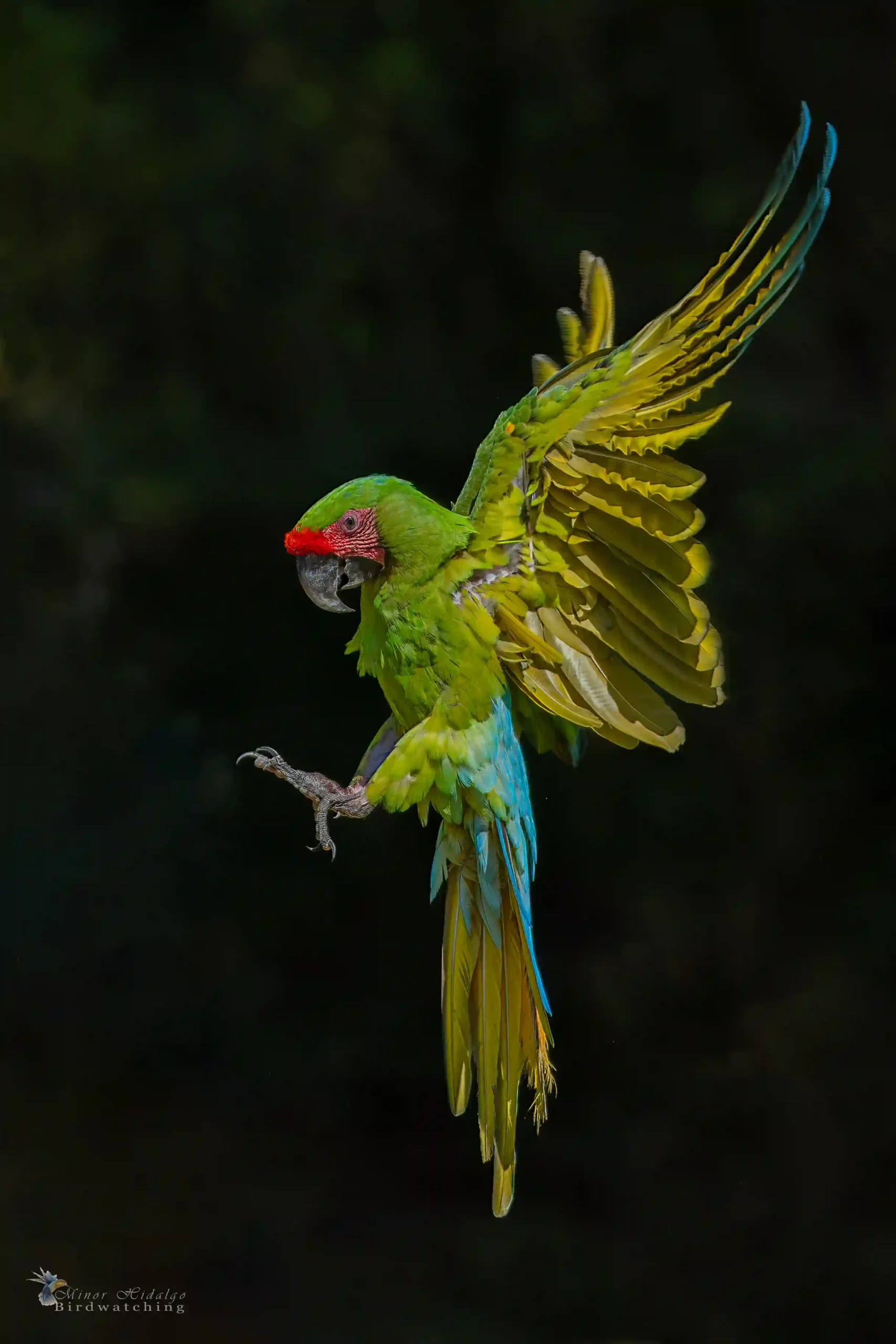
Ara ambiguus
Scientific Name
Psittacidae
Family
Psittaciformes
Order
Ara ambiguus guayaquilensis
Subspecies. Western Ecuador
Range and Habitat of Great Green Macaw
Geographic Range
The natural range of the Great Green Macaw extends from eastern Honduras through Nicaragua, Costa Rica, and Panama into northwestern Colombia. A separate subspecies, Ara ambiguus guayaquilensis, survives in western Ecuador. Forest clearing has divided its formerly broader range into small, increasingly isolated populations.
Migratory Patterns
The movements of this species are not fully understood. In Costa Rica, Great Green Macaws travel widely across the Caribbean slope, apparently following seasonal food supplies, especially fruiting mountain almond trees. Concentrations may occur near the coast from approximately October through December, followed by movement inland for breeding and wider dispersal afterward.
Preferred Habitat
Associated primarily with humid lowland rainforest containing large trees for feeding and nesting. It also uses forest edges and open areas while traveling between forest patches.
Altitude Range
Most records are below 600 meters (about 2,000 feet), although seasonal movements may take the birds to approximately 1,000 meters in Costa Rica.
Costa Rica Habitat
In Costa Rica, the species is concentrated in the northern Caribbean lowlands, including Boca Tapada, Sarapiquí, and Tortuguero, with additional habitat extending toward Nicaragua. Connected forests and biological corridors allow the macaws to move between nesting, feeding, and seasonal gathering areas.
Conservation Status
Conservation Status
Critically Endangered
Population Status
Fewer than 1,000 wild individuals. Listed on CITES Appendix I. Exact counts are difficult because the macaws travel widely and gather in different locations throughout the year.
Habitat loss and fragmentation caused by conversion of forest to pasture, farmland and plantations. Logging of mountain almond trees for their exceptionally hard timber has been particularly damaging. Illegal capture for the pet trade, and hunting in some parts of the range, place additional pressure on populations.
Conservation efforts
Population counts, nest monitoring, habitat restoration, protection of active nests, and planting of native food and nesting trees. Communities, conservation organizations and private landowners are working to reconnect fragmented forests, with particular attention to the mountain almond tree (Dipteryx panamensis), which provides both food and natural nesting cavities.
Primary Threats
Habitat loss and fragmentation caused by conversion of forest to pasture, farmland and plantations. Logging of mountain almond trees for their exceptionally hard timber has been particularly damaging. Illegal capture for the pet trade, and hunting in some parts of the range, place additional pressure on populations.
Great Green Macaw Identification
How to Identify the Species
Rarity Level:
RareBest Viewing Times:
Early Morning (Dawn - 8 AM), Afternoon (2 PM - 5 PM)
Size
85-90 cm (33-36 in) in length; 1,265-1,430 g (2.8-3.2 lb)
Plumage
Predominantly bright lime-green plumage. Blue appears on the lower back and wings, while the tail includes blue and orange-red. A narrow red band crosses the forehead above the bill. Immature birds are generally duller and more olive.
Distinctive Features
An exceptionally large parrot with a long, tapered tail and a massive dark bill. The pale facial patch is crossed by fine rows of feathers. In some older birds, particularly females, these lines may turn reddish.
Sexual Dimorphism
Males and females look alike and cannot be reliably distinguished in the field.
Diet and Feeding Behavior
Primary Diet
- Seeds, nuts and fruit. Seeds of the mountain almond (Dipteryx panamensis) are especially important, and the wild almond trees of the Caribbean lowlands are the single most reliable food source for this species in Costa Rica. The macaws also eat titor (Sacoglottis trichogyna) when mountain almond fruit is scarce, as well as other forest fruits and hard-shelled seeds.
Foraging Techniques
- Forages primarily in the canopy, using its powerful bill to open fruits and seed coverings that many birds cannot penetrate. The macaws follow the food rather than a fixed territory, and will travel to wherever a food source is available, whether that is primary forest, secondary forest or farmland.
Feeding Times
- Feeding activity is driven by seasonal food availability rather than a fixed daily routine. Wherever a food source is available, whether primary forest, secondary forest or farmland, the macaws will travel there to feed.
Behavior Patterns
Great Green Macaw
Social Structure
Great Green Macaws form long-term pair bonds and are commonly seen as pairs or small family groups. Larger gatherings may form around abundant food.
Song and Vocalization
The flight call is a deep, powerful, far-carrying “raaah,” generally deeper than the call of the Scarlet Macaw (Ara macao). These calls often alert birdwatchers to the birds before they come into view.
Courtship and Mating Ritual
Detailed courtship behavior in the wild is not well documented, but bonded birds remain closely associated and may reinforce their relationship through mutual preening and coordinated movement.
Territoriality
The species does not defend its entire feeding range. During the breeding season, however, a pair protects the immediate area around its nest cavity, a valuable resource where mature trees are scarce.
Birdwatching Tips
Best Locations for Spotting Great Green Macaw
Although the Great Green Macaw is Critically Endangered, it is not necessarily difficult to see in the right habitat. Its range in Costa Rica runs through the Caribbean lowlands from Tortuguero to Sarapiquí, and these are the sites our guides rely on:
- Tortuguero, where forest trails, lodge grounds and boat trips through the waterways all produce sightings.
- La Selva Biological Station, in Sarapiquí, with extensive lowland forest and mature trees.
- Tirimbina Reserve, also in Sarapiquí, with protected primary and secondary forest.
- Selva Verde Lodge, whose grounds and surrounding reserve sit inside the core of the macaw range.
- Pierella Gardens, a smaller private site in the Sarapiquí area.
- Laguna del Lagarto Lodge, in the Boca Tapada area, one of the best places in the country to see and photograph the species.
Best Time of the Year
Great Green Macaws can be seen year-round in the Caribbean lowlands of Costa Rica. From approximately December through May, pairs may remain closer to nesting areas. During the rest of the year, they disperse more widely while following seasonal food supplies, changing where they are found but not necessarily making them more difficult to see.
Common Behavior
Watch for pairs or family groups flying high above the forest with strong, direct wingbeats and long tails trailing behind them. The birds also gather in the canopy of productive fruiting trees, where they use their powerful bills to open hard fruits and extract the seeds.
Recommended Gear
Bring binoculars, lightweight rain protection, and a field guide or birding app. Photographers will benefit from a 200-600 mm telephoto lens and protection for equipment in the humid Caribbean climate. Lightweight clothing in subdued colors and comfortable walking shoes are recommended.
Breeding and Nesting Behavior
Breeding Season
December through April in Costa Rica, sometimes extending later.
Nesting Sites
Secondary cavity nester, relying on naturally formed hollows in large trees. Mountain almond trees are strongly preferred in Costa Rica, making the same tree essential for both food and reproduction.
Clutch Size
Two or three eggs
Incubation Period
Approximately 29 days, based on information from captive birds. The female incubates while the male brings her food.
Parental Care
The nestlings remain in the cavity for about 11 weeks, with both parents providing food. Young birds may stay with their parents after fledging while learning where to find food and suitable roosting areas.
Did You Know?
Do Great Green Macaws use tools?
A Great Green Macaw in Costa Rica was documented using pieces of leaves as tools while eating tropical almond fruit. Researchers believe the bird used the leaves to help remove the bitter outer covering of the fruit before extracting the nutritious seed.
Why is the Great Green Macaw endangered?
Its greatest threats are the loss and fragmentation of lowland forest, removal of mature mountain almond trees, and illegal capture for the pet trade.
Where does the Great Green Macaw live?
Its range extends from parts of Central America into northwestern Colombia, with a separate subspecies in Ecuador. In Costa Rica, it is found mainly in the Caribbean lowlands.
What does the Great Green Macaw eat?
It eats seeds, nuts, and fruit, with mountain almond seeds playing an especially important role during the breeding season.
How long does a Great Green Macaw live?
Reliable longevity information for wild birds is limited. Like other large macaws, however, it is considered a long-lived species and may survive for several decades.
How can the Great Green Macaw be saved?
Protecting mature forest, mountain almond trees, nest cavities, and biological corridors is essential. Community conservation, reforestation, nest monitoring, and enforcement against wildlife trafficking also contribute to its survival.
What is the difference between a Military Macaw and a Great Green Macaw?
The Great Green Macaw is larger, paler green, and has a heavier bill and longer tail with more orange-red coloring. The Military Macaw is smaller and darker olive-green and does not occur naturally in Costa Rica.