Great Potoo
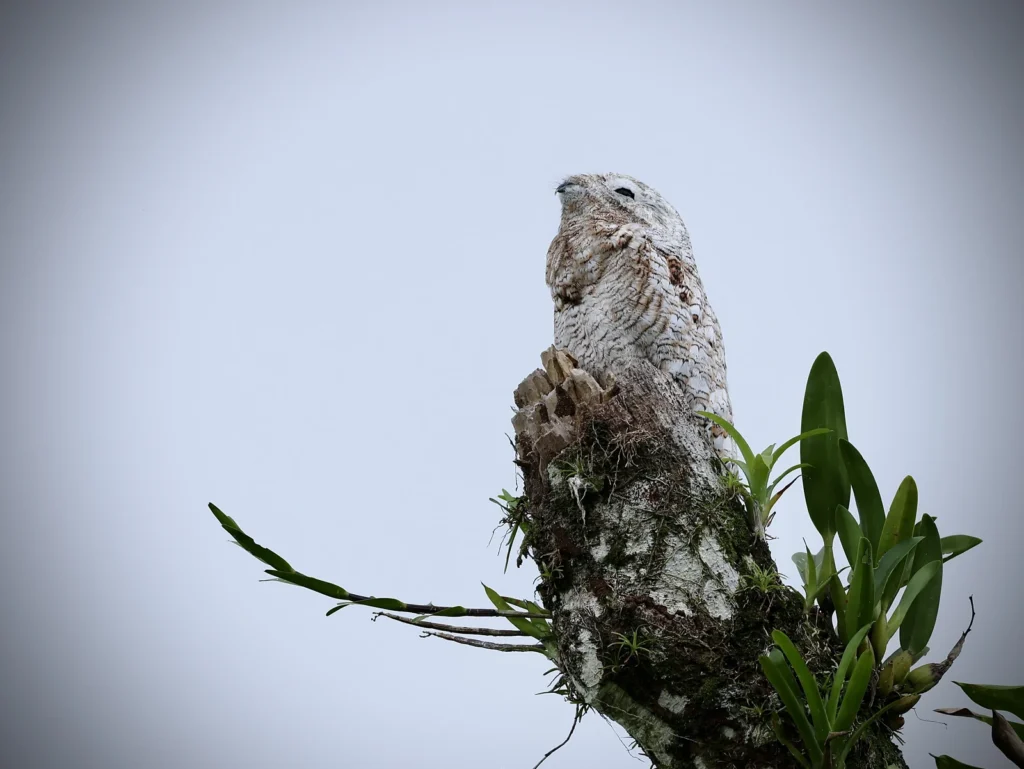
Few birds demonstrate the art of camouflage quite like the Great Potoo. During the day this large nocturnal bird sits almost perfectly motionless on a broken branch, its mottled gray-brown plumage blending so completely with the bark that even experienced birdwatchers can walk right past it. At night it becomes an entirely different bird, and…

Nyctibius grandis
Scientific Name
Nyctibiidae
Family
Nyctibiiformes
Order
Range and Habitat of Great Potoo
Geographic Range
The Great Potoo is found through much of Central and South America, from southern Mexico through Central America and into large portions of tropical South America.
Migratory Patterns
Great Potoos are generally considered resident birds rather than long-distance migrants. Individuals remain within suitable habitat throughout the year, although local movements may occur in response to food availability and breeding activity.
Preferred Habitat
Great Potoos inhabit tropical and subtropical forests, forest edges, secondary growth, wooded clearings, plantations, and other areas containing mature trees. They are particularly associated with lowland and foothill forests. During the day, they often choose exposed branches or broken tree stumps that complement their plumage.
Altitude Range
From sea level to approximately 800 meters (0-2,625 feet).
Costa Rica Habitat
In Costa Rica, Great Potoos are found primarily in the lowlands and foothills of both the Caribbean and the Pacific. Suitable habitat includes mature rainforest as well as forest edges and partially open landscapes containing large trees.
Conservation Status
Conservation Status
Least Concern
Population Status
The global population size is unknown. The IUCN lists the Great Potoo as Least Concern, so no formal census of the species is carried out.
Habitat loss is the principal long-term concern. Clearing forest for agriculture, development, and other land uses reduces both roosting and feeding habitat.
Conservation efforts
Protecting tropical forest and maintaining connected forest corridors benefits the Great Potoo along with countless other species. Mature trees are especially important because they provide hunting perches, daytime roosts, and potential nesting sites. Private reserves, national parks, biological corridors, and reforestation projects throughout Costa Rica all contribute to maintaining suitable habitat.
Primary Threats
Habitat loss is the principal long-term concern. Clearing forest for agriculture, development, and other land uses reduces both roosting and feeding habitat.
Great Potoo Identification
How to Identify the Species
Rarity Level:
UncommonBest Viewing Times:
Night (After Dark)
Size
48-60 cm (19-24 in) in length; 360-650 g (12.7-22.9 oz)
Plumage
A complex mixture of gray, brown, buff, black, and white, creating a pattern remarkably similar to tree bark. This camouflage becomes especially effective when the bird assumes its characteristic daytime posture.
Distinctive Features
The largest member of the family Nyctibiidae, with an oversized head, very large dark eyes, a short bill, and an extraordinarily wide mouth. A resting Great Potoo may stretch its head upward, partially close its eyes, and hold its body rigidly against a branch, so that the outline of the bird begins to resemble an extension of the tree itself.
Sexual Dimorphism
Males and females look alike, although females are slightly larger than males.
Diet and Feeding Behavior
Primary Diet
- Largely flying insects, including beetles, moths, grasshoppers, and other large insects. Great Potoos are also capable of taking larger prey, including small vertebrates on occasion.
Foraging Techniques
- Primarily an aerial predator. Hunts at night from exposed perches, taking prey in flight before returning to the perch.
Feeding Times
- Nocturnal. Leaves its daytime resting site after dusk to hunt.
Behavior Patterns
Great Potoo
Social Structure
Great Potoos are generally solitary or encountered in pairs rather than in flocks. During daylight hours they remain remarkably still, depending on camouflage rather than retreating into a concealed roost. After dark they become active and vocal.
Song and Vocalization
The Great Potoo call is one of the most distinctive nighttime sounds in its habitat: a deep, resonant series of descending notes with an almost mournful quality. People hearing it for the first time sometimes have difficulty believing that such an eerie noise comes from a bird.
Courtship and Mating Ritual
Much of the behavior of the Great Potoo occurs at night and can be difficult to observe. Vocalizations likely play an important role in communication between individuals. Pairs are generally monogamous during the breeding period, and both adults participate in caring for their young.
Territoriality
Vocalizations are thought to play an important role in establishing and maintaining territories, although detailed territorial behavior in the wild is not well documented.
Birdwatching Tips
Best Locations for Spotting Great Potoo
Costa Rica offers excellent opportunities to see Great Potoos. These are the places our guides rely on for this species:
- La Selva Biological Station, in the Caribbean lowlands, where extensive mature forest and well-known day roosts make this one of the most dependable sites in the country.
- Carara National Park, on the central Pacific, where the transition between dry and humid forest supports a wide range of species.
- Tarcoles River Estuary, where mature trees along the waterway provide the exposed perches potoos favor.
- Palo Verde, in the northern Pacific lowlands, with large trees scattered through wetland and dry forest habitat.
- Caño Negro, in the northern wetlands, particularly where mature trees remain along waterways and forest edges.
Best Time of the Year
Great Potoos are resident in Costa Rica and can be seen throughout the year. There is no single season when visitors must travel specifically to see them.
Common Behavior
During the day, expect very little movement. A Great Potoo may remain in almost exactly the same position for hours. After sunset the transformation begins: the bird becomes an active hunter, moving between exposed perches while watching for prey.
Recommended Gear
Binoculars are essential, particularly for studying a bird perched high in the canopy. A spotting scope can provide excellent views of a distant daytime roost. Photographers will benefit from a telephoto lens in the 400-600 mm range. For nighttime birding, bring a flashlight or headlamp, but use artificial light carefully and follow the instructions of your guide to minimize disturbance.
Breeding and Nesting Behavior
Breeding Season
There is no defined nesting season in Costa Rica. The species does not migrate, and because weather and food supply are favorable year-round, breeding can take place at any time of year.
Nesting Sites
Great Potoos do not construct elaborate nests. A female typically lays a single egg directly into a natural depression on a broken branch or tree stump. The exposed location might appear dangerous, but camouflage provides much of the protection: an incubating adult blends remarkably well with the wood beneath it and may remain motionless for long periods.
Clutch Size
A single egg. Great Potoos lay one egg and raise one chick at a time.
Incubation Period
30 to 35 days. Both parents share incubation.
Parental Care
Both parents participate in incubation and in caring for the chick. Young potoos develop the same instinctive camouflage behavior as the adults. As a chick grows, it may sit upright on the nesting site and remain motionless when threatened, helping it resemble part of the tree.
Did You Know?
Can a Great Potoo see with its eyes closed?
Great Potoos have tiny openings in their eyelids that allow them to detect movement even when their eyes appear to be completely closed. This adaptation helps a resting bird remain aware of its surroundings without sacrificing the camouflage created by its motionless daytime posture.
What is a potoo?
It is a nocturnal bird belonging to the family Nyctibiidae. Potoos are known for their large heads, enormous mouths, distinctive calls, and remarkable ability to resemble broken branches while resting during the day.
Where do potoo birds live?
They live in tropical regions of Mexico, Central America, South America, and the Caribbean, depending on the species. The Great Potoo occurs across a broad area of Central and South America.
Is the Great Potoo an owl?
No. Although the Great Potoo is nocturnal and has very large eyes, it is not an owl. Potoos belong to the family Nyctibiidae and are more closely related to other night birds than to owls.
Are potoo birds real?
They certainly are. Their enormous eyes, unusual mouths, and strange posture have made them internet favorites, and photographs can make them look almost imaginary.
What do potoo birds eat?
Great Potoos feed primarily on large flying insects such as moths and beetles. They hunt at night from exposed perches and may occasionally capture small vertebrates.
What does a Great Potoo sound like?
The Great Potoo call is deep, haunting, and descending. The unusual sound carries well through tropical forest at night and is often the first indication that one is nearby.
Are potoo birds dangerous?
No. They are wild birds and should always be treated with respect, but they are not dangerous to people.