Resplendent Quetzal
The resplendent quetzal (Pharomachrus mocinno) is a vividly colored bird native to the cloud forests of southern Mexico and Central America. Renowned for its brilliant emerald-green plumage, crimson breast, and the male's spectacular tail streamers—which can reach up to a meter long during breeding season—it's widely considered one of the most beautiful birds in the…

Pharomachrus mocinno
Scientific Name
Trogonidae (trogons)
Family
Trogoniformes
Order
P. m. mocinno
Subspecies. Southern Mexico to northern Nicaragua
P. m. costaricensis
Subspecies. Costa Rica and western highlands of Panama
Range and Habitat of Resplendent Quetzal
Geographic Range
Endemic to Central American highlands from southern Mexico (Chiapas) through Guatemala, Honduras, Nicaragua, Costa Rica, and western Panama. Occurs in a narrow belt of montane cloud forest rather than widespread lowland forest.
Migratory Patterns
Unlike many migratory birds, Resplendent Quetzals do not migrate long distances between countries. Instead, they undertake seasonal elevational movements within Costa Rica’s mountain ranges.
Their movements are driven primarily by food availability, particularly fruits from trees in the laurel family (Lauraceae), commonly referred to as wild avocados. As different species of avocado fruit at different elevations throughout the year, quetzals follow these seasonal food sources.
This means birds may spend part of the year in higher-elevation cloud forests before moving to slightly lower elevations when food becomes more abundant elsewhere. Understanding these patterns helps explain why quetzal sightings can vary between locations and seasons.
Preferred Habitat
Mature, moist cloud forests and montane evergreen forests rich in epiphytes, mosses, and especially wild avocado trees (aguacatillos; Lauraceae). Often in canopy and subcanopy near forest edges, ravines, and partially open areas adjacent to intact forest.
Altitude Range
In Costa Rica, most reliable sightings are between about 2,000–2,700 m in San Gerardo de Dota / Cerro de la Muerte, and 1,400–1,800 m around Monteverde.
Costa Rica Habitat
The Resplendent Quetzal is found primarily in Costa Rica’s cloud forests and highland oak forests, typically between 1,200 and 3,000 meters (3,900–9,800 feet) above sea level. While the species occurs throughout much of the country’s mountainous regions, some locations offer significantly better viewing opportunities than others.
San Gerardo de Dota and the Savegre Valley
Often considered the best place in Costa Rica to see Resplendent Quetzals, the Savegre Valley supports a healthy population throughout the year. The abundance of wild avocado trees and protected cloud forest habitat makes sightings relatively reliable, especially during the breeding season. Many birders visiting Costa Rica specifically include San Gerardo de Dota in their itinerary for the chance to observe quetzals at close range.
Monteverde Cloud Forest
Monteverde is another excellent location for quetzals, particularly between February and May when many birds are nesting. While sightings can require more patience than in the Savegre Valley, Monteverde offers the opportunity to combine quetzal watching with some of Costa Rica’s richest cloud forest birding.
Cerro de la Muerte and the Talamanca Highlands
The extensive high-elevation forests surrounding Cerro de la Muerte support quetzals throughout the year. These forests are less visited than Monteverde but can provide exceptional birding opportunities, especially for visitors seeking a more remote experience.
Tapantí and Other Highland Forests
Quetzals also occur in several protected areas along Costa Rica’s mountain ranges wherever mature cloud forest habitat and fruiting avocado trees are present. Local movements in response to food availability mean sightings can vary throughout the year.
Conservation Status
Conservation Status
Near Threatened
Population Status
Overall trend believed to be declining
Loss and fragmentation of cloud forests from logging, agriculture, pasture, and infrastructure development, and climate change shifting suitable cloud‑forest zones upslope, potentially reducing available habitat and disrupting fruiting phenology.
Conservation efforts
Large tracts of habitat protected in national parks and reserves, including Costa Rica’s Los Quetzales National Park, Monteverde Cloud Forest Reserve, and parts of the Talamanca range.
Primary Threats
Loss and fragmentation of cloud forests from logging, agriculture, pasture, and infrastructure development, and climate change shifting suitable cloud‑forest zones upslope, potentially reducing available habitat and disrupting fruiting phenology.
Resplendent Quetzal Identification
How to Identify the Species
Rarity Level:
RareBest Viewing Times:
Early Morning (Dawn - 8 AM), Evening (Dusk)
Size
Body length (without long tail coverts): about 36–41 cm (14–16 in); Weight: roughly 180–225 g (about 6.3–8 oz).
Plumage
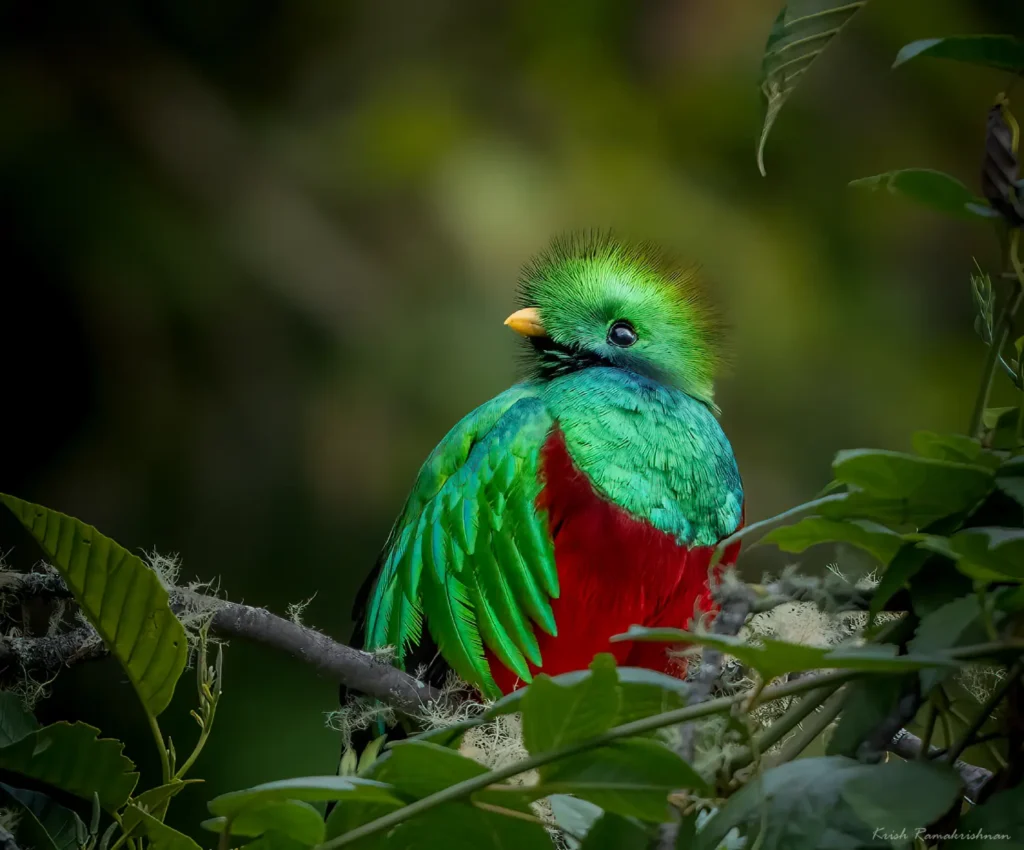
Adult males have iridescent emerald‑green head, back, and upper breast; crimson red lower breast and belly; blackish inner wing feathers; very long, flowing upper tail coverts that form the trademark “long tail.”
Adult female: Green upperparts with duller, more brownish head, grayish or brownish breast and belly, and a much shorter tail; overall less vivid but still iridescent.
Distinctive Features
Iridescent feathers that appear green but are structurally brown with special light‑scattering; this is why colors shimmer and shift.
Males have extremely elongated upper tail coverts (streamers) rather than elongated tail feathers themselves.
Yellow bill in males; bill darker (often blackish) in females.
Sexual Dimorphism
Strong: males are more ornate, with much longer tail coverts and brighter red underparts, and a yellow bill. Females are duller green with gray underparts and shorter tails, better camouflaged against mossy trunks and cavities when nesting.
Diet and Feeding Behavior
Primary Diet
- Mostly fruits, especially wild avocados (aguacatillos) in the laurel family (Lauraceae). Also eats other small fruits, insects, and occasional small vertebrates such as small frogs or lizards.
Foraging Techniques
- Uses strong flight to hover briefly (“quetzal hover”) at canopy fruiting trees, plucking individual fruits from outer branches.
Feeding Times
- Most active in early morning and late afternoon when they move between feeding trees and perches.
Behavior Patterns
Resplendent Quetzal
Social Structure
Quetzals are usually seen singly or in pairs; family groups may occur around nests and in good fruiting areas. Not strongly flocking, but several individuals may share productive fruiting trees.
Song and Vocalization
Although often celebrated for their appearance, quetzals are also surprisingly vocal.
Their calls include a series of soft whistles and clear, ringing notes that carry through the cloud forest canopy. During the breeding season, vocal activity often increases as pairs communicate and defend territories.
Experienced birders frequently locate quetzals by sound before ever seeing them. Learning to recognize their calls can greatly improve the chances of finding this species in dense forest habitat.
Courtship and Mating Ritual
During breeding, males perform display flights, showing off long tail coverts as they fly between canopy perches. Courtship involves calling, mutual perching near nest cavities, and both partners inspecting cavities.
Territoriality
Pair defends a territory around suitable nest trees and feeding areas during breeding season. Territorial interactions include aerial chases and vocal exchanges, especially between males.
Birdwatching Tips
Best Locations for Spotting Resplendent Quetzal
- San Gerardo de Dota and Los Quetzales National Park (Cerro de la Muerte area) – widely regarded as the most dependable location.
- Monteverde and Santa Elena Cloud Forest Reserves – classic quetzal destination with strong, well‑studied population.
Best Time of the Year
Quetzals can be found in Costa Rica year-round, but certain times of year offer better opportunities for observation.
From February through May, many pairs are actively nesting. During this period, adults make frequent trips between feeding areas and nest cavities, often allowing prolonged views. Males are especially conspicuous as they display their spectacular tail streamers while defending territories and attracting mates.
June through August can still provide excellent sightings, particularly in areas where food resources remain abundant. Outside the breeding season, quetzals are often more widely dispersed and may move between elevations in search of fruiting trees.
Because these movements are closely linked to food availability, there is no single "best" month for every location. Local knowledge and current fruiting conditions often play a major role in finding quetzals.
Common Behavior
Finding a quetzal often comes down to locating food sources before locating the bird itself.
Look for fruiting wild avocado trees, particularly in cloud forest habitat. Quetzals frequently perch quietly near these trees before making short feeding flights to pluck fruit.
Early morning is generally the most productive time for observation, when birds are actively feeding and vocalizing. Listening for their distinctive calls can often reveal their location before they are visible.
Patience is important. Quetzals often remain motionless for extended periods and can blend surprisingly well into the canopy despite their bright colors.
Local guides familiar with current nesting activity and fruiting trees can significantly increase the chances of a successful sighting.
Recommended Gear
Binoculars: 8×42 or 10×42 for low‑light, misty forest conditions. Camera: 300–500 mm lens with good high‑ISO performance; weather protection is helpful in cloud forests.
Breeding and Nesting Behavior
Breeding Season
Late February or March through June, tied closely to wild avocado fruiting.
Nesting Sites
Nests in natural or pre‑existing cavities in decaying trees or stumps, often enlarged by the birds themselves. In Monteverde, artificial nest boxes have been installed to supplement limited natural cavities and support the population.
Clutch Size
Typically 2 eggs per clutch.
Incubation Period
Around 17–19 days, with both parents sharing incubation.
Parental Care
Both male and female incubate eggs and feed nestlings.
Did You Know?
Interesting Behaviors
Quetzals’ “green” color is structural; feathers are actually brown with microscopic structures that refract light to create shimmering emerald hues.
Cultural Significance
Sacred to ancient Maya and Aztec cultures, associated with the feathered serpent god Quetzalcoatl, and a symbol of freedom (a quetzal was believed to die in captivity).
Photography Tips
Photographing Resplendent Quetzals presents unique challenges due to the low-light conditions typical of cloud forests.
Early morning and overcast conditions often require higher ISO settings and fast lenses. Many photographers find that natural perches near fruiting trees provide some of the best opportunities for clean images.
During the breeding season, males are particularly photogenic as their elongated tail streamers are fully developed. However, photographers should always maintain a respectful distance from active nests and avoid disturbing breeding birds.
Patience often produces the best results. Quetzals frequently return to favored perches, rewarding photographers willing to wait quietly.
Why do Quetzals eat avocados?
Resplendent quetzals favor wild avocados for their dense nutrition and the symbiotic bond they share with the trees. The birds swallow the small fruits whole, digest the rich flesh, and regurgitate the large seeds—acting as the forest’s chief “gardener” by planting new trees.
Quetzals and wild avocado trees depend on each other for survival as wild avocados are far smaller than store-bought varieties—just the right size for a quetzal to swallow whole., and the bird holds the seed until the flesh is stripped away, then regurgitates the pit, sometimes catching it mid-air to extract every last nutrient. By flying off before dropping the seed, the quetzal plants new trees far from the parent, preventing overcrowding. For quetzals themselves, these fatty fruits fuel the birds’ active lives in the high-altitude cloud forests.
Surprising Traits
Despite their spectacular appearance, they can be surprisingly hard to see, remaining motionless in dense moss and epiphytes where colors blend with the forest.
How do I identify this bird?
Look for a medium‑sized trogon with iridescent green head and back, bright red belly, and in males, incredibly long green upper tail coverts forming a streaming tail; in Costa Rica, any trogon‑shaped bird with that long green “banner” tail in cloud forest is almost certainly a Resplendent Quetzal.
Where is the best place to see it in Costa Rica?
San Gerardo de Dota / Savegre Valley (Los Quetzales NP) is generally considered the most reliable year‑round, with Monteverde a close second during its December–August peak season.
Is it endangered?
It is currently listed as Near Threatened rather than fully endangered, but continues to decline in many parts of its range due to cloud‑forest loss and climate change, so strong habitat protection remains critical.