Tropical Royal Flycatcher
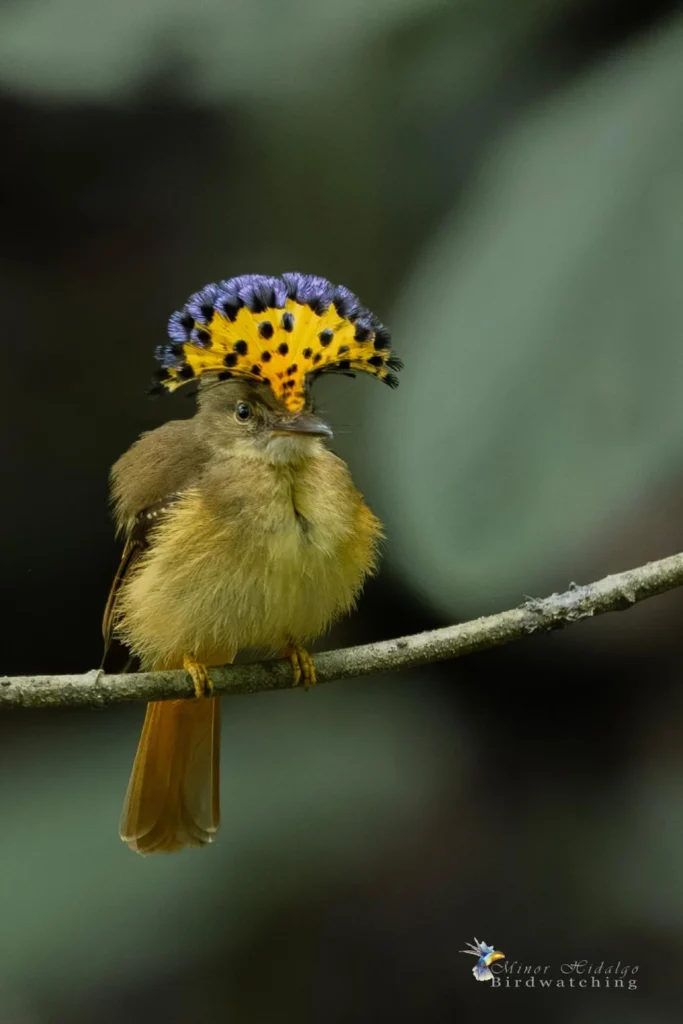
The Tropical Royal Flycatcher is a slender, medium-sized flycatcher found in humid lowland forests from Mexico to Bolivia, famous for its extraordinary fan-shaped crest adorned with brilliant red or orange feathers tipped in blue and black, which it rarely displays except during courtship, territorial disputes, or when handled.

Onychorhynchus coronatus
Scientific Name
Tityridae (Tityras and Allies) - formerly placed in Tyrannidae
Family
Passeriformes
Order
O. c. mexicanus
Subspecies. From southern Mexico to western Panama
Range and Habitat of Tropical Royal Flycatcher
Geographic Range
The Tropical Royal Flycatcher ranges from southern Mexico through Central America to South America, including Guatemala, Belize, El Salvador, Honduras, Nicaragua, Costa Rica, Panama, Colombia, Venezuela, Guyana, Suriname, French Guiana, Ecuador, Peru, Bolivia, and Brazil.
Migratory Patterns
This is a non-migratory resident species.
Preferred Habitat
The Royal Flycatcher inhabits humid lowland and foothill forests, preferring areas near streams and rivers. It favors forest edges, gaps, and second growth adjacent to primary forest.
Altitude Range
Globally, it occurs from sea level to 1,500 m elevation. In Costa Rica, it is most common below 600 m, occasionally ranging up to 1,200 m in suitable habitat.
Costa Rica Habitat
In Costa Rica, the species occurs on both slopes but is more common on the Caribbean side. It is found in the lowlands and foothills of all provinces but is generally scarce.
Conservation Status
Conservation Status
Least Concern
Population Status
The species shows declining trends throughout much of its range due to habitat loss.
Primary threats include deforestation and fragmentation of lowland forests. Loss of riparian forests particularly impacts this species.
Conservation efforts
The Royal Flycatcher is protected in several Costa Rican national parks and reserves.
Primary Threats
Primary threats include deforestation and fragmentation of lowland forests. Loss of riparian forests particularly impacts this species.
Tropical Royal Flycatcher Identification
How to Identify the Species
Rarity Level:
OccasionalBest Viewing Times:
Early Morning (Dawn - 8 AM), Afternoon (2 PM - 5 PM)
Size
Length: 15-17 cm; Males weigh 12-16 g while females weigh 11-14 g
Plumage
Both sexes appear predominantly brown when the crest is lowered. The upperparts are uniformly olive-brown with rufous-cinnamon coloring on the tail and rump. When erected, males display a spectacular fan-shaped crest that is brilliant scarlet-orange with black tips and blue-black spotting at the base. Females have a similar crest structure but in yellow-orange rather than red.
Distinctive Features
The most remarkable feature is the spectacular erectile crest, normally laid flat and invisible against the head.
Sexual Dimorphism
The primary difference is crest color - brilliant scarlet-orange in males versus yellow-orange in females.
Diet and Feeding Behavior
Primary Diet
- The Royal Flycatcher feeds primarily on flying insects including flies, flying ants and wasps, small beetles, termites during emergence flights, and mayflies and caddisflies near streams.
Foraging Techniques
- This species employs classic flycatcher sally-strike feeding, launching from perches to catch prey in mid-air.
Feeding Times
- Peak activity occurs during early morning from 6:00-9:00 and late afternoon from 15:00-17:30. The species feeds intermittently throughout the day in shaded forest interior and increases feeding rate before and after rain when insect activity peaks.
Behavior Patterns
Tropical Royal Flycatcher
Social Structure
Royal Flycatchers are typically solitary except during breeding season when found in pairs. They rarely join mixed-species foraging flocks, preferring to hunt alone.
Song and Vocalization
The Royal Flycatcher is generally quiet with subtle vocalizations. The primary call is a clear, liquid “wheeep” or “peeuu” whistle, often given at long intervals.
Courtship and Mating Ritual
The spectacular crest display is central to courtship. Males perform elaborate crest-fanning displays, slowly rotating the head to show all angles of the colorful crest. Display flights involve slow, butterfly-like wing beats with the crest fully erected.
Territoriality
Pairs maintain territories of approximately 2-4 hectares year-round. Males defend territories through crest displays rather than vocalizations.
Birdwatching Tips
Best Locations for Spotting Tropical Royal Flycatcher
Key sites include
- La Selva Biological Station along stream trails
- Tortuguero National Park canal edges
- Sarapiquí River lowlands with gallery forest
- Carara National Park near streams
- Corcovado National Park stream valleys
- Esquinas Rainforest Lodge trails
- Wilson Botanical Garden forest sections
Best Time of the Year
Best viewing opportunities occur from February to May during breeding season when birds are more active and vocal. Early morning hours from 6:00-9:00 offer peak activity.
Common Behavior
Look for solitary birds perched quietly on horizontal branches 2-5 meters high. Check shaded areas along forest streams and rivers.
Recommended Gear
Essential equipment includes 8×42 or 10×42 binoculars for forest birding, and a camera with good low-light capability to capture crest displays if fortunate.
Breeding and Nesting Behavior
Breeding Season
Breeding occurs primarily during the dry and early wet season. In Costa Rica, nesting spans from February to June, with peak activity in March-April.
Nesting Sites
The nest is one of the most distinctive features of this species. It constructs an extremely long, pendulous nest measuring 60-180 cm in length (sometimes up to 2 meters). The nest is bag-shaped with a side entrance near the top, woven from plant fibers, rootlets, and dead leaves. It typically hangs over water from branches or vines 2-6 meters high.
Clutch Size
Females lay 2 eggs, rarely 1 or 3
Incubation Period
18-20 days
Parental Care
The female primarily incubates while the male guards the territory. Both parents feed the nestlings with insects. Chicks fledge at 20-24 days. Parents continue to feed fledglings for 3-4 weeks after leaving the nest.
Did You Know?
Interesting Behaviors
The crest is normally completely hidden and only displayed during excitement or stress. When handled by researchers, the bird invariably erects its crest in a threat display.
Cultural Significance
The spectacular crest has made this bird legendary among indigenous peoples. In some cultures, the crest feathers were believed to have magical properties. The Spanish name “Mosquero Real” (Royal Flycatcher) reflects the crown-like appearance of the crest. The species appears in pre-Columbian art from several Central American cultures.
Surprising Traits
The crest can be erected in less than one second when the bird is startled.
How do I identify this bird?
When the crest is lowered (its normal state), look for a plain brown flycatcher with a long tail, broad flat bill, and ochre-buff underparts. The rufous tail and rump are good field marks. If you’re lucky enough to see the crest erected, the brilliant orange-red (males) or yellow-orange (females) fan is unmistakable.
Where is the best place to see it in Costa Rica?
La Selva Biological Station and the Sarapiquí lowlands offer the best chances, particularly along forested streams. However, this is a scarce species that requires patience and luck to encounter.
Is it endangered?
Listed as Least Concern globally, but populations are declining due to habitat loss. In Costa Rica, it’s uncommon to rare and definitely a species of conservation concern due to its specialized habitat requirements and low population density.