Streak-chested Antpitta
The Streak-chested Antpitta is a medium-sized, terrestrial bird found in montane forests from Costa Rica to Bolivia, characterized by its heavily streaked breast, olive-brown upperparts, and skulking behavior as it hops along the forest floor foraging for insects and invertebrates, often detected first by its loud, distinctive whistled calls.

Hylopezus perspicillatus
Scientific Name
Grallariidae (Antpittas)
Family
Passeriformes
Order
H. p. intermedius
Subspecies. Costa Rica to western Panama
Range and Habitat of Streak-chested Antpitta
Geographic Range
The Streak-chested Antpitta ranges from Honduras through Nicaragua, Costa Rica, Panama, Colombia, to northwestern Ecuador.
Migratory Patterns
This is a strictly sedentary species with no migratory movements. Individuals maintain small territories year-round with minimal dispersal even among juveniles.
Preferred Habitat
The Streak-chested Antpitta inhabits humid lowland and foothill forests with dense understory, particularly areas with thick leaf litter. It prefers primary and mature secondary forests, ravines and steep slopes with accumulated leaf litter, areas near streams but not flooded, and forest with intact understory and minimal disturbance. The species avoids open areas and forest edges.
Altitude Range
This is primarily a lowland to lower montane species. In Costa Rica, it occurs from sea level to 1,200 m elevation, most commonly between 50-700 m. Occasional records exist up to 1,500 m on Caribbean slope.
Costa Rica Habitat
In Costa Rica, the species occurs primarily on the Caribbean slope and locally on the Pacific slope. It is found from the lowlands to middle elevations in appropriate habitat. Distribution includes Caribbean slope from the Nicaraguan border south through Limón province, Sarapiquí region of Heredia province, eastern Alajuela province, Braulio Carrillo National Park area, and locally on the Pacific slope in the Carara and Tárcoles region.
Conservation Status
Conservation Status
Least Concern
Population Status
Costa Rican populations appear stable in protected areas but declining elsewhere. Density in optimal habitat ranges from 2-5 pairs per 10 hectares.
Major threats include deforestation and forest fragmentation eliminating habitat. The species is highly sensitive to understory disturbance from selective logging or cattle.
Conservation efforts
The Streak-chested Antpitta is protected in several Costa Rican national parks and reserves.
Primary Threats
Major threats include deforestation and forest fragmentation eliminating habitat. The species is highly sensitive to understory disturbance from selective logging or cattle.
Streak-chested Antpitta Identification
How to Identify the Species
Rarity Level:
UncommonBest Viewing Times:
Early Morning (Dawn - 8 AM), Evening (Dusk)
Size
11-12 cm in total length, making it one of the smaller antpitta species. Males weigh 18-22 g while females weigh 17-20 g.
Plumage
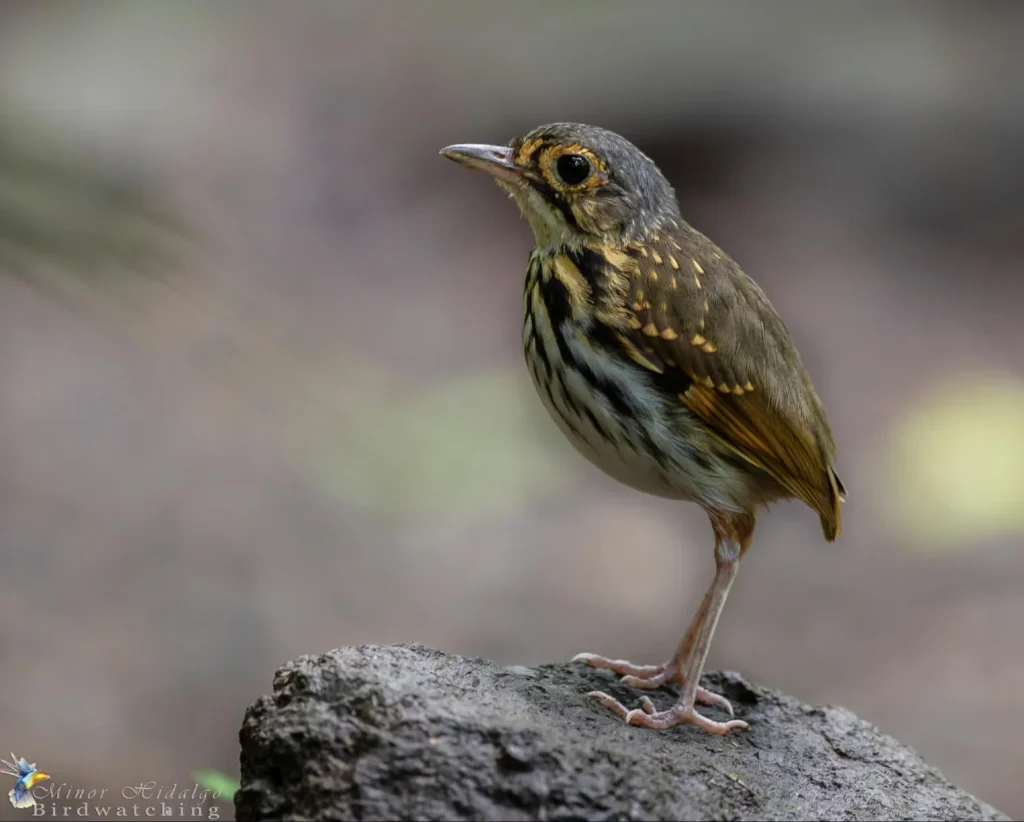
Adults display olive-brown to grayish-brown upperparts with a slightly warmer brown tone on the crown. The face shows a distinctive buff to whitish eye-ring and loral stripe, creating a “spectacled” appearance that gives rise to the alternative common name. The throat is white to pale buff. The breast and upper belly are buff to pale cinnamon with distinctive dark brown or black streaking, heaviest on the breast and becoming finer on the flanks.
Distinctive Features
The species has a relatively short, straight black bill measuring 14-16 mm, typical of small antpittas. The legs are notably long and pinkish-gray to flesh-colored, well-adapted for terrestrial locomotion. The buff eye-ring and spectacle pattern is diagnostic among Costa Rican antpittas.
Sexual Dimorphism
Sexual dimorphism is minimal. Males and females are virtually identical in plumage, though males average slightly larger and may show marginally heavier breast streaking. Behavioral differences during breeding season are more reliable for sex determination.
Diet and Feeding Behavior
Primary Diet
- The Streak-chested Antpitta feeds primarily on small invertebrates found in leaf litter, including ants (though not an obligate ant-follower), beetles and their larvae, spiders, small crickets and grasshoppers, termites, small snails, and various other arthropods.
Foraging Techniques
- This antpitta employs a distinctive foraging strategy of hopping through leaf litter, pausing frequently to listen for prey movement. It uses its feet to scratch and toss leaves aside, similar to a towhee.
Feeding Times
- Peak foraging activity occurs during early morning from 5:30-8:00 when leaf litter arthropods are most active. A secondary peak occurs in late afternoon from 16:00-17:30. The species remains active during light rain when prey movement increases but becomes inactive during heavy rain.
Behavior Patterns
Streak-chested Antpitta
Social Structure
These antpittas are strictly solitary except during breeding season when pairs form. Each individual maintains exclusive use of its territory throughout the year. Family groups break up quickly after fledglings become independent.
Song and Vocalization
The primary song is a series of clear, hollow whistles “whoop-whoop-whoop-whoop,” typically 4-8 notes delivered at a steady pace. Each note slightly rises in pitch. The species produces a sharp “pik” or “chip” alarm call when disturbed and a soft “purr” or trill during close-range communication between mates.
Courtship and Mating Ritual
Courtship involves males establishing singing posts within territory and increasing song rate. Males perform a subtle display involving puffing out breast feathers to emphasize streaking. Courtship feeding has been observed with males presenting prey items to females.
Territoriality
Individuals defend territories of 1-3 hectares year-round through regular vocal advertisement from established song posts.
Birdwatching Tips
Best Locations for Spotting Streak-chested Antpitta
Key sites include
- La Selva Biological Station (especially the Research Trail and Camino Circular)
- Braulio Carrillo National Park (Quebrada González sector)
- Rara Avis Reserve forest trails
- Selva Verde Lodge forest trails
- Carara National Park (less common)
- Tirimbina Biological Reserve
- Cope Arte trail near Guápiles
- La Tirimbina Rainforest Center
Best Time of the Year
Best detection occurs from April to July during breeding season when vocalizations peak. Dawn (5:30-7:00) and dusk (17:00-18:00) offer highest vocal activity.
Common Behavior
This is one of the most challenging Costa Rican birds to observe. Listen for hollow whistled song at dawn and dusk from forest interior. Look for movement in leaf litter rather than the bird itself. Check areas where small streams create leaf accumulation. The bird often freezes when it detects observers. Best results come from knowing individual territories and returning repeatedly.
Recommended Gear
Essential equipment includes high-quality binoculars (8×42 or 10×42) for dark forest conditions.
Breeding and Nesting Behavior
Breeding Season
Breeding occurs primarily during the early wet season. In Costa Rica, nesting activity spans from April to August, with peak activity May-June when arthropod prey is most abundant.
Nesting Sites
The nest is placed on or near the ground, often in a natural depression or against a fallen log. Construction consists of a cup made from dead leaves, rootlets, and moss, lined with finer plant fibers and sometimes feathers. The nest is typically concealed under overhanging vegetation, fallen palm fronds, or tree buttresses.
Clutch Size
2 eggs, rarely 1 or 3
Incubation Period
16-17 days
Parental Care
Both parents share incubation duties, with females incubating at night. Both parents feed nestlings with arthropods brought in the bill. Young leave the nest at 12-14 days but cannot fly well initially. Parents continue feeding fledglings for 3-4 weeks while teaching foraging techniques. Family groups remain together for approximately one month after fledging.
Did You Know?
Interesting Behaviors
The Streak-chested Antpitta can remain completely motionless for over 10 minutes when it detects danger. It has been observed “bathing” in dry leaf litter similar to dust bathing.
Cultural Significance
The name “gallito hormiguero” (little ant rooster) reflects the bird’s terrestrial habits and association with ants. Indigenous peoples traditionally interpreted antpitta calls as weather predictors. The bird’s secretive nature has made it a symbol of the hidden mysteries of the rainforest floor.
Surprising Traits
The species can leap vertically up to 30 cm to catch flying prey, remarkable for a terrestrial bird. Some individuals have learned to follow researchers who disturb leaf litter while walking.
How do I identify this bird?
Look for a small, nearly tailless bird with distinctive buff “spectacles” around the eyes and dark streaking on a buff breast. The upright posture, long pinkish legs, and terrestrial behavior are characteristic. The hollow, whistled song is often the first indication of presence.
Where is the best place to see it in Costa Rica?
La Selva Biological Station offers the best chances, particularly along quieter forest trails at dawn. The species is always challenging to see, requiring patience, knowledge of vocalizations, and often multiple attempts. Focus on areas with intact understory and deep leaf litter.
Is it endangered?
Listed as Least Concern globally, but populations are declining due to habitat loss. The species requires intact forest understory and is sensitive to disturbance, making it vulnerable to forest fragmentation. It serves as an excellent indicator species for forest health.