Rufescent Tiger-Heron
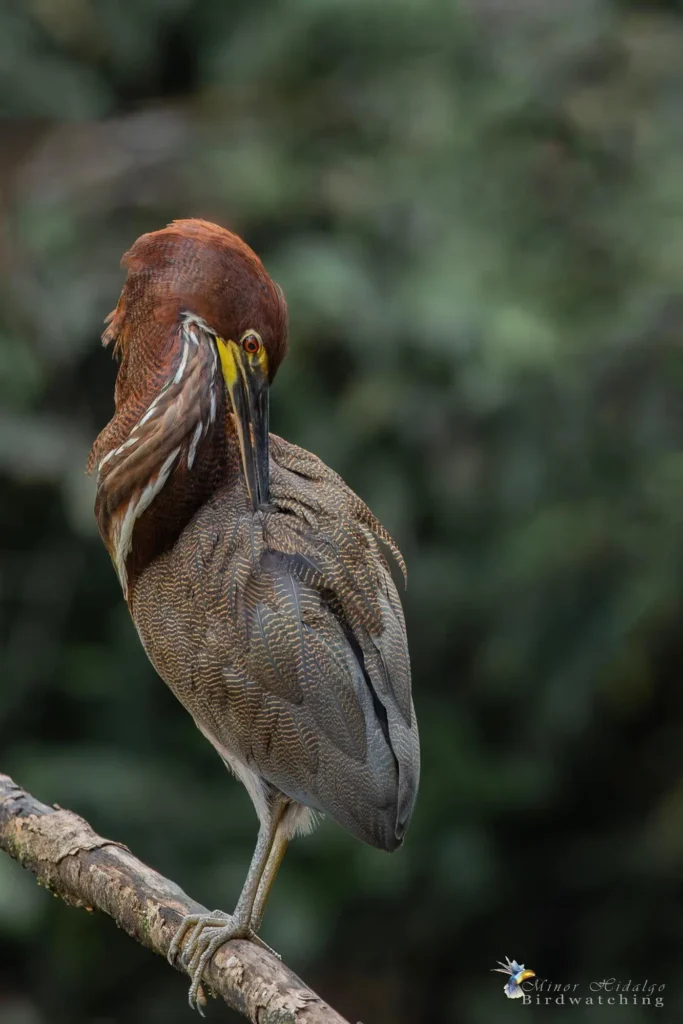
The Rufescent Tiger-Heron is a medium-sized, stocky wading bird found along forested streams, rivers, and wetlands from Honduras to Argentina, characterized by its rich rufous neck and underparts, finely barred upperparts, and secretive hunting behavior as it stands motionless or stalks slowly through dense vegetation to ambush fish and aquatic prey.

Tigrisoma lineatum
Scientific Name
Ardeidae (Herons, Egrets, and Bitterns)
Family
Pelecaniformes
Order
T. l. lineatum
Subspecies. From Honduras south through South America
T. l. marmoratum
Subspecies. Eastern South America
Range and Habitat of Rufescent Tiger-Heron
Geographic Range
The Rufescent Tiger Heron has an extensive range from Honduras through Nicaragua, Costa Rica, Panama, Colombia, Venezuela, Guyana, Suriname, French Guiana, Ecuador, Peru, Brazil, Bolivia, Paraguay, and northern Argentina.
Migratory Patterns
This is a non-migratory resident species. However, juveniles may disperse widely from natal areas, and some local movements occur in response to water levels and prey availability.
Preferred Habitat
The Rufescent Tiger Heron inhabits forested streams and rivers, mangrove swamps and channels, wooded swamps and marshes, pond and lake edges with tree cover, slow-moving rivers with vegetated banks, and occasionally coastal lagoons. It strongly prefers areas with overhead canopy cover and avoids open wetlands.
Altitude Range
This is primarily a lowland species. Globally and in Costa Rica, it occurs from sea level to 1,200 m elevation, with most records below 500 m. Occasional vagrants have been recorded up to 1,500 m.
Costa Rica Habitat
In Costa Rica, the species occurs on both Caribbean and Pacific slopes from lowlands to middle elevations. It is found in all provinces with appropriate wetland habitat. Notable locations include Tortuguero National Park, Caño Negro Wildlife Refuge, Palo Verde National Park, Carara National Park, Tárcoles River basin, Térraba-Sierpe wetlands, La Selva Biological Station, and numerous rivers throughout both slopes.
Conservation Status
Conservation Status
Least Concern
Population Status
Costa Rican populations appear healthy where appropriate habitat exists.
Major threats include deforestation along rivers and streams removing overhead cover.
Conservation efforts
The Rufescent Tiger Heron is protected under Costa Rican wildlife laws.
Primary Threats
Major threats include deforestation along rivers and streams removing overhead cover.
Rufescent Tiger-Heron Identification
How to Identify the Species
Rarity Level:
CommonBest Viewing Times:
Early Morning (Dawn - 8 AM)
Size
The Rufescent Tiger Heron is a medium-large heron measuring 66-76 cm in total length. Males weigh 850-1,100 g while females are slightly smaller at 750-950 g.
Plumage
Adults display rich rufous-chestnut head, neck, and upper breast with fine black vermiculations creating a “tiger-striped” pattern. The back is finely barred brown and black with a greenish gloss in good light. The belly is buff to tawny with dark barring becoming less distinct toward the vent. The tail shows black and rufous barring. A distinctive white stripe runs down the center of the foreneck.
Distinctive Features
The species has a relatively short, thick bill for a heron, measuring 65-75 mm, with the upper mandible dark gray to black and the lower mandible yellowish with a dark tip.
Sexual Dimorphism
Sexual dimorphism is minimal. Males average slightly larger than females, but there are no reliable plumage differences for field identification. Males may show slightly brighter bare part coloration during breeding season.
Diet and Feeding Behavior
Primary Diet
- The Rufescent Tiger Heron feeds primarily on fish ranging from 5-20 cm in length, including cichlids, characins, and catfish. It also consumes crustaceans such as freshwater crabs and crayfish, amphibians including frogs and tadpoles, aquatic insects and their larvae, water snakes, and small caimans.
Foraging Techniques
- This heron is primarily a stand-and-wait predator, remaining motionless for extended periods at water's edge. It hunts mainly from shoreline or partially submerged logs rather than wading.
Feeding Times
- Peak foraging occurs during early morning from 5:00-7:00 and evening from 17:00-19:00. The bird may hunt throughout the night during bright moonlight and becomes more active during overcast days when shadows provide better concealment.
Behavior Patterns
Rufescent Tiger-Heron
Social Structure
These herons are primarily solitary throughout the year. Pairs form only during breeding season. Juveniles may remain in loose association with parents for several weeks after fledging.
Song and Vocalization
The Rufescent Tiger Heron has a distinctive vocal repertoire. The primary call is a deep, hollow “ooom” or “hoom” that carries far through forest. It produces a guttural “rok-rok-rok” when alarmed or in flight.
Courtship and Mating Ritual
Courtship involves elaborate displays including neck stretching with erected plumes, bill pointing skyward followed by rapid lowering, mutual preening and bill touching, and synchronized calling between pairs. Males present nest material to females as part of pair bonding. Both sexes perform a “stretch display” showing the white throat stripe.
Territoriality
Individuals defend linear territories along streams or rivers, typically 200-500 meters of shoreline.
Birdwatching Tips
Best Locations for Spotting Rufescent Tiger-Heron
Prime locations include Tortuguero National Park canals, Caño Negro Wildlife Refuge, Río Tárcoles bridge area and boat tours, La Selva Biological Station along the Puerto Viejo River, Palo Verde National Park wetlands, Manuel Antonio National Park lagoons, Carara National Park along the river, boat trips in Térraba-Sierpe mangroves, and various lodge ponds with forest edges throughout the country.
Best Time of the Year
The species can be observed year-round, with increased activity during breeding season (June-August). Dawn and dusk offer the best viewing opportunities.
Common Behavior
Look for motionless birds standing at water’s edge in shadows. Check partially submerged logs and shadowy areas under overhanging vegetation. Listen for deep “ooom” calls at dawn and dusk. Watch for birds flying low over water with slow, steady wingbeats.
Recommended Gear
Essential equipment includes 8×42 or 10×42 binoculars with good low-light performance, a spotting scope useful for distant birds along rivers, a camera with telephoto lens (400mm+) for photography, a flashlight or headlamp for dawn/dusk observation.
Breeding and Nesting Behavior
Breeding Season
Breeding occurs primarily during the wet season when water levels are higher. In Costa Rica, nesting spans from May to October, with peak activity June-August.
Nesting Sites
The nest is a platform of sticks and branches measuring 40-60 cm across. It is typically placed 3-10 meters high in trees overhanging or near water. Preferred trees include mangroves, figs, and other sturdy branched species.
Clutch Size
Females lay 2-3 eggs, typically 2. Eggs are pale blue-green with sparse brown spots.
Incubation Period
31-34 days
Parental Care
Both parents share incubation duties and feeding of young. Parents regurgitate fish and other prey for chicks. Young can climb from nest at 4 weeks but don't fledge until 7-8 weeks. Post-fledging dependency continues for 6-8 weeks as young learn fishing techniques.
Did You Know?
Interesting Behaviors
When threatened, juveniles can “freeze” in an upright posture with bill pointed skyward, resembling a branch.
Cultural Significance
The name “Martín Peña” in some regions refers to the bird’s habit of standing motionless like Saint Martin in meditation. Indigenous peoples traditionally used the distinctive call to predict weather changes. The striking juvenile plumage appears in pre-Columbian art from several Costa Rican cultures. Local fishermen sometimes use the bird’s presence to locate good fishing spots.
Surprising Traits
Despite their size, these herons can be incredibly difficult to spot when motionless. They can swallow fish up to 25 cm long, nearly one-third their body length. The species shows remarkable patience, with individuals recorded standing motionless for over two hours.
How do I identify this bird?
Adults show distinctive rufous-chestnut coloring on head and neck with fine black barring, a white stripe down the front of the neck, and greenish-black barred back. Juveniles are boldly barred black and buff throughout without any rufous coloring. The relatively short, thick bill and hunched posture distinguish it from other herons.
Where is the best place to see it in Costa Rica?
Tortuguero National Park canals and the Tárcoles River offer excellent opportunities. Any forested river or stream edge provides potential habitat. Early morning boat trips in mangroves or along rivers provide the best chances. Look in shadowy areas along water edges.
Is it endangered?
No, the Rufescent Tiger Heron is listed as Least Concern with stable populations. However, it requires forested wetland habitat and is sensitive to water pollution and riparian deforestation. The species remains common in protected areas but has declined in heavily developed regions.