Ornate Hawk-Eagle

Spizaetus ornatus
Scientific Name
Accipitriformes
Family
Accipitriformes
Order
S. o. vicarius
Subspecies. From Mexico through northwestern South America (the form present in Costa Rica).
S. o. ornatus
Subspecies. Across the rest of the South American range.
Range and Habitat of Ornate Hawk-Eagle
Geographic Range
From southern Mexico through Central America to northeastern Argentina and southeastern Brazil. Two recognized subspecies: S. o. vicarius from Mexico through northwestern South America (the form present in Costa Rica), and S. o. ornatus across the rest of the South American range.
Migratory Patterns
Non-migratory. Pairs hold year-round territories and frequently re-use the same nest site across multiple breeding seasons.
Preferred Habitat
Tall, unbroken lowland and foothill tropical rainforest. Strongly tied to mature primary forest, though it also uses cloud forest at higher elevations and tall secondary growth adjacent to intact forest. Tends to abandon areas where forest tracts fall below a few hundred hectares.
Altitude Range
Sea level to roughly 1,500 m (4,900 ft), occasionally to 1,800 m (5,900 ft). Wandering birds have been recorded as high as 3,000 m (9,800 ft) in Costa Rica.
Costa Rica Habitat
Most reliable in the Caribbean lowlands and foothills — Sarapiquí, Boca Tapada, the Arenal area, and Tortuguero region — and in mid-elevation Caribbean forests of the Guanacaste Conservation Area. Also present on the Pacific slope in middle-elevation forest around San Ramón and the Bajo La Paz area.
Conservation Status
Conservation Status
Near Threatened
Population Status
Declining. Modeling tied to projected Amazon deforestation estimates a 25–30% decline across the Americas over the next three generations as suitable habitat is lost.
Habitat loss from deforestation and forest fragmentation is the principal threat. Persecution by landowners who perceive the eagle as a risk to poultry is a secondary pressure. Naturally low reproductive output — typically a single egg, often every other year — slows population recovery.
Conservation efforts
Protected within Costa Rica's national park and biological reserve system. Listed on CITES Appendix II, regulating international trade.
Primary Threats
Habitat loss from deforestation and forest fragmentation is the principal threat. Persecution by landowners who perceive the eagle as a risk to poultry is a secondary pressure. Naturally low reproductive output — typically a single egg, often every other year — slows population recovery.
Ornate Hawk-Eagle Identification
How to Identify the Species
Rarity Level:
UncommonBest Viewing Times:
Late Morning (8 AM - 11 AM)
Size
Medium-large raptor. Body length 58–67 cm (23–26 in); wingspan roughly 100–120 cm (3–4 ft); weight 1.0–1.6 kg. Females are noticeably larger than males.
Plumage
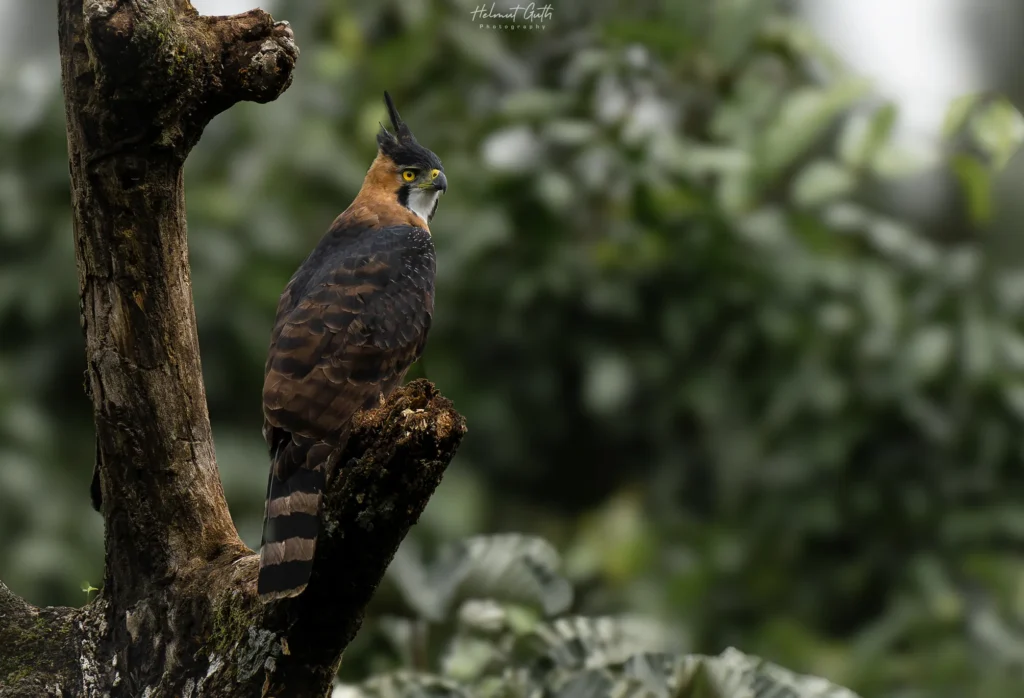
Adults have a black crown and long, spiky black crest; rufous-chestnut sides of the head, neck, and breast; and a white throat and central breast bordered by a black stripe. Underparts, leg feathering, and wing linings are white with bold black barring. Upperparts are blackish; the long tail shows three to four broad dark bands. Juveniles look strikingly different, mostly white on the head and underparts with sparse barring on the belly, and a shorter crest. Juveniles can take two to three years to acquire full adult plumage.
Distinctive Features
Long, pointed black crest, often raised when the bird is alert. Fully feathered tarsi (the “trousered” look characteristic of booted eagles). Yellow eyes, cere, and feet. In flight, broad rounded wings and a long, boldly barred tail.
Sexual Dimorphism
Sexes are alike in plumage. Females are noticeably larger and heavier, as is typical of raptors.
Diet and Feeding Behavior
Primary Diet
- A powerful and versatile predator capable of taking prey approaching or exceeding its own body weight. Diet includes: Medium to large birds — guans, chachalacas, curassows, parrots, toucans Small to medium mammals — squirrels, opossums, small monkeys, occasionally bats Reptiles — iguanas and arboreal snakes
Foraging Techniques
- Still-hunts from concealed perches inside the forest, launching short, fast attacks. Pursues birds through the canopy and is agile enough to take prey in flight. Drops to the forest floor for terrestrial prey. Occasionally seizes prey from shallow water.
Feeding Times
- Most active in the early to mid-morning and again in the late afternoon Hunts year-round; prey composition can shift with seasonal abundance of local birds and mammals
Behavior Patterns
Ornate Hawk-Eagle
Social Structure
Solitary or in pairs. Forms long-term monogamous bonds, with pairs holding and defending the same territory across multiple breeding seasons.
Song and Vocalization
A loud, far-carrying series of clear whistles, often described as a rising, hiccupping or laughing cadence. Frequently called in flight, which is often how the species is first detected. Vocal activity increases during courtship and early breeding.
Courtship and Mating Ritual
Extended courtship period lasting one to two months. Pairs perform aerial displays over the territory, including diving flights by the male and synchronized soaring, accompanied by frequent calling.
Territoriality
Strongly territorial year-round. Pairs defend large home ranges and respond aggressively to intruding raptors. Vultures near the nest can trigger crest-raising, mantling, and loud calling from the female.
Birdwatching Tips
Best Locations for Spotting Ornate Hawk-Eagle
- Arenal area — lowland and foothill rainforest, including private reserves bordering the forest
- Sarapiquí and Boca Tapada — reliable Caribbean lowland sites
- Bajo La Paz / San Ramón area — middle-elevation forest on the Pacific slope
- Heliconias Lodge and Tenorio area — known nesting territories
- Guanacaste Conservation Area (mid-elevation Caribbean forest) — recent records
Best Time of the Year
Resident year-round, but most vocal and conspicuous during courtship and early breeding, roughly February through May on the Caribbean slope. Soaring activity is best on sunny mornings once thermals develop.
Common Behavior
Most often detected by call before being seen. Birds soar above the canopy mid-morning; perched birds sit motionless inside the canopy and are easy to overlook. The raised crest is a giveaway when a perched bird is alert or excited.
Recommended Gear
- 8x or 10x binoculars
- Spotting scope for soaring birds at distance
- Telephoto lens (400 mm or longer) for photography
- Familiarity with the call before the trip — ear ID is often what locates the bird
- A good Costa Rica raptor reference (Garrigues & Dean, or the Birds of Costa Rica app)
Breeding and Nesting Behavior
Breeding Season
Nesting typically begins in the dry season, roughly February through May in Central America. Pairs often nest every other year due to the long dependency period of the young.
Nesting Sites
Large stick platforms built high in the forks of tall emergent trees, often in primary forest. Nests can reach about 1.7 m across, are lined with fresh green leaves, and are frequently reused and refurbished across seasons.
Clutch Size
Almost always one egg per clutch (rarely two). Eggs are whitish with reddish-brown spotting.
Incubation Period
Approximately 44–48 days. The female does roughly 95% of the incubation while the male hunts and delivers prey.
Parental Care
The female broods and feeds the chick; the male delivers most prey during the early nestling period. Young fledge at roughly 9–13 weeks but remain dependent on the adults for up to a year, often staying within a few hundred meters of the nest tree.
Did You Know?
Juvenile Ornate Hawk-Eagles look so different from adults — largely white on the head and underparts with only sparse barring — that early naturalists once mistook them for a separate species. It takes two to three years for a young bird to fully acquire its adult plumage.
A pair can take prey approaching or exceeding their own body weight, including guans, curassows, and small monkeys.
The long pointed crest isn’t just decorative — birds raise it when alert or excited and lower it flat against the head in flight.
A single pair may use the same nest tree for years, but often raises only one chick every other breeding cycle, which is one reason the species recovers slowly from population loss.