Lattice-tailed Trogon
The Lattice-tailed Trogon is a strikingly beautiful bird found in humid lowland forests from Costa Rica to Ecuador, notable for its vibrant green upperparts, red belly, and distinctive black-and-white barred undertail that resembles a lattice pattern, typically seen perched upright in the mid-story as it sallies for insects and fruit.

Trogon clathratus
Scientific Name
Trogonidae (Trogons)
Family
Trogoniformes
Order
T. c. clathratus
Subspecies. Costa Rica to western Ecuador
T. c. extimus
Subspecies. Western Colombia
Range and Habitat of Lattice-tailed Trogon
Geographic Range
The Lattice-tailed Trogon ranges from Costa Rica through Panama, western Colombia, and western Ecuador.
Migratory Patterns
This is a non-migratory resident species, though some altitudinal movements occur in response to fruit availability.
Preferred Habitat
The Lattice-tailed Trogon inhabits humid lowland and foothill forests, both primary and mature secondary growth. It prefers forest edges, partially cleared areas with tall trees remaining, and riparian forests along streams and rivers.
Altitude Range
In Costa Rica, it is most common from sea level to 800 m, occasionally ascending to 1,200 m in suitable habitat.
Costa Rica Habitat
In Costa Rica, the species primarily inhabits the Pacific slope from the Carara region southward through the Osa Peninsula. The bird is found in Puntarenas province (central and southern portions), southern San José province, and southeastern Limón province.
Conservation Status
Conservation Status
Least Concern
Population Status
Costa Rica maintains healthy populations in protected areas.
Deforestation and habitat fragmentation, particularly in lowland areas.
Conservation efforts
The Lattice-tailed Trogon receives protection in numerous Costa Rican national parks and reserves.
Primary Threats
Deforestation and habitat fragmentation, particularly in lowland areas.
Lattice-tailed Trogon Identification
How to Identify the Species
Rarity Level:
UncommonBest Viewing Times:
Early Morning (Dawn - 8 AM), Afternoon (2 PM - 5 PM)
Size
28-30 cm in length; Males weigh between 75-85 g, while females are slightly lighter at 70-80 g.
Plumage
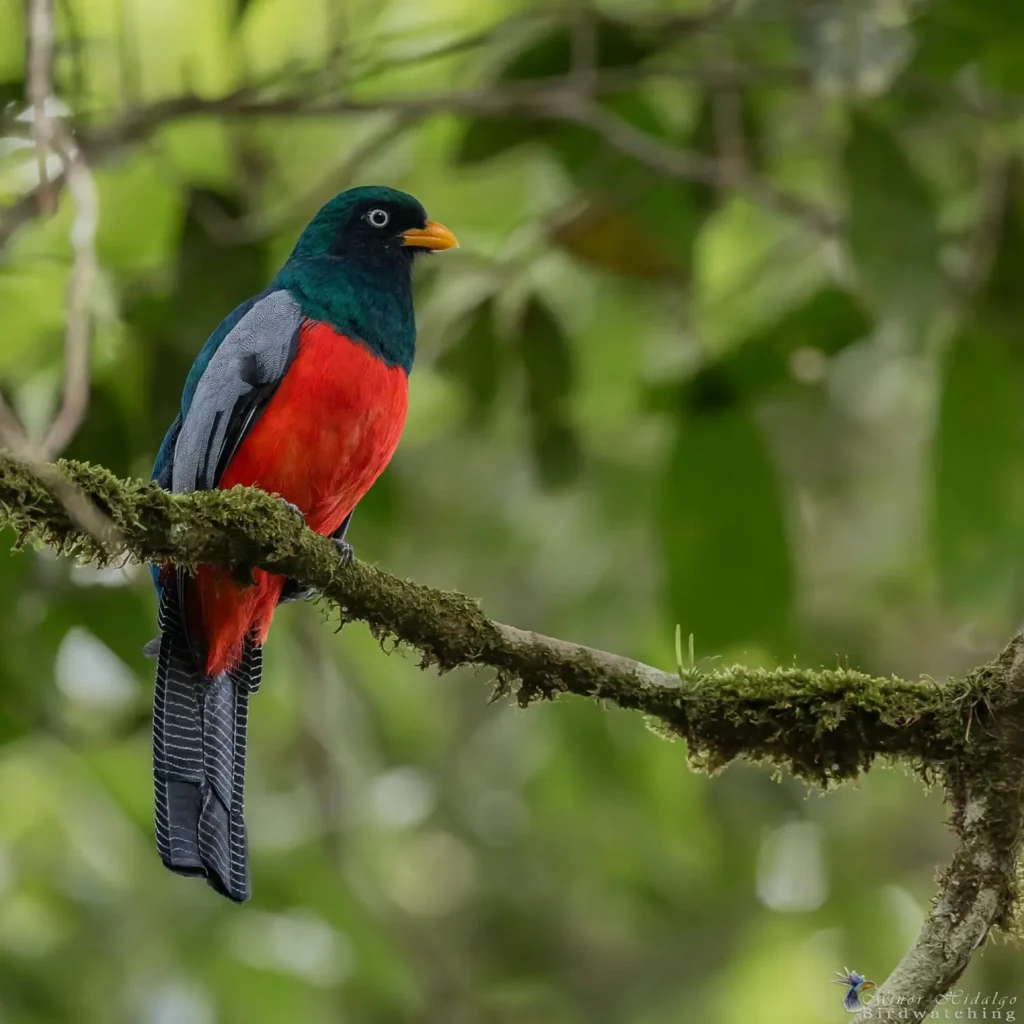
Adult males display an iridescent green head, upper back, and chest. The lower breast and belly are bright golden-yellow to orange-yellow. The undertail displays a distinctive lattice pattern of black and white bars forming a crosshatch design that gives the species its name.
Adult females have slate-gray replacing the male’s green areas, with the same yellow underparts though slightly duller. Both sexes show white tips on the outer tail feathers.
Distinctive Features
The distinctive latticed undertail pattern with fine black and white crosshatching is unique among Costa Rican trogons. The tail is relatively long and square-tipped when folded.
Sexual Dimorphism
Males show iridescent green on the head and upper body while females display slate-gray in these areas. Males have brighter yellow-orange underparts compared to females' duller yellow.
Diet and Feeding Behavior
Primary Diet
- The Lattice-tailed Trogon feeds primarily on fruits, mistletoe berries, and also insects including caterpillars, beetles, orthopterans, and walking sticks.
Foraging Techniques
- This trogon employs sally-gleaning as its primary foraging method, hovering briefly to pluck fruits from branches. It captures insects through aerial sallies from perches and occasionally gleans prey from foliage and bark.
Feeding Times
- Peak activity occurs during early morning hours from 6:00-9:00 and again in late afternoon from 15:00-17:30. The bird may feed intermittently throughout the day when fruit is abundant.
Behavior Patterns
Lattice-tailed Trogon
Social Structure
These trogons are typically observed alone or in pairs throughout the year. During the breeding season, family groups of 3-4 individuals may be seen.
Song and Vocalization
The primary song consists of a series of hollow “cow-cow-cow-cow” notes, typically 4-8 notes delivered at a steady pace. The call is a sharp “kwa” or “kyow” note, often given in flight. The species is generally less vocal than other trogon species.
Courtship and Mating Ritual
Courtship involves males performing display flights with exaggerated wing beats. Males feed females during courtship and the breeding season. Tail-raising displays show off the distinctive latticed pattern, and synchronized calling strengthens pair bonds.
Territoriality
Pairs defend territories year-round, with territory size ranging from 3-6 hectares. They respond aggressively to playback of conspecific calls and chase intruders from fruiting trees within their territory.
Birdwatching Tips
Best Locations for Spotting Lattice-tailed Trogon
Prime locations include
- Carara National Park along the River Trail and Quebrada Bonita Trail
- Manuel Antonio National Park
- Corcovado National Park at Sirena and Los Patos stations
- Wilson Botanical Garden along forest trails
- Esquinas Rainforest Lodge area
- Tiskita Jungle Lodge surroundings
- Los Cusingos Bird Sanctuary
- Hacienda Barú National Wildlife Refuge
Best Time of the Year
The species can be observed year-round, but it is most active and vocal from March to May during the breeding season. September to November offers good viewing when many trees are fruiting.
Common Behavior
Look for the bird perched quietly on horizontal branches in the mid-canopy. Listen for hollow calling, especially in early morning. Check fruiting laurel and palm trees where they often feed.
Recommended Gear
Essential equipment includes 8×42 or 10×42 binoculars for forest birding and a camera with telephoto lens of 400mm or greater for photography
Breeding and Nesting Behavior
Breeding Season
March to May during the transition from dry to wet season.
Nesting Sites
The nest consists of a cavity excavated in arboreal termite nests. Nests are usually placed 3-12 meters above ground in trees at forest edges or gaps. The entrance hole measures 6-7 cm in diameter, with the nest chamber measuring 15-18 cm in diameter.
Clutch Size
2-3 eggs, typically 3
Incubation Period
16-17 days
Parental Care
Both parents share incubation duties and feeding responsibilities. Chicks fledge at 15-17 days of age. Post-fledging care continues for 3-4 weeks as young learn foraging techniques.
Did You Know?
Interesting Behaviors
The Lattice-tailed Trogon excavates its nest cavity using its bill to chip away at termite nests, a process that can take up to two weeks. The bird has been observed using “broken wing” distraction displays to lead predators away from nests.
Cultural Significance
Indigenous communities have traditionally used trogon feathers in ceremonial dress. The bird appears in pre-Columbian art from southern Costa Rica, and its hollow call is said to predict rain in local folklore.
Surprising Traits
The Lattice-tailed Trogon can rotate its head nearly 180 degrees while keeping its body still. The species can digest fruits toxic to many other birds, including some Lauraceae species.
How do I identify this bird?
Look for a medium-sized bird with an upright perching posture typical of trogons. Males show iridescent green above and bright yellow below, while females are gray above and yellow below. The distinctive latticed pattern on the undertail with fine black and white crosshatching is diagnostic and unique among Costa Rican trogons.
Where is the best place to see it in Costa Rica?
Carara National Park offers excellent opportunities, particularly along the River Trail where pairs are regularly seen. Manuel Antonio National Park and the gardens at Wilson Botanical Garden also provide reliable sightings. Early morning hours offer the best activity levels.
Is it endangered?
No, the Lattice-tailed Trogon is listed as Least Concern with stable populations in protected areas. However, it requires intact forest habitat and is vulnerable to deforestation in unprotected lowland areas.