Tricolored Munia, Black-headed Munia
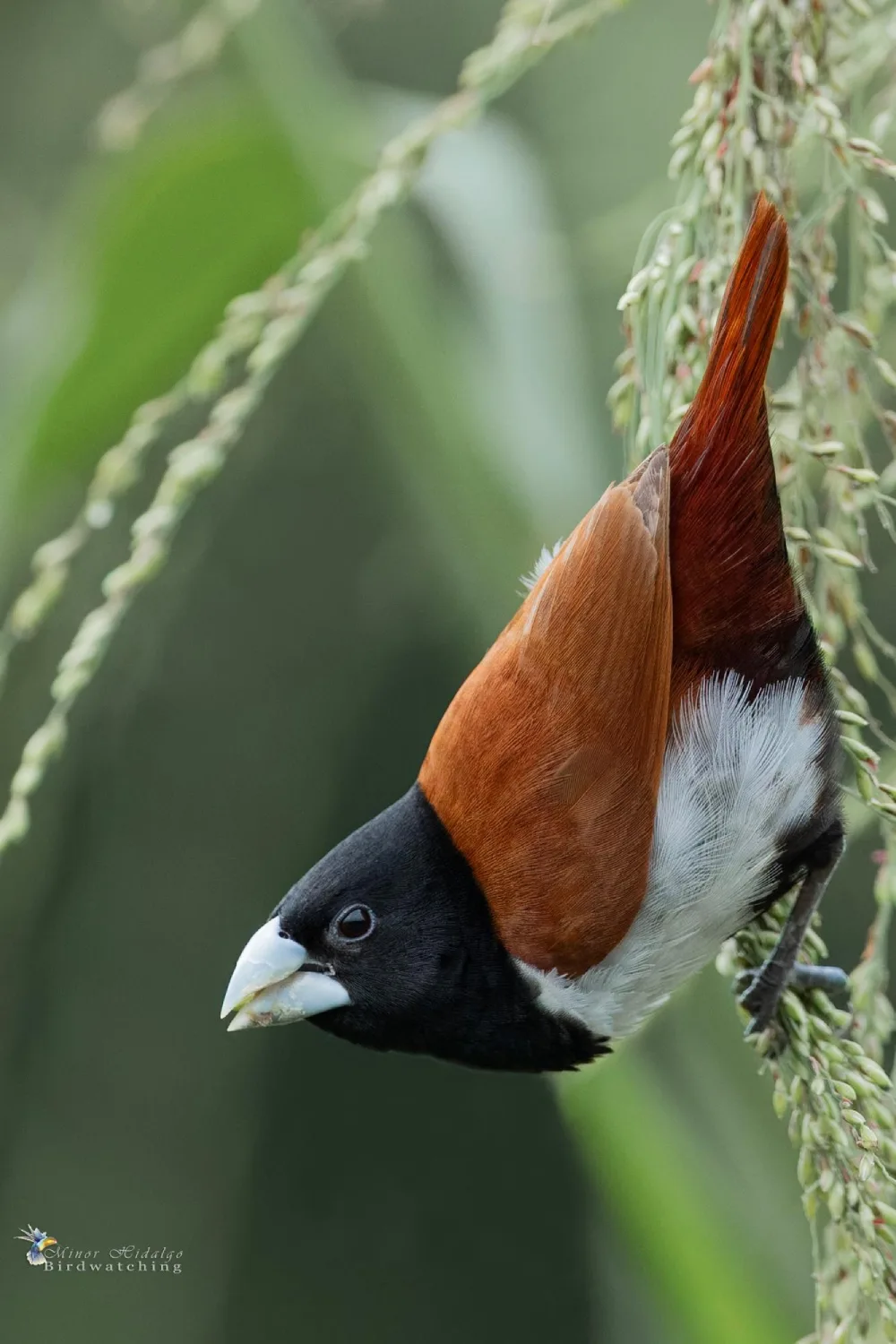
While visiting Costa Rica, have you ever spotted a small, cinnamon-and-black finch hanging out in rice paddies or weedy pastures near the coast? That could be the Tricolored Munia, a species that didn’t evolve here in Costa Rica but found its way and stayed.
Lonchura malacca
Scientific Name
Estrildidae (Waxbills, Munias & Allies)
Family
Passeriformes
Order
Range and Habitat of Tricolored Munia, Black-headed Munia
Geographic Range
These little birds are originally from Southern Asia, and were brought into the Western Hemisphere in the mid‑20th century, mostly for caged bird trade. The first established population in Costa Rica was spotted in 1999, near La Guinea, Guanacaste. Since then, they’ve spread quietly through wetlands and agricultural fields.
Tricolored Munia is native to Bangladesh, India, Sri Lanka, Pakistan, and southern China. Introduced populations are established in Trinidad, Jamaica, Hispaniola (Dominican Republic and Haiti), Puerto Rico, Cuba, Venezuela, Colombia, Panama, Costa Rica, Nicaragua, and parts of the United States (Florida, California).
Migratory Patterns
Year-round resident where established. Expanding range through natural dispersal and continued introductions from the pet trade
Preferred Habitat
- Wet grasslands and marshes
- Rice fields and agricultural areas with grain crops
- Tropical lowland moist habitats
- Reed beds near water sources
- Open areas with tall grasses near water
- Human-modified landscapes including parks and gardens
- Avoids dense forest interior
Altitude Range
Primarily lowlands from sea level to 500 meters, with occasional records up to 800 meters in agricultural valleys
Costa Rica Habitat
Most commonly reported in Guanacaste Province, Puntarenas Province, and parts of San José Province
Notable locations: Areas around rice fields in Guanacaste, wetlands near Puntarenas, and agricultural zones in the Central Valley
Protected areas: Occasionally reported in Palo Verde National Park, Santa Rosa National Park, and Carara National Park
Conservation Status
Conservation Status
Least Concern
Population Status
Population size considered large and stable across its range
Habitat loss: Drainage of wetlands and conversion of grasslands to intensive agriculture; Agricultural persecution: Occasional control efforts in rice-growing areas
Conservation efforts
Indirect protection through habitat conservation in Palo Verde National Park (important wetland habitat), Santa Rosa National Park (grassland conservation), and Carara National Park (transitional habitats)
Primary Threats
Habitat loss: Drainage of wetlands and conversion of grasslands to intensive agriculture; Agricultural persecution: Occasional control efforts in rice-growing areas
Tricolored Munia, Black-headed Munia Identification
How to Identify the Species
Rarity Level:
CommonBest Viewing Times:
Early Morning (Dawn - 8 AM), Afternoon (2 PM - 5 PM)
Size
Length: 11.5 cm (4.5 inches); Weight: 12-16 grams
Plumage
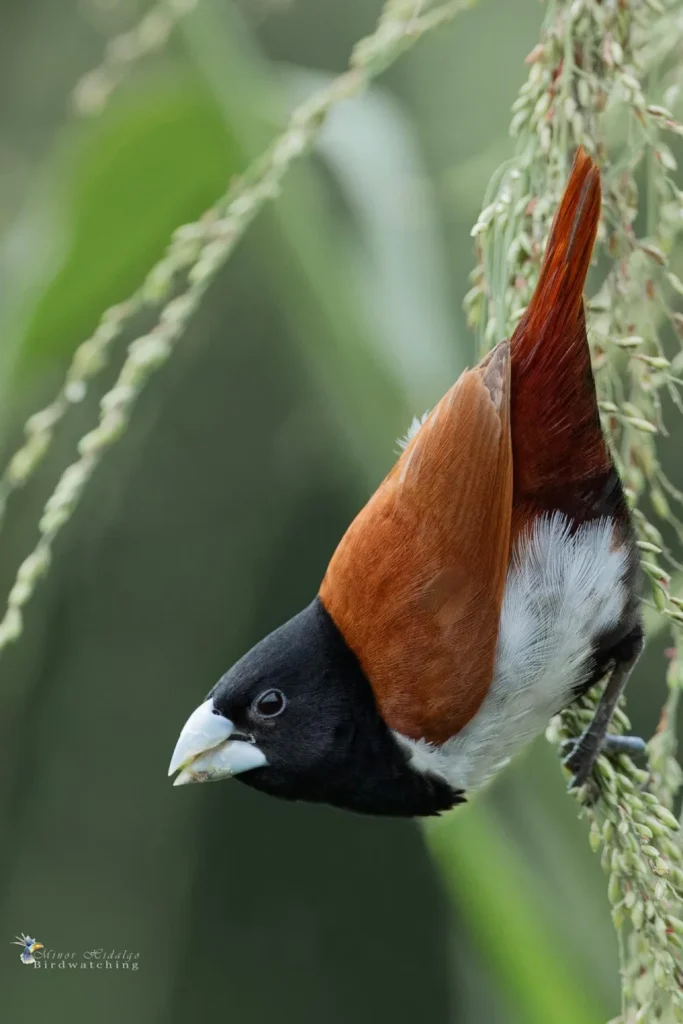
Adult Males have sriking black head, throat, and upper breast extending to belly and undertail coverts. White lower breast and flanks create distinctive tricolored pattern. Back and wings are warm chestnut-brown. Rump and uppertail coverts are reddish-maroon. Males typically show slightly brighter and more pronounced coloring.
Adult Females are nearly identical to males but may have slightly duller coloring on the reddish-maroon rump area and less pronounced black on the throat. While Juveniles are completely different from adults – pale brown upperparts without dark head markings. Underparts are uniform buff to pale brown. Can be easily confused with juvenile Scaly-breasted Munias.
Distinctive Features
Beak: Pale bluish-gray, conical shape typical of seed-eating birds, measuring 12-13 mm in length with males showing a more pronounced ridge
Tail: Dark brown, relatively short and pointed
Eye: Brown iris in adults, darker brown in juveniles
Legs and feet: Gray with darker scales
Unique markings: The striking tri-color pattern of black, white, and chestnut is unmistakable in adultsSexual Dimorphism
Males may have slightly brighter plumage, a more bulky head, more pronounced beak ridge, and marginally darker throat markings, but field identification by sex is extremely difficult.
Diet and Feeding Behavior
Primary Diet
- Grass seeds (primary food source - 70-80% of diet); cultivated grains, especially rice; small seeds from weedy plants and wildflowers; mistletoe berries and other small fruits (seasonal); small insects during breeding season for protein; algae (rich protein source before breeding)
Foraging Techniques
- Ground foraging in flocks, searching through grass and leaf litter, climbing grass stems to reach seed heads, plucking seeds directly from grain heads
Feeding Times
- Active throughout the day with peak feeding activity in early morning (6:00-9:00 AM) and late afternoon (3:00-6:00 PM). Less active during midday heat.
Behavior Patterns
Tricolored Munia, Black-headed Munia
Social Structure
Highly gregarious species forming flocks of ten to 100 individuals outside breeding season. During breeding, pairs may nest in loose colonies while maintaining pair bonds. Mixed-species flocking common with other munias, grassquits, and seedeaters.
Song and Vocalization
Male song: Very soft, complex, and variable song audible only at close range (under 10 meters). Described as a musical jingle consisting of high notes followed by a croaky rattle, ending in a slurred whistle
Calls: Soft “pip-pip” contact calls, sharp chipping alarm notes, and variations of “kitty-kitty-kitty” calls during flock communication
Courtship and Mating Ritual
- Males initiate courtship by flying with a grass blade in their beak
- Male perches beside female, drops grass blade, and begins elaborate dance
- Dance involves head bobbing that intensifies to jumping on perch
- Male adopts upright posture with head down, mouth open, and belly feathers fluffed, accompanied by very quiet mating song
- Female acceptance shown by lowering to horizontal position with tail and head turned toward male
Territoriality
Non-territorial outside breeding season. During breeding, pairs defend small area around nest site (typically five to ten meter radius)
Birdwatching Tips
Best Locations for Spotting Tricolored Munia, Black-headed Munia
- Palo Verde National Park: Wetlands and marshes, especially along Rio Tempisque
- Santa Rosa National Park: Grasslands and seasonal wetlands in Guanacaste
- Carara National Park: Transitional zone grasslands and agricultural edges
- Central Valley: Rice fields and agricultural areas around San José Province
- Guanacaste lowlands: Rice fields and cattle pastures with water sources
- Puntarenas wetlands: Coastal marshes and mangrove edges
Best Time of the Year
Peak activity: March-October during breeding season when birds are most vocal and visible
Common Behavior
Flocking behavior: Look for small flocks feeding in grass or flying between feeding and roosting areas
Habitat cues: Focus on areas where water meets grassland or agricultural fields
Recommended Gear
- Binoculars: 8×42 or 10×42 magnification for detailed observation of small birds
- Camera: 400mm+ lens for photography; birds are relatively approachable within 10-15 meters
Breeding and Nesting Behavior
Breeding Season
Peak breeding March-October during wet season, but can breed year-round where conditions are suitable
Nesting Sites
Large, loosely-built oval or spherical nest with single entrance. Typically one to three meters above water in emergent vegetation, reed beds, or tall grass swamps.
Clutch Size
Four to five eggs
Incubation Period
12-13 days
Parental Care
Both parents share incubation duties equally. Parents alternate sitting periods and both remain in nest overnight.
Did You Know?
Interesting Behaviors
Males perform an elaborate courtship dance while carrying grass blades in their beaks. Pairs often reuse and continuously add to their nests, creating enormous structures that can last multiple breeding seasons.
Surprising Traits
Despite being called “Tricolored,” juveniles show completely different coloration and can be mistaken for entirely different species. Nests can be so large that they’re mistaken for those of much larger birds.
How did the Tricolored Munia get to Costa Rica?
The first established population in Costa Rica was spotted in 1999, near La Guinea, Guanacaste. Since then, they’ve spread quietly through wetlands and agricultural fields.
How do I identify Tricolored Munia?
Adult Tricolored Munias are unmistakable with their black head and breast, white flanks, and chestnut back creating a distinctive tri-color pattern. The sturdy, pale gray beak is characteristic of seed-eating finches. Juveniles are much more challenging, appearing entirely pale brown and requiring careful attention to beak shape and behavior to distinguish from other young munias. Size (smaller than a sparrow) and pointed tail help separate them from similar species.
Where is the best place to see Tricolored Munia in Costa Rica?
Palo Verde National Park offers the most reliable sightings, particularly along the wetland edges and grasslands near Rio Tempisque. The rice fields of Guanacaste Province provide excellent habitat, and birds can often be seen from roadside viewing points. Santa Rosa National Park’s seasonal wetlands during the wet season (May-November) also provide good opportunities. For easy access, check agricultural areas in the Central Valley, particularly around Cartago and San José provinces.
Is it endangered?
No, the Tricolored Munia is listed as “Least Concern” by the IUCN and has stable, expanding populations globally. In Costa Rica, as an introduced species, it faces no conservation threats and appears to be successfully establishing breeding populations.