The Complete Costa Rica Birding Guide 2026
If you are a wildlife explorer, then nothing could be better than the menagerie of Costa Rica. Whether iguanas, or toucans, crocs or monkeys, every animal and bird species will give you a thrilling experience. With world-class bio-diversified parks, Costa Rica is a dedicated country that provides harbor to many endangered and rare species. No…
Why Costa Rica is the World’s Premier Birding Destination
Imagine spotting a Resplendent Quetzal in emerald cloud forest mist, then hours later watching a pair of Scarlet Macaws soar over Pacific waves. Welcome to Costa Rica, a country where 930+ bird species thrive across just 51,000 square kilometers (19,700 square miles). That’s more bird species than the entire United States and Canada combined, packed into an area smaller than West Virginia.
Costa Rica’s position as a living bridge between North and South America creates an unparalleled birding laboratory. Migratory routes funnel hundreds of species through the country seasonally, while endemic species found nowhere else on Earth make permanent homes across the country’s 12 distinct ecological zones, from mangrove swamps to high-altitude cloud forests at 3,800 meters (12,500 ft) elevation.
By the numbers:
- 930+ recorded species across all habitats
- 150+ species possible in a single 24-hour period with expert guidance
- 12 life zones ranging from dry tropical forest to alpine páramo
- 4 mountain ranges creating diverse microclimates
- Endemics: Species found only in Costa Rica or Costa Rica + adjacent regions
What makes Costa Rica unique: Unlike destinations where birding is restricted to specific seasons or locations, Costa Rica offers world-class birding year-round across multiple ecosystems within short driving distances. See Caribbean lowland species in the morning, Pacific slope birds at lunch, and cloud forest specialties by dinner.
Top Costa Rica Birding Regions
1- Monteverde Cloud Forest Reserve (1,400–1,700m / 4,500-5,500 ft elevation)
Why it’s legendary: The crown jewel of Costa Rican birding, Monteverde holds the country’s highest bird diversity in a single location. Permanent cloud cover creates a unique microclimate supporting 400+ species, including species found nowhere else on Earth.
The Resplendent Quetzal Experience The holy grail of Costa Rican birding lives here. This impossibly beautiful bird, with iridescent emerald feathers, crimson chest, and 24-inch tail plumes, appears sacred for good reason. In Maya and Aztec cultures, it symbolized freedom and divinity.
- Best viewing: January – April (Nesting Season)
- Sighting probability: 97% with certified guide during nesting season
- Viewing tips: Arrive at dawn; males display at favorite perches
- Photography: Silhouette against misty canopy, tail catching first light
Other Species Highlights:
- Three-wattled Bellbird: Loud, unusual call echoes through forest (March–July)
- Northern Emerald Toucanets: Jewel tone Toucan
- Resplendent Quetzal Visible year-round
- Long-tailed Manakins: Males perform synchronized dance displays
- Silvery-fronted Tapaculo: Shy but vocal, skulks in dense vegetation
Practical Information:
- Entrance: $18–22 USD
- Accessible reserves: Monteverde Reserve (private), Curi-Cancha Reserve, Santa Elena Reserve
- Accommodation: Lodges ranging from budget ($100) to luxury ($350+)
- Guides: Local certified naturalists available at all reserves; highly recommended
- Hiking difficulty: Easy to moderate; well-maintained trails
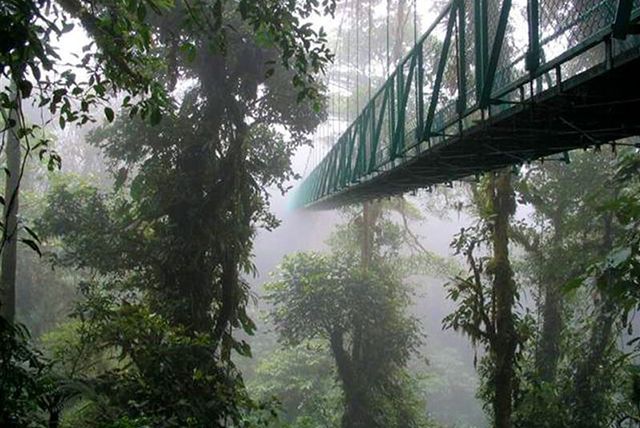
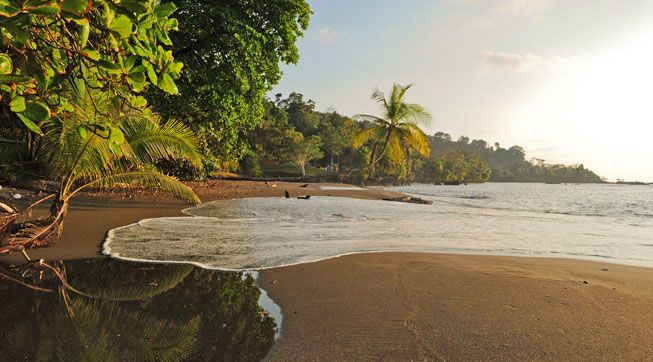
2. Osa Peninsula & Corcovado National Park (lowland rainforest, sea level–400 m / 1300 ft)
Why it’s legendary: One of the most biologically intense regions on Earth. The peninsula contains 350+ bird species in the most pristine rainforest remaining in Central America. Expect daily sightings of species extinct elsewhere on the peninsula.
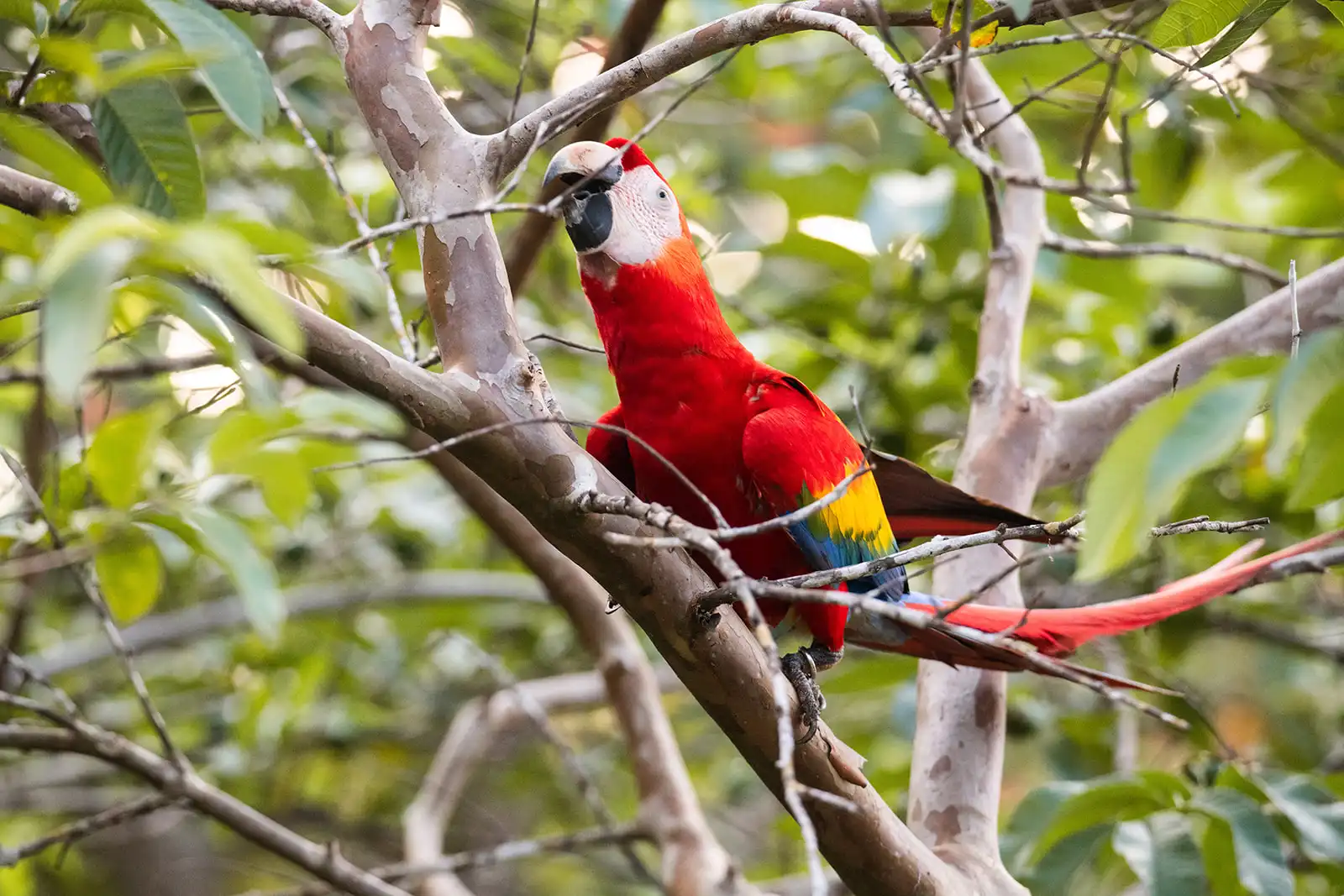
Scarlet Macaw These brilliantly colored birds, once widespread across Central America, nearly vanished due to habitat loss and illegal pet trade. Corcovado offers the best wild macaw viewing in the world.
- Sighting guarantee: Pairs or family groups almost daily (year-round)
- Peak season: January–May (larger flocks, more active)
- Viewing location: Riverine habitats, wild-almond trees, fruiting trees near lodges
- Photography: Early morning flight shots, perched pairs, feeding behavior
Other Species Highlights:
- Fiery-billed Aracaris: Smaller toucans, acrobatic feeding behavior
- Velvety Manakin: As the name suggests, black velvet in the rainforest
- Black Hawk Eagle: Rare and majestic, on every birders most wanted list
- Trogons: Multiple species with jewel-like plumage
- Mangrove specialists: Roseate Spoonbills, Tiger Herons, Boat-billed Herons
Practical Information:
- Park entrance: $25 USD
- Access: Most visitors use eco-lodges with guided hikes
- Accommodation: Eco-lodges with wide range of prices ($150 – $800 per night)
- Hiking difficulty: Moderate to strenuous; muddy trails through primary rainforest
- Best activity: Early morning “early bird tours” (5:30–9:30 AM)
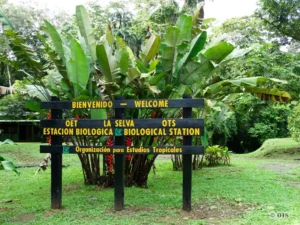
3. La Selva Biological Station & Rainforest Reserve (100–120 m / 320-390 ft elevation)
Why it’s legendary: An international research station hosting 300+ scientists annually. The site has recorded 450+ bird species, making it one of the world’s best tropical birding destinations. Access to primary rainforest with professional infrastructure and expert guides.
Research Station Advantage Unlike tourist reserves, La Selva operates as a working research station. This means trained naturalists, current species data, and recent discoveries shared with visitors.
Key Species:
- Great Green Macaw: Population recovering; regular sightings
- Keel-billed Toucans: Daily sightings in canopy
- Snowy Cotingas: Stunning white birds in flowering trees
- Trogons: Multiple species throughout forest
- Honeycreepers & Tanagers: Colorful visitors to the gardens
Practical Information:
- Entrance fee: $10–15 USD
- Guided tours: Essential; naturalists know exact locations of shy species
- Accommodation: Stay at nearby Selva Verde Lodge (500 acres of connected forest)
- Hiking difficulty: Easy to moderate; elevated walkways reduce mud and falling hazards
- Best activity: Multi-day visits to build species list
Visitor Experience: Elevated wooden paths tucked into the rainforest provide incomparable close-up opportunities without disturbing the forest floor. Combine with adventure activities (horseback riding, whitewater rafting) for mixed-interest groups.
4. Carara National Park & Manuel Antonio (transition zone, 50–300m elevation)
Why it’s legendary: Where the northern Pacific slope meets the southern Pacific lowlands. Carara’s location in a transition area means more open rainforest, making wildlife spotting a bit easier than dense lowland sites. Manuel Antonio offers unrivaled biodiversity in a small space, rated one of the world’s most beautiful parks by multiple renowned travel guides.
Scarlet Macaw Stronghold. While Scarlet Macaws populate several locations, Carara offers the most accessible, reliable sightings of wild pairs and family groups. The park’s management has successfully protected macaw populations.
- Sighting guarantee: 95% probability with early morning hike
- Group size: Pairs or small flocks (3–5 birds)
- Best viewing time: 5:30–8:00 AM
- Photography opportunities: Flight shots over river, perched displays
Other Species Highlights:
- Motmots: Multiple species with beautiful tail movements
- Mangrove Hummingbird: Endemic to Costa Rica
- Wading birds: Herons, egrets, ibises in wetland areas or the Tarcoles River
- Migratory warblers: Seasonal visitors (spring and fall)
- Roseate Spoonbills: Pink wading birds in brackish waters
Practical Information:
- Park entrance: $18 USD
- Accommodation: Birding lodges nearby, or towns of Jaco and Quepos that have full services
- Hiking difficulty: Easy; well-maintained trails
- Guide requirement: Highly recommended; guides spot birds from calls
5. Tortuguero National Park (Caribbean lowland, sea level–100m elevation)
Why it’s legendary: Accessible only by boat or small plane, Tortuguero creates a unique birding experience in pristine Caribbean lowland forest. The park protects 309+ bird species in 76,800 hectares of rainforest, wetlands, and coastal systems. Named for the sea turtles that nest on its beaches, but a birdwatcher’s paradise year-round.
Caribbean Specialty Species
This remote location hosts birds rarely seen in other Costa Rican reserves, particularly water-loving species adapted to the canal-crossed landscape.
- Sighting guarantee: 80%+ for specialty species with guide
- Best season: July – November (slightly decreased rainfall)
- Unique advantage: Boat-based birding through canals (different from hiking)
- Specialty: Herons, kingfishers, water birds, canopy species
Key Species:
- Great Green Macaw: Recovering population; regular sightings
- King Fishers: Multiple species (Ringed, Belted, Amazon, Pygmy, Green & Rufous)
- Roseate Spoonbills: Wading birds in shallow waters
- Herons and Egrets: Many species of each
- Macaws & Parrots: Great Green Macaw and various parrot species
- Toucans & Trogons: residents of the Caribbean Lowlands
Practical Information:
- Access: By boat (recommended) or small charter plane from San Jose
- Accommodation: Eco-lodges accessible only by water (adds to experience)
- Guided tours: Essential; guides navigate waterways and spot birds and wildlife
- Hiking difficulty: Easy to moderate; flat terrain, boardwalks available
- Best activity: Multi-day stay recommended (2–3 days ideal)
Unique Experience:
Unlike other birding destinations, Tortuguero offers boat-based birding through water canals allowing different perspectives to the birds and access to species found in the mangroves. . Combining sea turtle nesting viewing (seasonal) with birding provides a complete nature experience.
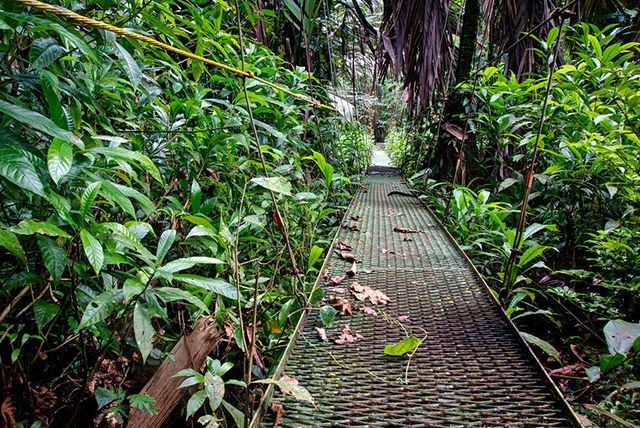
6. Palo Verde National Park (100m elevation, wetland/dry forest hybrid)
Why it’s legendary: Where wetland meets dry forest. Boat tours through Tempisque River wetlands expose bird communities rarely seen elsewhere. The sparse landscape makes spotting significantly easier than in dense rainforest regions.
Jabiru Storks—Tallest Flying Bird in the Americas These incredible birds stand up to 5 feet tall with wingspan approaching 12 feet. Seeing them in flight is awe-inspiring.
Key Species:
- Jabiru Storks: Black and white with red facial markings
- Tiger Herons: Striped, elusive marsh specialists
- White Ibises: Curved bills probe shallow water
- Roseate Spoonbills: Pink plumage unique in region
- American Crocodiles & Caimans: Not birds, but visible from boats
Practical Information:
- Access: North Pacific region, near Liberia
- Activity: Boat tour (primary method)
- Hiking: Trails through dry forest also available
- Best season: Dry season (December–April) for easier touring
- Equipment: Waterproof camera bag, polarizing filter (glare off water)
7. Turrialba (Caribbean slope, 600m elevation)
Why it’s legendary: Renowned for being the home to some of the best birding in Costa Rica, this mid-elevation paradise is a bird watchers dream. With 450+ species recorded in the region, the area represents some of the highest birding success rates globally.
Snowcap Hummingbird—The Prize Sighting This tiny, iridescent hummingbird with a characteristic snowy white cap represents the pinnacle of birding achievement. Seeing a Snowcap is like earning your birding degree.
- Sighting location: On-site hummingbird feeding stations and active gardens
- Identification: Males sparkle iridescent red-violet; females greenish with white patches
- Photography: Challenging due to rapid wing beats; high-speed camera essential
- Rarity level: Reliable at Rancho Naturalista and surrounding areas
Other Species Highlights:
- Collared Aracaris: Colorful parrots visiting feeders
- Laughing Falcon: Unique call from the canopy
- Mid-elevation species: Gardens and surrounding forest and volcanic slopes are prolific
- Orange-billed Sparrow: Hopping around the understory
- Tanagers: Rainbow of colors in the gardens and forest
Practical Experience: Preferred Lodge is Rancho Naturalista. Watch hummingbirds from the breakfast table. Morning hikes to nearby Tapantí National Park increase chances of sought after and hard to find species. Other off the beaten path birding locations abound in this region.
8. San Gerardo de Dota – Savegre Valley (2,200–2,600m elevation)
Why it’s legendary: Tucked deep in the Talamanca Mountains, San Gerardo de Dota is widely regarded as the most reliable place in Costa Rica to see the Resplendent Quetzal. Cool temperatures, pristine oak forest, and a protected river valley create ideal conditions for highland specialties, many of them endemic to Costa Rica and western Panama.
The Resplendent Quetzal Experience
This is the single most dependable location for Quetzal sightings in Costa Rica. Birds are accustomed to human presence, nest predictably, and feed in easily accessible fruiting trees along the valley.
Best viewing: January – May (Peak nesting season)
Sighting probability: 98% with an experienced local guide during nesting season
Viewing tips: Early morning along fruiting avocado trees; males often perch in open view
Photography: Clean backgrounds, soft highland light, tail plumes often fully visible
Other Species Highlights:
- Fiery-throated Hummingbird: Brilliant iridescence; frequent at feeders
- Long-tailed Silky-Flycatcher: Common valley species with elegant flight
- Black Guan: Large, dark endemic; often seen along forest edges
- Collared Redstart: Active and confiding, often near trails and rivers
- Scintillant Hummingbird: Smallest Hummingbird in Central America
Practical Information:
- Elevation: 7,200–8,500 ft (cool mornings; jackets recommended)
- Access: 2.5–3.5 hours from San José via paved mountain roads
- Accommodation: Small lodges and eco-hotels ($120–$300+), many with riverside trails
- Guides: Local specialist guides are essential and highly effective
- Hiking difficulty: Easy to intermediate; riverside paths and forest trails
Species Spotlights (The Birds You Came For)
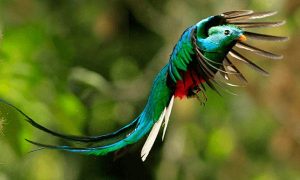
Resplendent Quetzal
Scientific name: Pharomachrus mocinno Range: Monteverde, San Gerardo, mountain cloud forests Best viewing: April–June Success rate with guide: 97% Difficulty level: Moderate (early mornings, patience) Photography rating: 9/10 (stunning but fast-moving)
Why they matter: Sacred to Maya and Aztec cultures, symbolizing freedom and divinity. Ornithologically, the longest-tailed Costa Rican bird with iridescent feathers that reflect light in hypnotic ways. One sighting converts a casual birdwatcher to lifelong birder.
Field marks:
- Males: Iridescent emerald head/back, crimson breast, 2-foot tail plumes
- Females: Less ornate but still beautiful; green-gray plumage
- Call: Distinctive “quo-tzal” vocalization
Where to see:
- Monteverde Cloud Forest Reserve
- San Gerardo de Dota (Talamanca Highlands)
- Curi-Cancha Reserve (Monteverde)
Scarlet Macaw
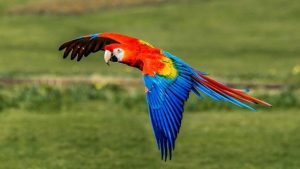
Scientific name: Ara macao cyanopterus Range: Carara NP, Osa Peninsula, Pacific slope Best viewing: Year-round (January–March peak) Success rate with guide: 95% Difficulty level: Easy (visible from distance) Photography rating: 10/10 (colorful, large, accessible)
Why they matter: Iconic symbol of Costa Rica. Once widespread across Central America, nearly extinct due to habitat loss and illegal pet trade. Recent conservation success story with recovering wild populations.
Field marks:
- Brilliant red plumage dominates
- Blue and yellow wings (macaws’ signature)
- Large curved bill, bare facial patches
- Pairs or small flocks travel together
- Loud, raucous flight calls
Where to see:
- Carara National Park (highest reliability)
- Osa Peninsula (Corcovado area)
- Central Pacific
- Puerto Jimenez
Behavior: Feed in fruit trees (mango, almond) early morning and late afternoon. Rest in tall trees midday. Can spot from lodge gardens/canopy platforms.
Snowcap Hummingbird
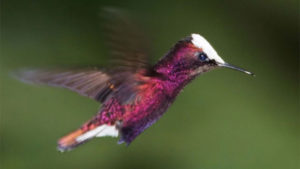
Scientific name: Microchera albocoronata Range: Caribbean slope (600–1,200m elevation) Best viewing: Rancho Naturalista feeders (January–April, July–Sept) Success rate with guide: 75% at Rancho Naturalista Difficulty level: Moderate (feeders available) Photography rating: 8/10 (fast, small, but predictable location)
Why they matter: Represents the pinnacle of birding achievement. Tiny (3.3 inches), iridescent, rare even in its limited range. The “bird you MUST see” for serious birders.
Field marks:
- Males: Iridescent red-violet plumage with white cap
- Females: Greenish-gray with red-spotted throat
- One of the smallest resident hummingbird in range (only 3.3g)
Where to see:
- Rancho Naturalista (fairly reliable sighting)
- Tranki Gardens (fairly reliable sighting)
Technical note: High-speed photography essential; 1/5000 shutter minimum.
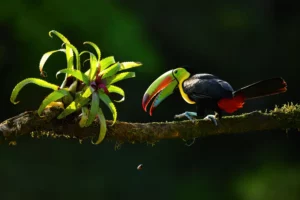
Keel-billed Toucan
Scientific name: Ramphastos sulfuratus Range: Lowland rainforest (La Selva, Caribbean slope) Best viewing: Year-round Success rate with guide: 90%+ Difficulty level: Easy (canopy fruiting trees) Photography rating: 9/10 (massive bill, colorful)
Why they matter: Impossibly large, colorful bill makes them instantly recognizable. Canopy birds but often visible from below. Popular in tourism (Peace Lodge aviaries) but nothing compares to wild sightings.
Field marks:
- Black plumage overall
- Massive, multicolored bill (lime, orange, red, black)
- Yellow orbital skin
- Groups and individuals gather at fruiting trees
Where to see:
- La Selva Biological Station & Caribbean Lowlands
- Selva Verde Lodge (connected forest)
- Arenal Foothills
Behavior: Fruit specialists, move in small groups. Often perch conspicuously on high branches, making them relatively easy to spot despite their large size.
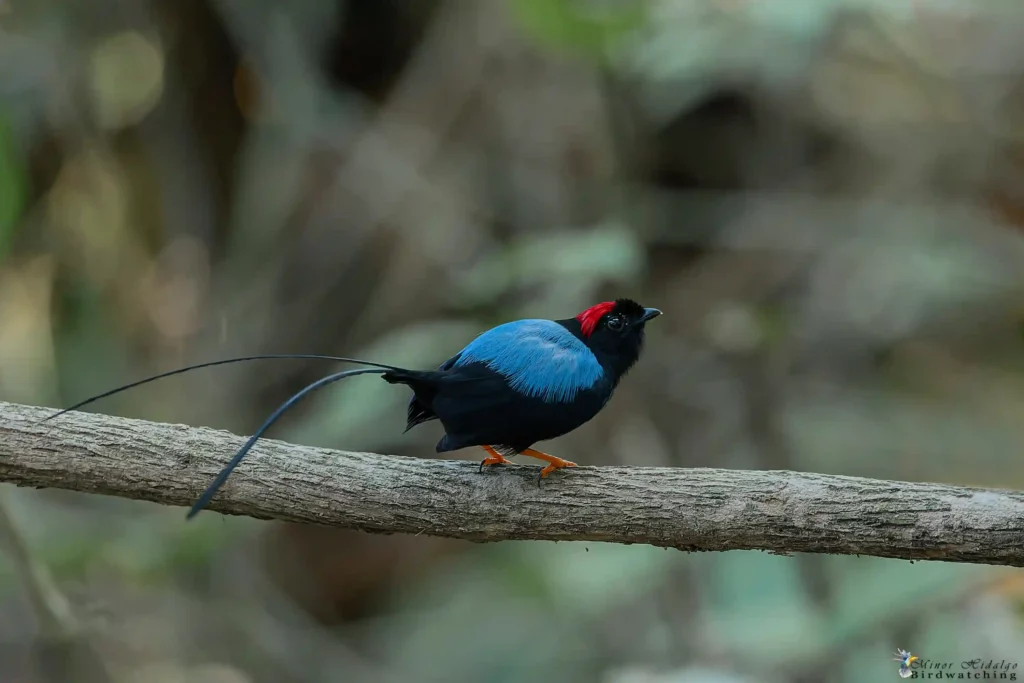
Long-tailed Manakin
Scientific name: Chiroxiphia linearis Range: Pacific slope, mid-elevation Best viewing: January–May (display season) Success rate with guide: 80%+ Difficulty level: Moderate (cryptic display locations) Photography rating: 7/10 (small, active, beautiful)
Why they matter: Males perform one of nature’s most complex, synchronized dances. Watching two males “butterfly display” together is a rare privilege.
Field marks:
- Males: Black with scarlet back, red cap
- Females: Mostly green, less striking
- Distinctive long tail filaments (tail streamers)
Display behavior: Males perform ritual dances where they:
- Flutter up and down together
- Hover backward while holding close position
- “Butterfly display” with coordinated wing beats
- Produce loud snapping sounds
Where to see:
- Monteverde area trails
- Mid-elevation Pacific slope
Best viewing: Early morning (6:00–8:00 AM) when males are most active.
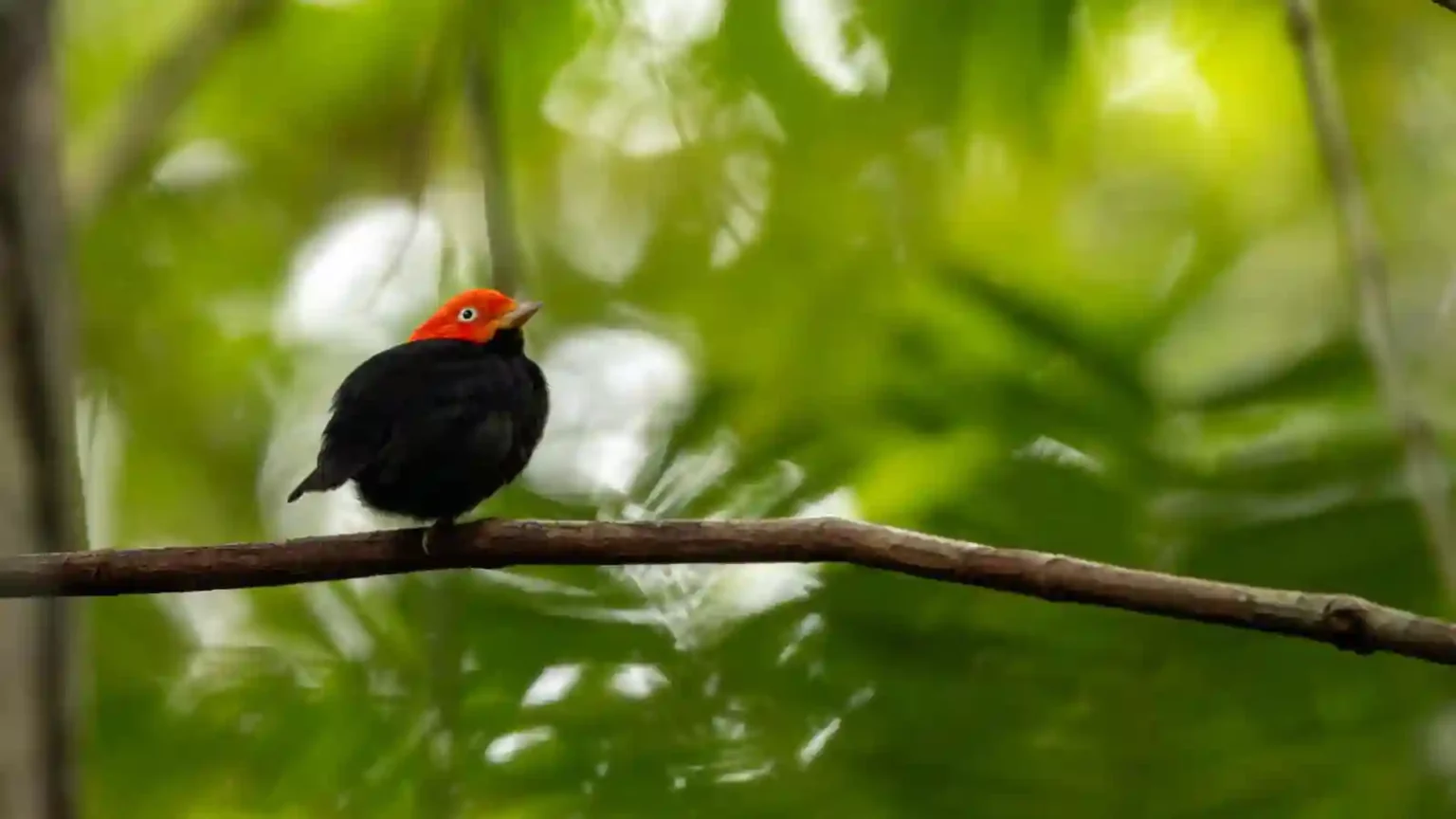
Red-Capped Manakin
Scientific name: Pipra mentalis Range: Caribbean slope, especially Santa Juana Best viewing: Year-round (best Feb–May) Success rate with guide: 90% Difficulty level: Easy to moderate Photography rating: 8/10 (colorful, accessible)
Why they matter: Nicknamed the “Michael Jackson bird” due to their famous moonwalk display. Small (3.8 inches), fruit-eating, extraordinary mating behavior.
Field marks:
- Males: Red cap, green body, yellow thighs
- Females: Green overall
- Distinctive vocalizations (snaps, buzzes)
Moonwalk display: Males literally slide backward on branches using feet while making snapping sounds, creating an unforgettable dance.
Where to see:
- Pacific Lowlands and mid-elevation forest
- Caribbean Lowlands
- Southern Pacific slope
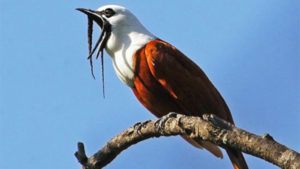
Three-Wattled Bellbird
Scientific name: Procnias tricarunculata Range: Monteverde, cloud forest Best viewing: March–July Success rate with guide: 60%+ Difficulty level: Difficult (audio-based location) Photography rating: 6/10 (cryptic but vocalizations help)
Why they matter: One of the loudest birds on Earth with a penetrating, metallic call. Hearing one is easier than seeing one.
Field marks:
- Brownish plumage overall (not showy)
- Distinctive three wattle structures hang from chest
- Male call: Loud, clear, metallic “BONK!”
Locating tips:
- Listen for distinctive call (guides are expert call imitators)
- Best during morning hours
- Scan high perches for individuals
Seasonal Birding Calendar
January to March Is Dry Season on the Pacific Coast, Prime months for Birding There
Why: For Pacific species from Guanacaste in the north, to the Osa Peninsula in the south this is the period with the least amount of rainfall. Sunny skies are the norm, with occasional showers possible as well.
Peak species:
- Scarlet Macaws: Flocks at Carara, Osa
- Migrant warblers: Still present
- Resplendent Quetzal: Nesting Season
Best regions: Carara, Osa Peninsula, Palo Verde, Southern Zone
Tour recommendation: 8 –12 days covering Pacific slope + wetlands
Advantages:
- Most reliable dry weather for Pacific species
- Easiest hiking conditions – less rain, dry trails
- Escape Northern Hemisphere winters
April to May Is Peak Migration and Breeding Season
Why: Spring migrants flowing north from South America overlap with breeding season species. The transition of seasons in Costa Rica creates budding flowers, green landscapes, and fruiting trees.
Peak species:
- Resplendent Quetzal: Still in the nesting season
- Long-tailed Manakins: Active displays (April–May)
- Spring migrants: Warblers, tanagers, flycatchers
- Breeding behaviors: Drumming woodpeckers, singing males everywhere
Best regions: San Gerardo de Dota (Quetzal), mid-elevations (migrants), Caribbean Lowlands (migration corridor)
Tour recommendation: Bird Watching and Photography is excellent throughout the country. A great time to combine Pacific and Caribbean locations.
Unique advantage: Double birding opportunity—both resident breeders + passing migrants
June to August Is Transition Season on the Pacific side; Showing Consistency on the Caribbean side
Why: Rain begins on the Pacific side of the country and creates lush vegetation and fruit production. Fewer tourists = more guide and lodge availability + low season prices.
Peak species:
- Breeding birds: Chicks being fed, adult behaviors obvious
- Hummingbirds: Peak flowering and activity
- Resident species: Most active of year
- Caño Negro birds: Water levels high; maximum populations
Best regions: The entire country is excellent for birding from June – August. While the Pacific will start receiving more rain, showers are short and sunshine replaces clouds rapidly. The Caribbean side remains consistent with average rainfall amounts not changing much.
Tour recommendation: Pacific + Caribbean combination
Advantages:
- Lower prices: Low season prices are active
- Fewer crowds: More personal guide availability and space at lodges
- Lush vegetation: Rain creates food, and food draws birds
- Water levels peak: Best for wetland birding
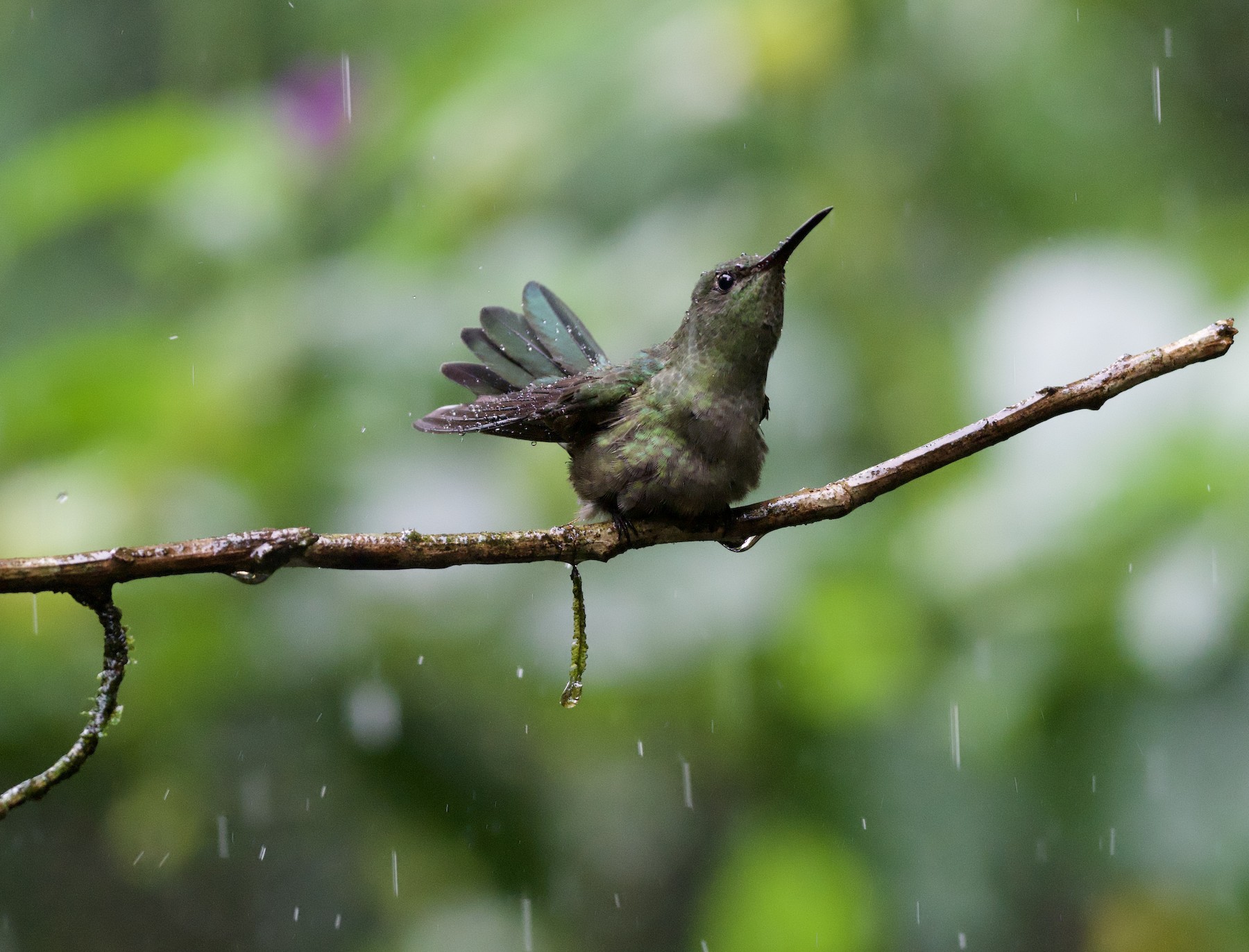
Challenge: Rain can make trails muddy, but after showers, birds come out to dry their feathers making viewing and photography exceptional
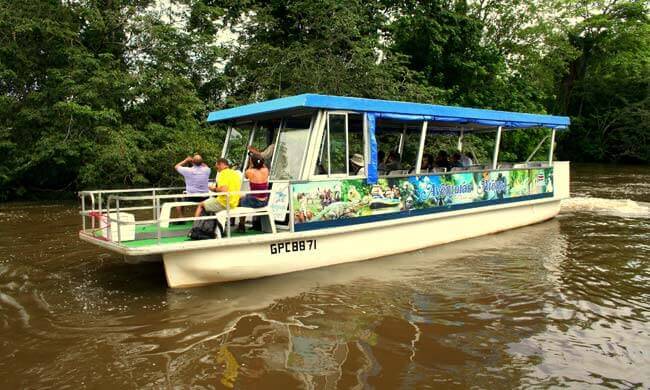
September to October: Rainy season on the Pacific side, driest months for the Caribbean and Fall Migration begins
Why: Migrants heading south from North America. Second wave of diversity. Less pronounced than spring but still significant. Raptor migration over the Caribbean coast of Costa Rica.
Peak species:
- Fall migrants: Different species composition than spring
- Southern migrant departure: Some residents moving downslope
- Late breeding: Second broods being fed
Best regions: Caribbean lowlands and mid-elevation. Tortuguero.
Tour recommendation: 8 – 12 days capturing migration wave, and tailored trip plan to take advantage of best weather conditions.

November to December: Post-Migration, Beginning of Dry Season
Why: Migration complete; birds settling into wintering territories. The weather begins to improve on the Pacific side of the country.
Peak species:
- Wintering migrants: North American warblers now in place for winter
- Resident species: Fully established in territories
- Beginning of dry-season fruiting: Early fruit trees attracting flocks
Best regions: November and December are prolific months in Costa Rica. The entire country is alive with activity. Rains are dissipating in the Pacific and the Caribbean remains consistent with bird activity.
Tour recommendation: If you want to arrive in November, visit Caribbean locations first and save the Pacific locations for late November and early December to take advantage of the best weather.
Advantages:
- Transition weather (increasingly dry as month progresses on the Pacific)
- Species diversity from migration + residents
- Visit before the holiday season.
Planning Your Costa Rica Birding Trip
Step 1: Choose Your Ideal Season
Quick decision matrix:
|
Goal |
Best Season |
Why |
Price |
|---|---|---|---|
|
Resplendent Quetzal |
January–mid-May |
Peak breeding, 97% sighting rate |
Higher |
|
Maximum species (Big Year) |
March–May |
Migrants + breeders |
Higher |
|
Macaws + Variety |
January–June |
Dry-season on Pacific, food sources, , reliable weather |
Higher |
|
Budget trip |
August–October |
Low season prices, still excellent birding |
Lower |
|
Water birds |
January – May |
Lower water levels, easier viewing |
Medium |
|
Combination trip |
May–October |
Moderate prices, migration diversity |
Lower |
Step 2. Critical Planning Choice: Work With Local Birding Experts
One of the most important and often overlooked decisions when planning a Costa Rica birding trip is how you plan it.
Costa Rica’s bird diversity is extraordinary, but it is also highly regional, seasonal, and logistically complex. Road conditions, park access hours, boat schedules, weather patterns, and even bird behavior change dramatically by month and by region. Online research alone rarely captures these nuances.
For most travelers, the most reliable way to maximize bird sightings, reduce logistical stress, and support conservation is to work with a local, in-country birding travel agency or specialist.
Why Local Expertise Matters
Local birding specialists don’t just book hotels and guides, they interpret the country in real time.
They bring:
- Up-to-date field knowledge (recent nest activity, fruiting trees, changing access rules)
- Realistic drive-time planning (avoiding exhausting routes that look “short” on maps)
- Seasonally adjusted itineraries based on rainfall patterns and bird movement
- Established relationships with top guides, lodges, and reserves
- On-the-ground problem solving if weather, health, or logistics change mid-trip
This kind of insight is nearly impossible to replicate from abroad, especially for first-time visitors.
Sustainability & Community Impact
Choosing a locally based travel company also has a direct impact on conservation and community livelihoods.
Local agencies:
- Reinvest tourism dollars within Costa Rica
- Prioritize locally owned lodges and reserves
- Support professional birding guides as full-time careers
- Encourage responsible access to sensitive habitats
Why “DIY” Planning can fall short
Costa Rica may look small on a map, but it is not a simple destination.
Common pitfalls of self-planned birding trips include:
- Overambitious itineraries with long drives, less time in the field
- Lodges chosen for reputation rather than seasonal bird activity
- Staying on the wrong side of the country for optimal weather
- Difficulty resolving issues once in-country without local support
Even experienced international birders often find that a locally guided plan results in more species, better photography opportunities, and a far smoother experience.
The Best Approach for Most Birders
For most travelers, the strongest results come from a collaborative approach:
- Use a local birding travel specialist to design the itinerary, handle logistics, and select guides
- Spend time in the field with professional birding guides
- Focus your energy on birding, not navigation, schedules, or contingency planning
This approach consistently produces higher sighting rates, better pacing, and a more rewarding overall experience.
Step 3: Hire a guide who aligns with your goals
Why it matters: Birding success depends on strategy and skill. Guides who specialize in birding and photography recognize vocalizations, track seasonal movements, understand behavior, and adjust routes based on conditions. When a guide’s expertise aligns with your goals, sighting rates and photographic opportunities increase substantially compared to birding on your own.
Guide certifications to verify:
✓ Official naturalist certification (Costa Rica’s system)
✓ Years of local experience (5+ years preferred)
✓ Species specialization to match your target list
✓ Multiple language capability
What expert guides provide:
- Call mimicry to bring hidden birds closer
- Real-time species identification including field marks
- Behavioral insights (what birds do, why)
- Safe trail navigation
- Photography composition advice
Comparing guides:
- Lodge-affiliated guides: Familiar with their area, good value
- Independent guides: Offer flexibility, scheduled sessions, local knowledge
- Private Professional Guides: Consistent quality, well-rounded, experts in flora & fauna
Guide price comparison:
- Budget: $50–70/day (often naturalists, not always birding experts)
- Standard: $60–150/day (generally solid knowledge in specific areas of the country)
- Premium: $150–250+/day (Professional birding or photography specialist )
Step 4: What to Bring: Essential Birding Gear
Binoculars (most important equipment):
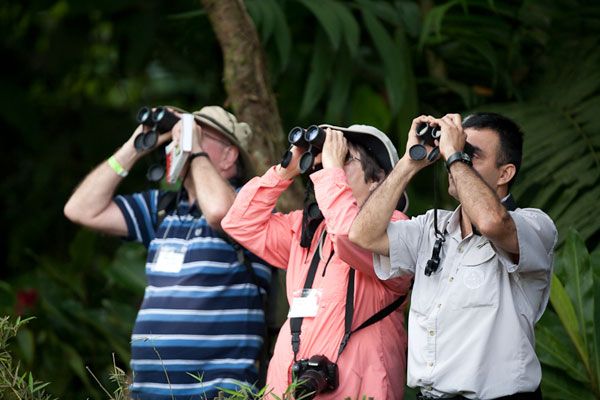
- Recommended specs: 8 x 30, 8×42 or 10 x 30 , 10×42 magnification
- Why: 8× easier to hold steady; 42mm objective provides good light gathering
- Budget range: $300–$4,800 USD
- Loan availability: Most lodges do not provide loaners, bring your own.
Camera for photography:
- Phone option: Modern smartphones (iPhone 15, Samsung S24) adequate for documentation
- Serious photography: DSLR or mirrorless with 200–400mm telephoto lens
- Stabilization: Monopod or tripod for canopy birds
- Shutter speed: 1/2000 minimum for flying birds
Field guide or app:
- Option 1: The Birds of Costa Rica: A Field Guide – Richard Garrigues
- Option 2: Merlin Bird ID app (free, reference recordings)
- Option 3: Birds of Costa Rica – Steven N.G. Howell
Clothing & footwear:
- Raincoat: Lightweight, packable (rain expected year-round)
- Moisture-wicking shirts: Cotton absorbs sweat, promotes fungal growth
- Hiking boots: Waterproof, good ankle support on muddy trails, closed toe only
- Rubber boots: If you’re coming in rainy season
- Insect protection: Hat, long sleeves (particularly cloud forest)
Other essentials:
✓ Notebook (field notes increase learning)
✓ Sunscreen (equatorial intensity)
✓ Water bottles (2+ liters daily)
✓ Head lamp for pre-dawn starts
✓ Backup batteries (humidity can drain them)
Step 5: Select Your Lodging Strategy
Birding-focused lodges vs. standard hotels
Premium Birding Lodges ($250–500+/night)
These lodges are chosen primarily for location and habitat access, not just amenities.
- Situated directly within or adjacent to top birding habitats
- Designed with bird activity in mind (trails, feeders, gardens, viewpoints)
- Meals often included, simplifying logistics in remote areas
- Early-morning and late-afternoon birding possible without long transfers
Examples: Rancho Naturalista, Selva Verde Lodge, Savegre Lodge, Corcovado Wilderness Lodge
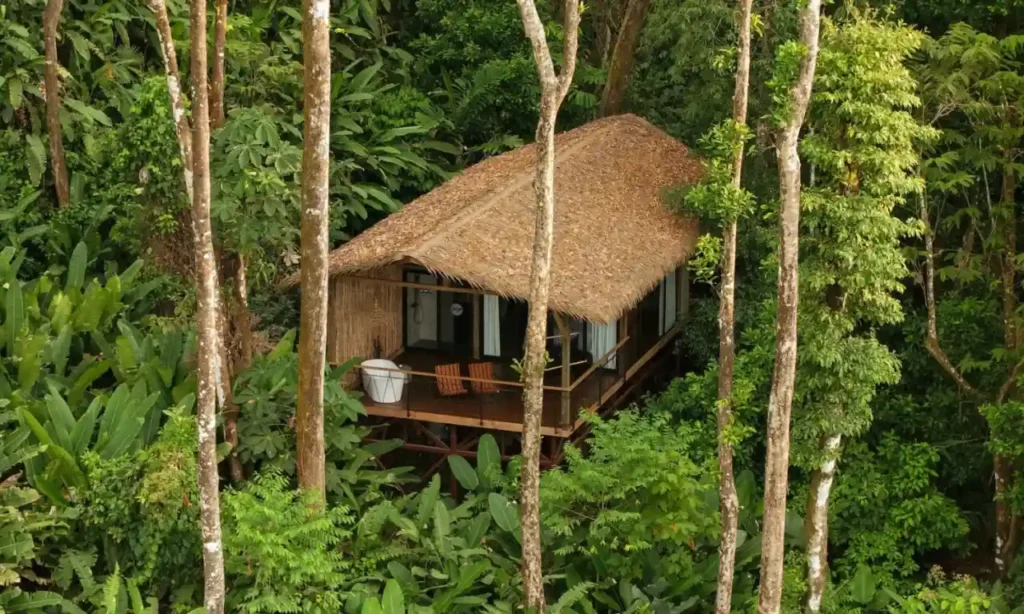
Standard Hotels in Birding Regions ($150–250/night)
Often located near excellent reserves and birding routes, offering strong value and flexibility.
- Comfortable bases close to key birding sites
- Greater choice in room style, dining, and pacing
- Easy to pair with private, independent birding guides
- Well suited for travelers mixing birding with culture or photography
Examples: Hotel Bougainvillea, Cerro Lodge, Trapp Family Lodge, Hacienda Guachepelin
Budget Lodges & Small Inns (Under $150/night)
Best for experienced travelers who prioritize time in the field over amenities.
- Simple accommodations with basic services
- Located near secondary habitats or access roads
- Can still deliver excellent birding when paired with the right guide
- Great for visitors not looking for amenities or extras
Examples: La Selva Biological Station, Las Cruces Biological Station
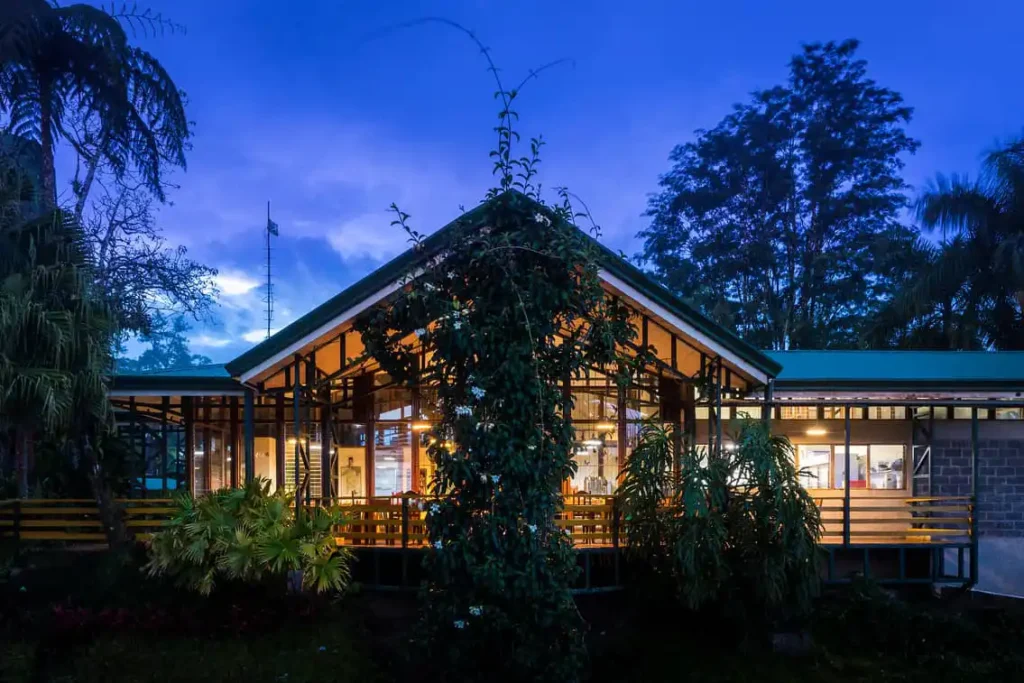
Recommended Approach
There is no single “right” lodging strategy, the best choice depends on your priorities.
If comfort, ambiance, and on-site amenities are important to you, premium birding lodges offer a polished experience in exceptional locations and simplify logistics, especially in remote areas.
If you are budget-minded but still want strong birding access, standard hotels in proven birding regions can be an excellent choice, particularly when paired with a knowledgeable guide who knows how to work the surrounding habitats.
If price point is the primary factor, smaller lodges and simple accommodations can still deliver rewarding birding, especially for experienced travelers who spend most of their day in the field.
Many travelers find that a mixed approach works best, combining a few nights at premium, habitat-rich lodges with standard hotels elsewhere allows you to balance comfort, location, and cost without sacrificing the quality of the birding experience.
Step 6: Create Your Itinerary
Example 10-day “Grand Tour” itinerary:
| Day | Location | Target Species | Activity |
|---|---|---|---|
| 1 | Arrive San Jose | Orientation | Transfer to Monteverde |
| 2 | Central Pacific | Scarlet Macaw | Carara N.P. |
| 3 | Central Pacific | Transition species | Tarcoles River Estuary |
| 4 | Central Pacific → Osa | Aracaris, Cotinga | Drive to Sierpe, boat to the Osa |
| 5 | Osa/ Corcovado | Pacific Lowland species | Early morning hike, Corcovado |
| 6 | Osa/ Cordovado | Macaws, Parrots, monkeys | Birding and wildlife viewing |
| 7 | Osa → Talamanca Highlands | Hummingbirds, endemics | Hummingbird feeders and gardens |
| 8 | San Gerardo de Dota | Resplendent Quetzal | Quetzal viewing |
| 9 | San Gerardo de Dota → Cachi | Mid-elevation Hummingbirds | Local hotspots, feeding stations |
| 10 | A.M. in Cachi, P.M. return to San Jose | Tanagers | Gardens and birding en route |
Total species possible: 200–250 (depending on guide skill, weather)
Step 7: Budget Planning
Typical daily costs:
| Item | Budget | Standard | Premium |
|---|---|---|---|
| Accommodation | Under $150 | $150-250 | $350–500+ |
| Guide (daily) | $50–70 | $80–150 | $150+ |
| Meals (B/L/D) | $25–40 | $40–70 | $75–100 |
| Park fees | $15–30 | $25–40 | $45–80 |
| Transport | $300-$500 | $500-$800 | $800-$1500 |
Approximate 10-day trip cost per person:
- Budget: starting at $2,600
- Standard: starting at $3,500
- Premium: starting at $5,800
Money-saving tips:
- Travel May–October (up to 25% lower lodge prices)
- Join group tours (shared guide and transportation costs)
- Ask your friends to join you. Four travelers vs two dramatically cuts down the per person cost.
Do I need a birding guide?
Absolutely, yes, especially if you’re serious. Guides:
– Recognize bird calls (how 40% of birds are located)
– Spot camouflaged species others miss
– Provide species identification and field marks
– Improve experience with ecological knowledge
– Increase sighting rates 300%+ vs. independent birding
All birders benefit from guide expertise.
Where are the best hummingbirds?
Different species in different zones, but hummingbirds can be seen everywhere in Costa Rica.
– Cloud forest (Monteverde, San Gerardo): Violet Sabrewings, White-Throated Mountain Gem, Lesser Violetear, Purple Throated Mountain Gem (1,200–1,700m)
– Mid-elevation gardens: Snowcap, White-necked Jacobin, Rufous Tailed, Garden Emerald (800–1,200m)
– Lowland Caribbean: Bronze Tailed, Violet Headed, Long-tailed Hermit, Little Hermit, Band-Tailed Barbthroat(100–400m)
– Highest reliability: Hummingbird gardens at lodges like Rancho Naturalista, Quetzal Paradise Lodge, and Quelitales Lodge
Mornings (6:00–9:00 AM) and late afternoon (3:00 – 5:00 PM) offer the best hummingbird activity.
Which region has the most bird species?
Caribbean lowland forests (La Selva Biological Station area) record the highest total species, 450+. However, Monteverde cloud forest shows the highest concentration in a small area (400 species in a single reserve). Pacific lowland rainforests (Osa, Corcovado) provide the greatest endemic diversity.
Can beginners enjoy Costa Rican birding?
Absolutely. Costa Rica is ideal for beginners because:
– Species are abundant and visible (not requiring advanced spotting skills)
– Guides do the heavy lifting
– Common birds are spectacular (beginners see amazing birds immediately)
– Multiple habitat types mean variety (not just one environment)
Pro tip: Study field guide photos before trip; recognition improves enjoyment.
What about private tours vs. group tours?
– Private tours: Flexible pace, guide focused on your interests, higher cost
– Group tours: Shared costs, meet other birders, social experience
Both effective; choice depend on budget and social preference.
How much experience should I have?
Costa Rica welcomes all levels:
– Beginners: Abundant common birds, professional guides make it easy
– Intermediate: Challenge yourself with field identification
– Expert: Test yourself against 930 species; guides help find rarities
About Costa Rica Focus: Your Birding Expert Team
Costa Rica Focus team has been facilitating transformational birding experiences for almost 10 years. . Our expert naturalist guides combine deep field knowledge with passion for sharing Costa Rica’s avifauna.
Our guides:
- Certified naturalists with 15–25+ years field experience
- Specialize in specific bird families and regions
- Fluent in English, Spanish
- Photography composition expertise
- Conservation knowledge and commitment
Start Your Costa Rican Birding Adventure
Questions about planning your trip? Contact Our Birding Specialists
Browse our packages: Costa Rica Birding Tours
Download our resources:
The Complete Costa Rica Birding Guide 2026
Get a Free Quote
See Most Recent Posts
Birding in Costa Rica in May: Weather, Bird Activity, and
May is a strong month for birding in Costa Rica — breeding activity, soft photography light, quiet reserves, and better…

From 50 Lifers to Life long Memories
A family birding trip through Caño Negro, Sarapiquí, and Savegre logged 51 lifers and 257 species in 12 days —…

Planning Your First Birding Trip to Costa Rica: What You
If you’re planning your first birding trip to Costa Rica, you’re in for something special. With over 930 recorded species…