
White-vented Euphonia
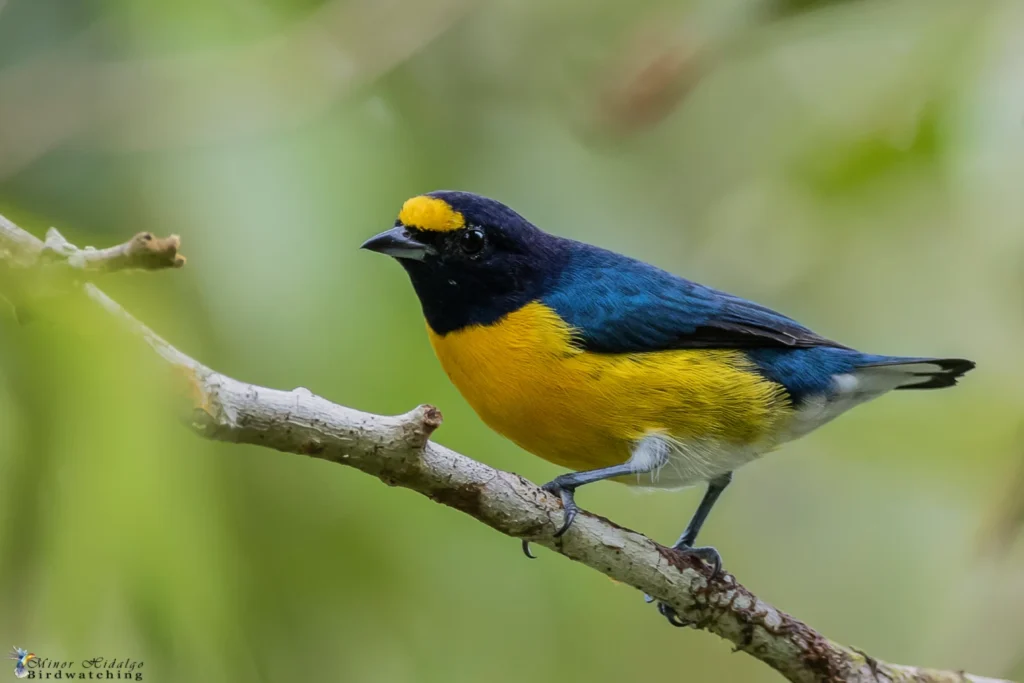
The White-vented Euphonia is a small, colorful tanager found in humid forests and woodland edges from southern Mexico to Panama, with males displaying glossy blue-black upperparts and bright yellow underparts with distinctive white undertail coverts, often seen in pairs or small groups feeding on mistletoe berries and small fruits in the canopy.

Euphonia minuta
Scientific Name
Fringillidae (Finches, Euphonias, and Allies) - formerly placed in Thraupidae
Family
Passeriformes
Order
E. m. humilis
Subspecies. Costa Rica and Panama
Range and Habitat of White-vented Euphonia
Geographic Range
The White-vented Euphonia ranges from eastern Guatemala and Belize through Central America to South America, including Colombia, Venezuela, the Guianas, Ecuador, Peru, Bolivia, and Amazonian Brazil.
Migratory Patterns
The species is non-migratory but shows local movements following fruiting mistletoe and other food sources. Some seasonal movements occur between forest types depending on fruit availability. Flocks may wander widely during non-breeding season.
Preferred Habitat
The White-vented Euphonia inhabits humid forest canopy and edges, secondary growth with fruiting trees, forest clearings with scattered trees bearing mistletoe, gardens and plantations with appropriate food plants, and riparian forests. It shows strong preference for areas with abundant mistletoe and other epiphytic plants.
Altitude Range
This is primarily a lowland species. In Costa Rica, it occurs from sea level to 1,200 m elevation, most commonly below 700 m. Occasionally recorded up to 1,500 m following fruiting events.
Costa Rica Habitat
In Costa Rica, the species occurs primarily on the Caribbean slope from the lowlands to middle elevations. It is found throughout the Caribbean lowlands from the Nicaraguan border southward, including the Sarapiquí region, La Selva area, Tortuguero, and Limón province. On the Pacific slope, it occurs locally in the Golfo Dulce region and Osa Peninsula. The species is expanding its range on the Pacific slope.
Conservation Status
Least Concern
Conservation Status
Population Status
Costa Rican populations appear healthy and may be expanding on the Pacific slope. Density varies with mistletoe abundance, typically 10-20 individuals per km² in suitable habitat.
Deforestation reduces both nesting habitat and mistletoe host trees. Complete forest clearing eliminates the species locally.
Conservation efforts
The White-vented Euphonia is protected in numerous Costa Rican parks and reserves.
Primary Threats
Deforestation reduces both nesting habitat and mistletoe host trees. Complete forest clearing eliminates the species locally.
White-vented Euphonia Identification
How to Identify the Species
Rarity Level:
CommonBest Viewing Times:
Early Morning (Dawn - 8 AM)
Size
The White-vented Euphonia is the smallest euphonia in Costa Rica, measuring only 9-9.5 cm in total length. Males weigh 9-11 g while females weigh 8-10 g.
Plumage
Adult males display glossy blue-black upperparts including the crown, back, wings, and tail. The forehead shows a distinctive yellow-orange patch extending to just above the eyes. The diagnostic feature is the white undertail coverts (vent), unique among Costa Rican euphonias. Adult females are olive-green above and yellowish-green below, paler on the belly.
Distinctive Features
The white vent distinguishes both sexes from all other euphonias. The tiny size is also diagnostic, being noticeably smaller than other euphonia species. Males’ limited yellow forehead patch differs from more extensive yellow crowns of other species.
Sexual Dimorphism
This species shows strong sexual dimorphism. Males are strikingly patterned with blue-black and yellow, while females are plain olive and yellowish. Both sexes share the diagnostic white undertail coverts.
Diet and Feeding Behavior
Primary Diet
- The White-vented Euphonia specializes in small fruits, particularly mistletoe berries. During breeding season, the diet includes more insects, especially for feeding young. Small spiders and larvae are gleaned from leaves and bark.
Foraging Techniques
- This euphonia typically forages in small flocks, often with other euphonia species. It plucks fruits while perched, reaching acrobatically when necessary. The bird swallows mistletoe berries whole, passing seeds intact for dispersal.
Feeding Times
- Peak feeding occurs in early morning from 6:00-9:00 and late afternoon from 15:00-17:30. Flocks move between fruiting trees throughout the day. Activity increases when preferred mistletoes are fruiting.
Behavior Patterns
White-vented Euphonia
Social Structure
These euphonias are highly social, usually found in pairs or small flocks of 4-10 individuals. During non-breeding season, they join mixed-species flocks with other euphonias, tanagers, and honeycreepers. Pairs maintain close contact year-round within flocks.
Song and Vocalization
Males produce a varied song of musical chips, twitters, and warbles, often incorporating mimicked calls of other species. The typical call is a soft “chip-chip” or “dee-dee” contact note. Flocks maintain contact with constant soft calling.
Courtship and Mating Ritual
Males sing persistently from prominent perches to attract females. Courtship feeding is common, with males offering fruits to females. Pairs perform mutual preening to strengthen bonds.
Territoriality
During breeding season, pairs defend small territories around nest sites but continue feeding socially.
Birdwatching Tips
Best Locations for Spotting White-vented Euphonia
Prime sites include La Selva Biological Station canopy tower and trails, Cope Arte trail near Guápiles, Selva Verde Lodge gardens and forest edges, Tortuguero National Park lodge grounds, Sarapiquí region forest edges with mistletoe, Puerto Viejo area gardens, La Tirimbina Rainforest Center, and any Caribbean slope location with fruiting mistletoe.
Best Time of the Year
Best observed year-round, with peak activity during breeding season (April-June). Easier to find when mistletoes are fruiting heavily.
Common Behavior
Look for small flocks in fruiting trees, especially those with mistletoe. Listen for soft contact calls of foraging flocks. Check forest edges and clearings with isolated trees. Often feeds high in canopy, making observation challenging.
Recommended Gear
Essential equipment includes 8×42 or 10×42 binoculars for canopy observation, a spotting scope useful for high perches.
Breeding and Nesting Behavior
Breeding Season
Breeding occurs primarily from March to August, with peak activity April-June during the height of the wet season when insects are abundant.
Nesting Sites
The nest is a globular structure with a side entrance, typical of euphonias. It measures 10-12 cm in diameter, constructed of moss, rootlets, and plant fibers. Nests are typically placed 3-10 meters high in tree forks, often concealed among epiphytes or mistletoe clumps.
Clutch Size
3-4 eggs, typically 3
Incubation Period
12-14 days
Parental Care
The female alone incubates while the male feeds her. Both parents feed nestlings with insects and fruit pulp. Young fledge at 14-16 days. Post-fledging care continues for 2-3 weeks as young learn to identify appropriate fruits.
Did You Know?
Interesting Behaviors
The species can digest mistletoe berries that are toxic to many other birds. Seeds pass through the digestive system in 15-30 minutes, ensuring quick dispersal.
Cultural Significance
The name “agüío” mimics one of its call notes. In folklore, euphonias are considered harbingers of rain. The bird’s role in spreading mistletoe has both positive and negative perceptions among farmers. Its small size has earned it the nickname “pocket euphonia.”
Surprising Traits
Despite its tiny size, this euphonia can swallow mistletoe berries nearly half its bill width. Individual birds can remember fruiting tree locations across seasons. The species shows remarkable ability to find rare mistletoe species.
How do I identify this bird?
Look for the smallest euphonia with diagnostic white undertail coverts in both sexes. Males show blue-black upperparts with limited yellow-orange forehead patch and yellow underparts. Females are olive and yellowish but also show white vents. The tiny size helps distinguish it from other euphonias.
Where is the best place to see it in Costa Rica?
Caribbean slope locations with abundant mistletoe offer best chances. La Selva Biological Station is particularly reliable, especially from the canopy tower. Any forest edge with fruiting mistletoe can host foraging flocks. Listen for soft calls of feeding groups.
Is it endangered?
No, it’s listed as Least Concern with stable populations. The species’ adaptability to disturbed habitats with appropriate food plants helps maintain populations. However, complete deforestation eliminates it locally due to dependence on mistletoe and other epiphytes.