
Violet Sabrewing
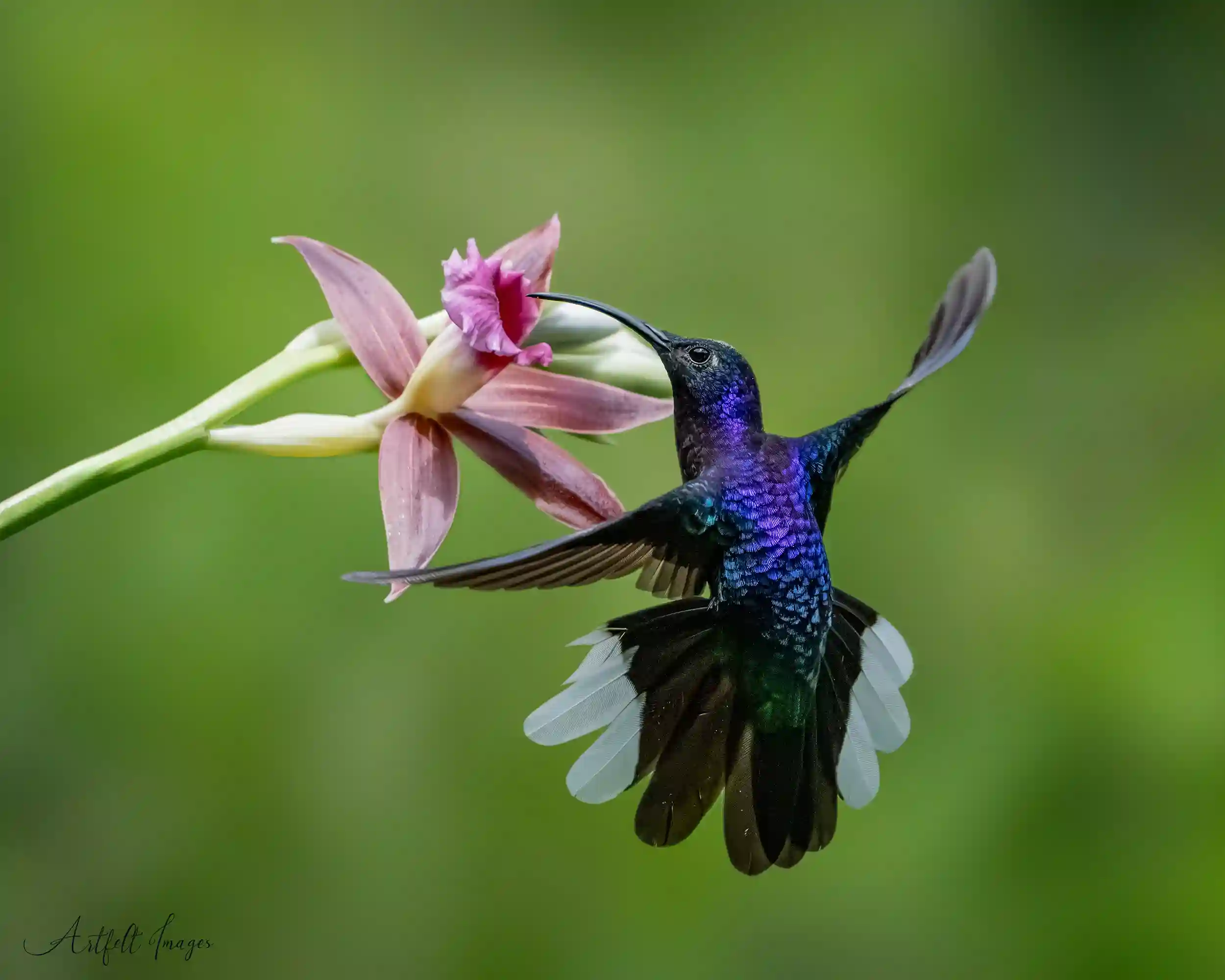
The Violet Sabrewing is a large, powerful hummingbird found in cloud forests and mountain regions from southern Mexico to Panama, with males displaying deep violet plumage and distinctive curved, saber-like outer tail feathers, known for their aggressive territorial behavior and preference for feeding at heliconias and other large flowers.
Campylopterus hemileucurus
Scientific Name
Trochilidae (Hummingbirds)
Family
Apodiformes
Order
C. h. hemileucurus
Subspecies. From southern Mexico to Nicaragua
C. h. mellitus
Subspecies. Costa Rica and western Panama
Range and Habitat of Violet Sabrewing
Geographic Range
The Violet Sabrewing ranges from southern Mexico (Oaxaca, Chiapas) through Guatemala, El Salvador (locally), Honduras, Nicaragua, Costa Rica, to western Panama.
Migratory Patterns
The species shows seasonal altitudinal migrations. It breeds at higher elevations from 1,500-2,400 m and descends to 500-1,500 m during the non-breeding season. Some individuals may remain at middle elevations year-round where food is reliable.
Preferred Habitat
The Violet Sabrewing inhabits mountain forests including cloud forest, oak forest edges, forest clearings and gaps, gardens with appropriate flowers, banana plantations at lower elevations during migration, and riparian corridors. It prefers areas with abundant understory flowers, particularly heliconias.
Altitude Range
Globally, it occurs from 500-2,800 m elevation. In Costa Rica, breeding occurs at 1,500-2,400 m, with non-breeding movements down to 500-1,500 m, occasionally as low as 300 m.
Costa Rica Habitat
In Costa Rica, the species inhabits all major mountain ranges including the Cordillera de Guanacaste, Cordillera de Tilarán, Cordillera Central, and Cordillera de Talamanca. It occurs in the provinces of Guanacaste (Volcán Miravalles, Volcán Tenorio), Alajuela (Volcán Arenal area, Monteverde), Heredia (Volcán Barva), San José (mountains), Cartago (Volcán Irazú, Tapantí), and Puntarenas (high elevations).
Conservation Status
Least Concern
Conservation Status
Population Status
The global population is considered stable and relatively large. Costa Rica maintains healthy populations in protected mountain areas.
The species faces habitat loss from deforestation in mountain areas and conversion of forest to agriculture and pasture.
Conservation efforts
The Violet Sabrewing is well-protected in Costa Rica's mountain national parks and reserves.
Primary Threats
The species faces habitat loss from deforestation in mountain areas and conversion of forest to agriculture and pasture.
Violet Sabrewing Identification
How to Identify the Species
Rarity Level:
CommonBest Viewing Times:
Early Morning (Dawn - 8 AM)
Size
The Violet Sabrewing is the largest hummingbird in Costa Rica's mountains. Length: males 13-15 cm; females 11.5-13 cm. Weight: males 9-12 g, females 6-8 g.
Plumage
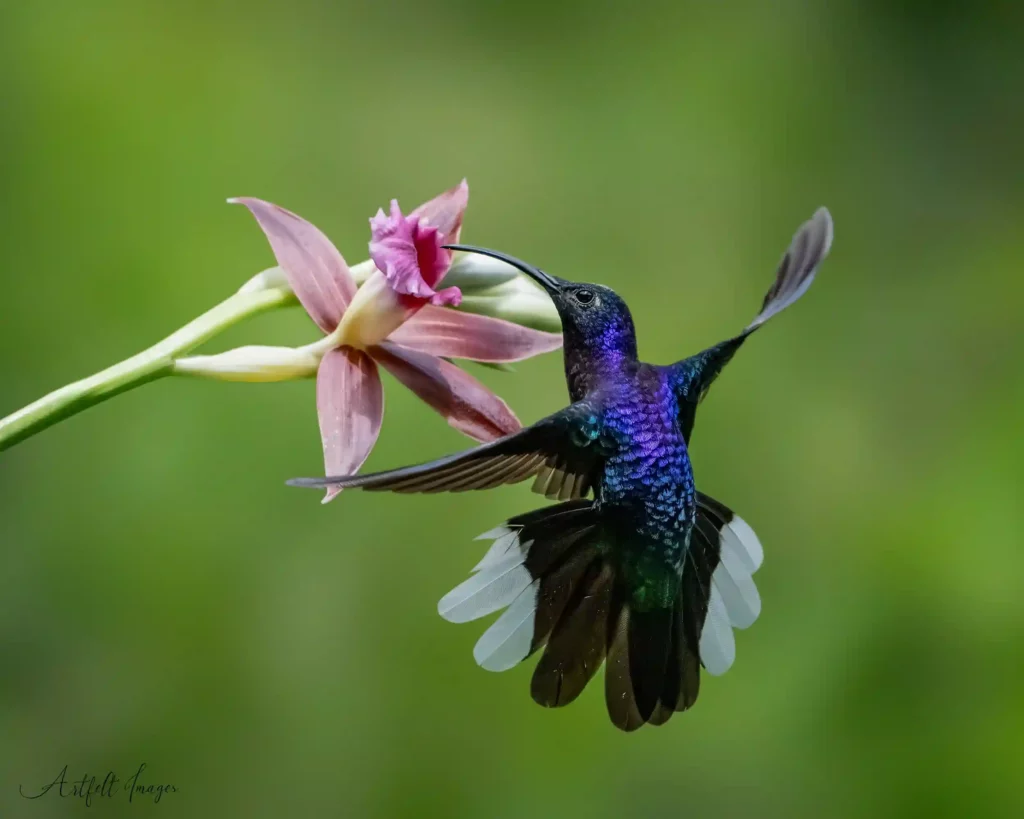
Adult males display spectacular deep violet-blue plumage covering the head, throat, upper breast, and back, with the color intensity varying with light angle. The lower breast and belly are dark bluish-green to black. Adult females are completely different, showing metallic green upperparts, gray underparts with green spotting on the flanks, and white tips on outer tail feathers. A small violet-blue patch appears behind the eye in females.
Distinctive Features
The species has a robust, slightly decurved black bill measuring 22-25 mm. The outer primary wing feathers are thickened and curved, creating the “saber” shape that gives the species its name. Males’ large size and entirely violet-blue front are unmistakable.
Sexual Dimorphism
This species shows extreme sexual dimorphism. Males are dramatically larger and display brilliant violet-blue plumage, while females are smaller with green and gray coloration. Males' bills are slightly longer and more curved than females'.
Diet and Feeding Behavior
Primary Diet
- The Violet Sabrewing feeds primarily on nectar from large flowers with high nectar production. Preferred plants include various Heliconia species, Centropogon species, passion flowers (Passiflora), banana flowers (Musa), native gingers (Costus, Renealmia), and bromeliads with tubular flowers.
Foraging Techniques
- This species employs trap-lining behavior, visiting regular flower circuits multiple times daily. Males defend productive flower patches aggressively.
Feeding Times
- Peak feeding occurs early morning from 5:30-8:00 and late afternoon from 15:00-18:00. The species feeds every 15-20 minutes throughout the day, with increased frequency during cold weather or breeding season.
Behavior Patterns
Violet Sabrewing
Social Structure
Males are highly territorial and solitary except during mating. Multiple individuals may gather at productive flower patches during migration, maintaining individual distances through threat displays.
Song and Vocalization
Males sing from exposed perches with a series of high-pitched chips and squeaks “tsip-tsip-tsee-tsee-tsip.” The call is a sharp, metallic “chip” or “tseek” given in flight.
Courtship and Mating Ritual
Males perform spectacular dive displays from heights of 10-20 meters. U-shaped flight patterns showcase the violet plumage in changing light. Males sing from regular perches within display territories.
Territoriality
Males aggressively defend feeding territories of 0.2-0.5 hectares. They use prominent perches to survey territory and chase all hummingbird intruders regardless of size. Physical combat includes mid-air collisions and bill-fencing.
Birdwatching Tips
Best Locations for Spotting Violet Sabrewing
Prime locations include:
- Monteverde Cloud Forest Reserve hummingbird gallery
- La Paz Waterfall Gardens feeders and trails
- San Gerardo de Dota valley feeders
- Savegre Mountain Lodge gardens
- Bosque de Paz Lodge
- Paraíso Quetzal Lodge
- Bajos del Toro area
- Trogon Lodge at San Gerardo de Dota
- various mountain lodges with feeders and gardens
Best Time of the Year
Best viewing occurs year-round at middle elevations. October-December offers peak breeding activity at higher elevations. May-August provides good viewing at lower elevations during altitudinal migration.
Common Behavior
Look for the largest hummingbird at mountain feeders and flowers. Males perch prominently on exposed branches when territorial. Listen for loud wing humming, especially from males. Check large red or purple tubular flowers and banana plantations during migration.
Recommended Gear
Essential equipment includes 8×42 or 10×42 binoculars with close focus ability, and a camera with fast shutter speed for flight shots.
Breeding and Nesting Behavior
Breeding Season
Breeding occurs primarily during the late wet season and early dry season. In Costa Rica, nesting spans from September to February, with peak activity October-December.
Nesting Sites
The female builds a cup nest measuring 5-6 cm in diameter externally and 3-4 cm internally. Construction materials include tree fern scales, moss, and spider silk, with the exterior decorated with lichens and moss for camouflage. Nests are typically placed 1-4 meters high on horizontal branches, often over or near streams, and frequently under overhanging leaves for weather protection.
Clutch Size
Females lay 2 white eggs measuring approximately 15 x 10 mm.
Incubation Period
17-19 days
Parental Care
The female alone builds the nest, incubates, and raises young with no male assistance. Chicks are fed regurgitated nectar and insects every 20-30 minutes. Fledging occurs at 22-25 days. Post-fledging care continues for 2-3 weeks as young learn foraging techniques.
Did You Know?
Interesting Behaviors
Males can remember individual humans and may become aggressive toward people who approach their territories too closely. Some individuals have learned to follow researchers to newly placed feeders.
Cultural Significance
The Violet Sabrewing is featured on Costa Rican currency (5,000 colones note). It appears frequently in Costa Rican nature art and photography. Indigenous names often reference the distinctive wing sound.
Surprising Traits
Despite their size, Violet Sabrewings can hover in winds that ground smaller hummingbirds. Males can be aged by the extent of violet plumage, with older males showing more extensive coloration.
How do I identify this bird?
Males are unmistakable – the largest mountain hummingbird with brilliant violet-blue head, throat, and back. Look for white tail corners and the distinctive curved “saber” wing shape. Females are green above and gray below with white tail tips. The large size distinguishes both sexes from other hummingbirds.
Where is the best place to see it in Costa Rica?
Monteverde Cloud Forest Reserve and La Paz Waterfall Gardens offer reliable, easy viewing at feeders. San Gerardo de Dota valley lodges also provide excellent opportunities. Any mountain lodge with feeders between 1,000-2,400 m elevation is likely to attract this species.
Is it endangered?
No, the Violet Sabrewing is listed as Least Concern with stable populations. It’s common in appropriate habitat and adapts well to gardens and modified habitats as long as flowering plants and some forest cover remain.