
Magenta-throated Woodstar
The Magenta-throated Woodstar is a tiny hummingbird found in the highlands of Costa Rica and western Panama, with males displaying an iridescent magenta throat patch and elongated tail feathers, typically seen hovering at flowers in forest edges, gardens, and mountain clearings at elevations between 1,200 and 2,500 meters.

Philodice bryantae
Scientific Name
Trochilidae (Hummingbirds)
Family
Apodiformes
Order
Range and Habitat of Magenta-throated Woodstar
Geographic Range
The Magenta-throated Woodstar is endemic to the highlands of Costa Rica and extreme western Panama (Chiriquí Province).
Migratory Patterns
This species shows seasonal altitudinal movements. It breeds at higher elevations from 1,500-2,800 m and descends to 800-1,500 m during the non-breeding season (September-December).
Preferred Habitat
The Magenta-throated Woodstar inhabits forest edges, clearings, gardens, páramo edges, coffee plantations with shade trees, scrubby pastures with flowering plants, and areas with abundant flowering shrubs and herbs.
Altitude Range
Globally and in Costa Rica, the species ranges from 800-3,000 m elevation. It is most common at 1,500-2,400 m during breeding season and 800-1,500 m in non-breeding season.
Costa Rica Habitat
In Costa Rica, the species inhabits the Central Mountain Range and Talamanca Mountain Range. It occurs in the provinces of Alajuela (eastern highlands), Heredia (upper elevations), San José (mountain areas), Cartago (throughout highlands), Puntarenas (high elevation areas only), and western Limón (mountain slopes).
Conservation Status
Least Concern
Conservation Status
Population Status
Costa Rica contains the majority of the global population. Population trends appear stable in protected areas.
The species faces habitat loss from deforestation in highland areas and conversion of forest edges to intensive agriculture.
Conservation efforts
The Magenta-throated Woodstar is well-protected in Costa Rica's mountain national parks.
Primary Threats
The species faces habitat loss from deforestation in highland areas and conversion of forest edges to intensive agriculture.
Magenta-throated Woodstar Identification
How to Identify the Species
Rarity Level:
CommonBest Viewing Times:
Early Morning (Dawn - 8 AM)
Size
Length 9-10 cm; Weight 2.5-3.2 g
Plumage
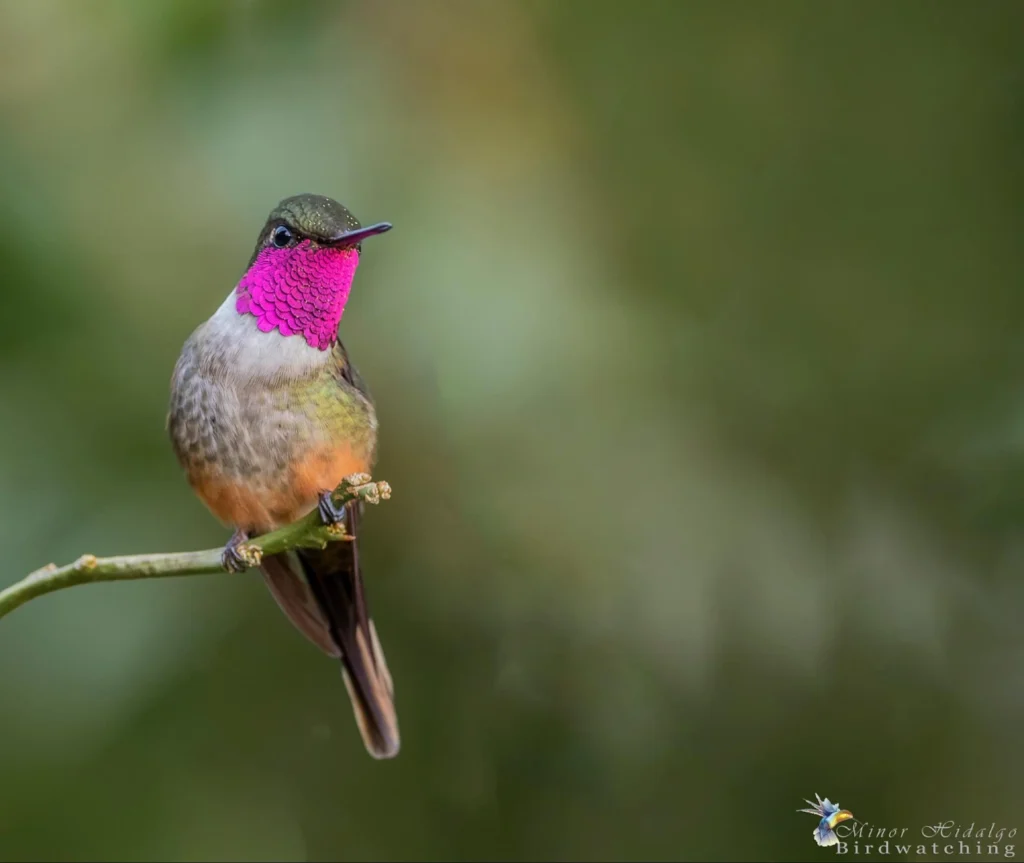
Adult males display bronzy-green upperparts with a glittering green crown. The gorget (throat patch) is brilliant magenta-purple with a violet-blue lower border, appearing black in poor light. The tail is long and deeply forked with white tips on outer feathers.
Distinctive Features
The species has a straight, needle-like black bill measuring 13-15 mm in males and 14-16 mm in females.
Sexual Dimorphism
This species exhibits extreme sexual dimorphism. Males have the brilliant magenta gorget, deeply forked tail, and are slightly larger. Females lack colorful throat patches, have shorter, less forked tails, and show buff-cinnamon coloring on the underparts.
Diet and Feeding Behavior
Primary Diet
- This hummingbird feeds primarily on nectar from small flowers. Their diet is supplemented with tiny insects and spiders, particularly gnats, aphids, and fruit flies.
Foraging Techniques
- The Magenta-throated Woodstar employs trap-lining behavior, visiting regular flower circuits. It hovers at small flowers that cannot support its weight and occasionally perches while feeding at larger flower clusters.
Feeding Times
- Peak feeding occurs in early morning from 5:30-8:00 and late afternoon from 15:00-17:30. The bird feeds frequently throughout the day due to high metabolic demands, visiting flowers every 10-15 minutes.
Behavior Patterns
Magenta-throated Woodstar
Social Structure
Males are highly territorial and solitary except during mating. Females are solitary while nesting but may feed in loose aggregations at flower patches.
Song and Vocalization
Males produce a thin, high-pitched “tsip-tsip-tsip” song from exposed perches. The call consists of sharp “chip” or “tik” notes given in flight.
Courtship and Mating Ritual
Males perform spectacular U-shaped dive displays, climbing 10-15 meters then diving past perched females. The gorget display involves hovering in front of females with gorget fully expanded and glittering.
Territoriality
Males aggressively defend flowering patches ranging from 100-400 m². They use prominent perches to survey territories and chase all intruders including larger hummingbird species. Females defend nest sites but are less aggressive at flowers. Territory boundaries shift with flowering phenology.
Birdwatching Tips
Best Locations for Spotting Magenta-throated Woodstar
Prime locations include:
- Cerro de la Muerte area along Route 2 (KM 80-95)
- Savegre Mountain Lodge gardens and trails
- Paraíso Quetzal Lodge feeders and gardens
- San Gerardo de Dota valley
- Irazú Volcano National Park visitor center area
- Villa Mills and surrounding habitat
- Los Quetzales National Park,
- Trogon Lodge gardens
Best Time of the Year
Best viewing occurs from November to February during peak breeding season when males are displaying. Early morning hours from 6:00-9:00 offer highest activity levels.
Common Behavior
Look for tiny hummingbirds at small roadside flowers, particularly composites. Males perch prominently on exposed twigs at territory edges. Check gardens with salvias and other tubular flowers.
Recommended Gear
Essential equipment includes 8×42 or 10×42 binoculars with close focus capability, a camera with telephoto lens and good autofocus for these fast-moving subjects.
Breeding and Nesting Behavior
Breeding Season
In Costa Rica, peak nesting activity spans November to January during the dry season when flowers are abundant.
Nesting Sites
The tiny cup nest measures only 2.5-3 cm in diameter externally and 1.5-2 cm internally. It is constructed of tree fern scales, moss, and plant down, bound with spider silk and decorated externally with lichens for camouflage. Nests are typically placed on thin horizontal twigs 1-4 meters above ground, often over or near water.
Clutch Size
2 eggs
Incubation Period
15-17 days
Parental Care
The female alone builds the nest, incubates, and raises young. Chicks are fed regurgitated insects and nectar every 20-30 minutes. Fledging occurs at 20-23 days. Post-fledging care continues for 10-14 days as young learn to forage.
Did You Know?
Interesting Behaviors
Males can beat their wings up to 80 times per second during display flights. The species enters torpor on cold nights, dropping body temperature to conserve energy.
Cultural Significance
The species appears on Costa Rican postage stamps celebrating endemic birds. Its Spanish name “chispita” (little spark) refers to the glittering gorget. The bird is featured in indigenous Cabécar stories about the origin of fire.
Surprising Traits
Despite weighing less than a penny, males fearlessly chase birds many times their size. The heart rate can exceed 1,200 beats per minute during flight.
How do I identify this bird?
Males are unmistakable with their brilliant magenta-purple gorget, deeply forked tail, and tiny size. Females are trickier, showing buff underparts with green spots, a short tail with cinnamon tips, and a white spot behind the eye. This is one of the smallest hummingbirds you’ll see in Costa Rica’s mountains.
Where is the best place to see it in Costa Rica?
The gardens at Savegre Mountain Lodge and Paraíso Quetzal Lodge offer excellent, reliable viewing, especially at feeders and flowering plants. The Cerro de la Muerte area along Route 2 provides roadside viewing opportunities. Visit during November-February for peak activity.
Is it endangered?
No, it’s listed as Least Concern with stable populations in protected highland areas. However, as an endemic species with a restricted range in Costa Rica and western Panama mountains, it could be vulnerable to climate change and habitat loss.