
Lanceolated Monklet
The Lanceolated Monklet (Micromonacha lanceolata) is a tiny forest puffbird that ranges from Costa Rica south through parts of northern South America, and it can be found locally in Caribbean‑slope foothill forests of Costa Rica.

Micromonacha lanceolata
Scientific Name
Bucconidae (puffbirds)
Family
Piciformes
Order
Range and Habitat of Lanceolated Monklet
Geographic Range
From Caribbean‑slope Costa Rica and western Panama through northwestern Colombia and east across parts of Venezuela, and south to at least northern Bolivia.
Migratory Patterns
Considered resident throughout its range; no long‑distance migration reported.
Preferred Habitat
Interior and edges of humid and wet forest, often along ravines and streams. Uses tall second growth and mature forest mid‑story rather than open habitats.
Altitude Range
In Costa Rica it is mainly in foothills, roughly from c. 300–1 200 m on the Caribbean slope.
Costa Rica Habitat
Mainly on the Caribbean slope of northern and central Costa Rica, in foothill and lower montane zones. Records include areas such as Braulio Carrillo region, Sarapiquí/La Selva area, and similar humid foothill forests.
Conservation Status
Least Concern
Conservation Status
Population Status
Considered rare to uncommon but not listed as nationally threatened in current country lists.
Deforestation and degradation of humid foothill forest, especially conversion to agriculture and pasture.
Conservation efforts
Occurs within several protected areas across its range, including reserves and national parks in Costa Rica and Panama.
Primary Threats
Deforestation and degradation of humid foothill forest, especially conversion to agriculture and pasture.
Lanceolated Monklet Identification
How to Identify the Species
Rarity Level:
CommonBest Viewing Times:
Early Morning (Dawn - 8 AM)
Size
Length about 13–14 cm, among the smallest puffbirds. Weight c. 15–20 g
Plumage
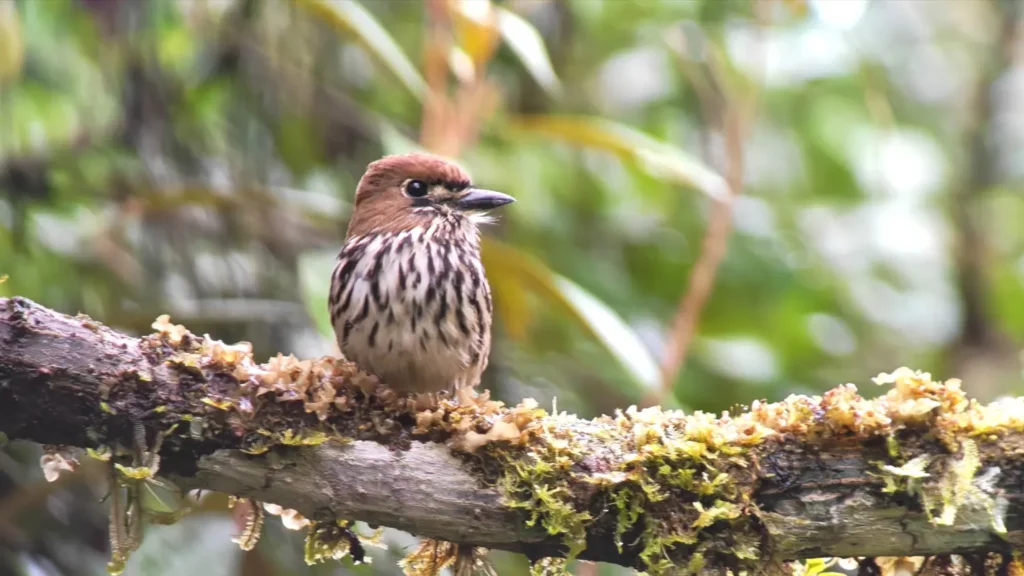
Adult: Overall brownish with fine pale streaking (the “lanceolated” pattern) on head, breast, and underparts. Underparts buffy to whitish with narrow dark shaft streaks; upperparts plain to slightly mottled brown.
Distinctive Features
Short, fairly thick dark bill typical of puffbirds; short tail and compact, stubby body; sits very upright on perches.
Sexual Dimorphism
No obvious plumage differences between sexes are described; males and females appear similar.
Diet and Feeding Behavior
Primary Diet
- Mostly small arthropods such as insects, like other puffbirds. May also take small invertebrates flushed by foliage movement.
Foraging Techniques
- Perches quietly in the forest mid‑story, then sallies to snatch prey from foliage or in short flights.
Feeding Times
- Forages during daylight hours, often most active during morning and late afternoon like many forest insectivores.
Behavior Patterns
Lanceolated Monklet
Social Structure
Usually seen singly or in pairs.
Song and Vocalization
Voice is described as a soft, simple whistled or piping series; notes can be heard in online libraries such as Xeno‑canto and Macaulay Library.
Courtship and Mating Ritual
Specific displays are poorly documented; puffbirds generally rely on vocalizations and close pair interactions rather than elaborate aerial displays.
Territoriality
Likely maintains small territories or core areas within dense forest, as indicated by repeated observations at favored perches.
Birdwatching Tips
Best Locations for Spotting Lanceolated Monklet
Humid Caribbean‑slope foothill forests such as the Braulio Carrillo region and Sarapiquí area (including La Selva surroundings) offer the best chances.
Best Time of the Year
As a resident, it can be encountered year‑round, though detection is always difficult due to its quiet, cryptic habits.
Common Behavior
Look for a very small, stocky brown bird sitting motionless on a horizontal mid‑story perch along forest trails or ravines.
Recommended Gear
- 8×32 or 8×42 binoculars provide a bright view in dim forest understory.
- A camera with good low‑light performance and at least a 300 mm lens helps document distant perches.
Breeding and Nesting Behavior
Breeding Season
In Costa Rica, any breeding likely follows the general pattern of many foothill forest birds, occurring mainly in the wetter part of the year, but precise months are not well documented.
Nesting Sites
Many puffbirds nest in burrows or cavities; lanceolated monklet is believed to follow similar patterns, possibly using earthen banks or natural cavities, though specific nest descriptions are rare.
Clutch Size
Likely small (often 2–3 eggs in related puffbird species), but exact clutch size for this species is not clearly documented in standard references.
Incubation Period
Not well known; related Bucconidae often have incubation around 2–3 weeks.
Parental Care
Puffbirds typically show biparental care, with both adults participating in incubation and chick feeding; lanceolated monklet is presumed similar though direct studies are lacking.
Did You Know?
Interesting Behaviors
The species often goes unnoticed even in well‑birded forests because it sits so still and vocalizes infrequently.
Cultural Significance
There are no well‑documented specific roles in Costa Rican folklore, and it is better known among specialist birders than in popular culture.
Surprising Traits
It is considered one of the smallest puffbirds, giving it a particularly compact, “toy‑like” appearance on its perch.
How do I identify this bird?
Look for a tiny, compact brown puffbird with fine pale streaking on the throat and chest, sitting upright and motionless in the mid‑story of humid forest.
Where is the best place to see it in Costa Rica?
Caribbean‑slope foothill forests, especially around Braulio Carrillo and Sarapiquí/La Selva region, provide the best odds, though it remains rare and elusive.
Is it endangered?
No; it is currently classified as Least Concern globally, but local populations are vulnerable to ongoing forest loss and fragmentation.