
Black-crested Coquette
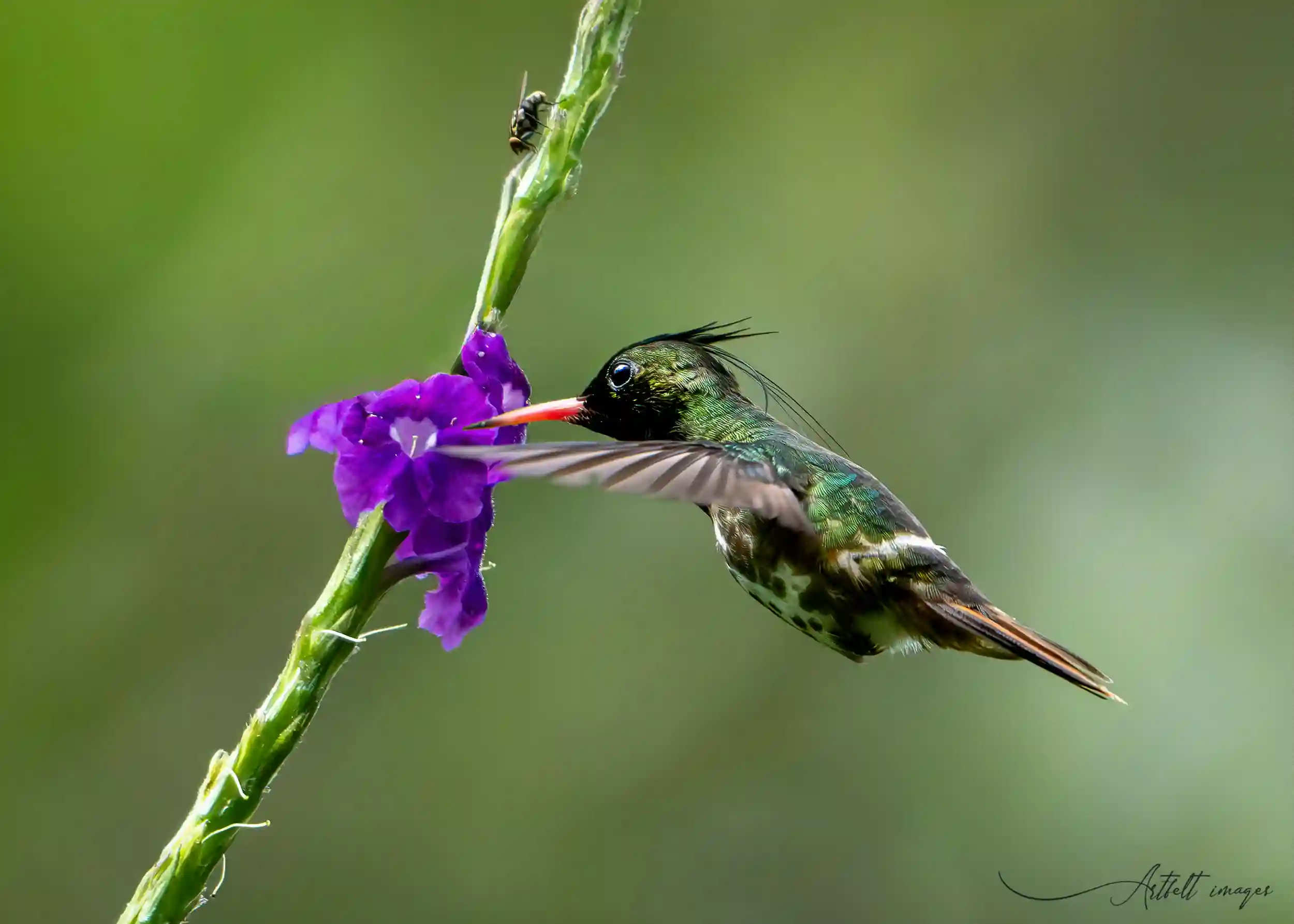
The Black-crested Coquette is a tiny, jewel-like hummingbird found in humid montane forests and edges from southern Mexico to Costa Rica, with males adorned by a distinctive black crest with elongated feathers, glittering green gorget, white rump band, and rufous underparts, typically seen feeding at small flowers in the understory and mid-levels of cloud forests…
Lophornis helenae
Scientific Name
Trochilidae (Hummingbirds)
Family
Apodiformes
Order
Range and Habitat of Black-crested Coquette
Geographic Range
The Black-crested Coquette is found in six Central American countries: Mexico (southern Veracruz, Oaxaca, Chiapas), Belize (southern regions), Guatemala (eastern and western populations), Honduras (eastern regions), Nicaragua (eastern regions), Costa Rica (Caribbean slope and central regions)
A separate, smaller population exists on the Pacific slope in the northern portion of its range, from Chiapas, Mexico, through much of western Guatemala.
Migratory Patterns
The Black-crested Coquette is a year-round resident throughout most of its range. However, in Costa Rica specifically, the species exhibits altitudinal movements rather than true migration. These irregular movements make the species unpredictable at any given location, though certain sites maintain more consistent populations.
Preferred Habitat
The species inhabits semi-open landscapes at the edges of humid montane and lowland evergreen forests, including forest gaps and clearings, brushy areas and hedgerows, second growth, coffee plantations with shade trees, and flowering trees in semi-open agricultural landscapes. The Black-crested Coquette typically forages in the canopy but will descend to lower levels, particularly at forest edges where flowering plants are abundant.
Altitude Range
300 to 1,200 m (980 to 3,940 ft), with most consistent occurrence at foothill and lower middle elevations (400-900 m)
Costa Rica Habitat
In Costa Rica, the Black-crested Coquette occurs primarily on the Caribbean slope from the northern border with Nicaragua southward to approximately central Costa Rica. The species is most regularly observed in:
- Alajuela Province: Arenal Volcano region, La Fortuna area
- Heredia Province: Braulio Carrillo National Park vicinity (especially foothill zones), Sarapiquí region
- Limón Province: Caribbean lowlands and foothills south to approximately Turrialba
- Cartago Province: Rancho Naturalista area represents the southern extent of regular occurrence
Conservation Status
Least Concern
Conservation Status
Population Status
Despite some localized declines, populations appear relatively stable, with the species able to adapt to human-modified habitats such as plantations
Conversion of humid forests to agriculture, pasture, and development represents the primary threat
Conservation efforts
Several protected areas in Costa Rica safeguard Black-crested Coquette habitat, including Arenal, Braulio Carrillo, and Tortuguero National Parks, and numerous private reserves.
Primary Threats
Conversion of humid forests to agriculture, pasture, and development represents the primary threat
Black-crested Coquette Identification
How to Identify the Species
Rarity Level:
UncommonBest Viewing Times:
Early Morning (Dawn - 8 AM), Afternoon (2 PM - 5 PM)
Size
Length: 6.3 to 7.7 cm; Weight: 2.6 to 2.8 g
Plumage
Adult males are striking with a wispy black-green crest, glittering green throat, elongated black-and-buff throat feathers, and a bold white rump band. Females are less ornate, lacking the crest and throat ornaments, with bronze-green upperparts, pale buff to cinnamon throat, and spotted white underparts. Both sexes show the distinctive white rump band in flight and have a red-and-black bill.
Distinctive Features
The most diagnostic feature visible in flight for both sexes is the white rump band.
Sexual Dimorphism
Males are significantly more colorful with the distinctive black crest, elongated throat feathers, glittering green throat, and more extensive iridescent plumage. Females lack the crest and throat ornaments entirely and have more subdued coloration overall, though both sexes share the distinctive white rump band.
Diet and Feeding Behavior
Primary Diet
- The Black-crested Coquette is primarily a nectarivore supplemented with small insects and spiders.
Foraging Techniques
- The primary foraging method involves visiting a regular circuit of flowering trees and plants, returning to the same productive flowers repeatedly
Feeding Times
- Activity patterns are diurnal, with peak feeding activity typically occurring in the early morning (dawn to mid-morning) and late afternoon (before dusk).
Behavior Patterns
Black-crested Coquette
Social Structure
Like most hummingbirds, the Black-crested Coquette is primarily solitary. Males and females only associate during brief courtship and mating, and do not form flocks or stable social groups.
Song and Vocalization
The Black-crested Coquette is typically silent or quiet, vocalizing infrequently compared to many hummingbirds. “A clear, upslurred tsuwee” repeated, primarily during breeding season.
Courtship and Mating Ritual
Males perform elaborate aerial displays, flying in U-shaped patterns in front of perched females.
Territoriality
Males defend productive feeding areas and territory around flowers, though not as aggressively as larger species.
Birdwatching Tips
Best Locations for Spotting Black-crested Coquette
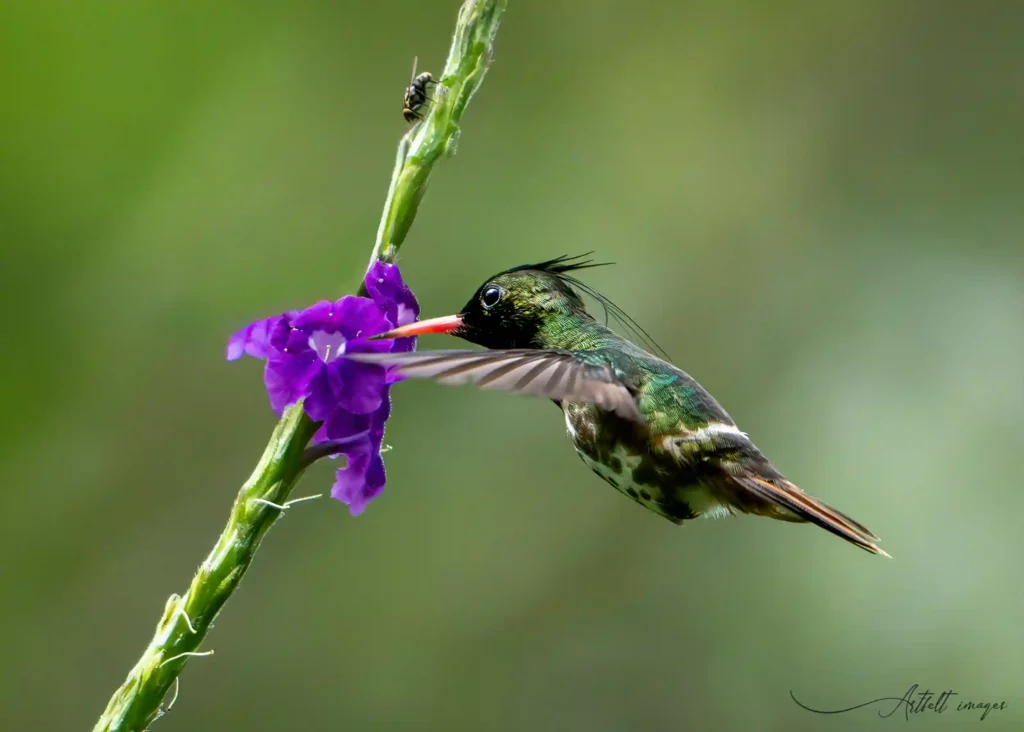
- Arenal Observatory Lodge (Alajuela Province): Perhaps the most reliable site in all of Costa Rica. Flowering Porterweed/Verbena bushes near the lodge buildings regularly attract both male and female Black-crested Coquettes. Multiple individuals often present simultaneously.
- Arenal Hanging Bridges entrance area (Alajuela Province): Flowering bushes near the entrance provide another excellent viewing opportunity in the Arenal region.
- El Tapir (Heredia Province): Just outside Braulio Carrillo National Park, this former eco-lodge location still has Porterweed hedges that attract coquettes along with other hummingbird species.
- Rancho Naturalista (Cartago/Limón Province border): Foothill and middle elevation site representing the southern extent of regular occurrence in Costa Rica.
- Sarapiquí region lodges (Heredia Province): Various eco-lodges in the Sarapiquí region including Selva Verde Lodge
- Virgen del Socorro area
- Quebrada González Station (Braulio Carrillo National Park)
- Various eco-lodges and private reserves in the Caribbean foothills (400-900 m elevation)
Best Time of the Year
December through April (dry season into early wet season) when many trees are flowering. As a resident species, the Black-crested Coquette can be observed year-round, but presence at specific sites may be irregular due to altitudinal movements following flowering resources.
Common Behavior
The species is most easily found by locating mass-flowering trees, particularly Porterweed, Inga, and small-flowered epiphytes. The slow, steady, bee-like flight is distinctive. Birds are easily mistaken for large bumblebees or moths.
Recommended Gear
Binoculars: 8×42 or 10×42 with close focus capability (under 2 meters) essential for viewing tiny hummingbirds at close range. Camera: DSLR or mirrorless with fast autofocus. Lens: 300-500mm telephoto lens or 100-400mm zoom.
Breeding and Nesting Behavior
Breeding Season
Breeding information for this species is extremely limited. One nest was documented active in March, suggesting breeding occurs at least during the late dry season/early wet season transition. However, breeding may occur over a longer period depending on flower availability.
Nesting Sites
Small cup-shaped nest built from fine plant fibers woven together, lined with soft plant fibers, animal hair, and feather down. The exterior is camouflaged with green moss.
Clutch Size
2 white eggs (standard for most hummingbirds)
Incubation Period
Likely 14-19 days based on similar-sized hummingbirds
Parental Care
All nesting duties are performed exclusively by the female, including nest construction, incubation, and chick rearing. The female feeds chicks with regurgitated food, primarily partially-digested insects (as nectar alone is insufficient protein for growing chicks). Young leave the nest at approximately 20 days old.
Did You Know?
Master of Disguise
The Black-crested Coquette’s flight style mimics bumblebees and large moths, possibly allowing it to “sneak” nectar from flowers guarded by larger, more aggressive hummingbirds without triggering territorial defense
Name Origin
The species name helenae honors Princess Helena of Waldeck and Pyrmont, who was Duchess of Orleans in the 19th century
Ancient Lineage
The genus Lophornis (derived from Greek lophos meaning “crest” and ornis meaning “bird”) was described in 1829, representing one of the earliest-described hummingbird genera
How do I identify this bird?
The combination of a wispy black-green crest on the crown, glittering green throat, elongated black-and-buff throat feathers, and a prominent white rump band visible in flight makes males unmistakable. The bronze breast band, white belly with bronze spots, and red bill with black tip are also diagnostic. Females can be confused with female White-crested Coquettes where ranges overlap, but geographic location helps (Black-crested is Caribbean slope; White-crested is Pacific slope south of Carara).
Where is the best place to see it in Costa Rica?
The Arenal Observatory Lodge in the Arenal Volcano region (Alajuela Province) is widely considered the most reliable location in Costa Rica—and possibly anywhere in the species’ range—to observe the Black-crested Coquette. The flowering Verbena (Porterweed) bushes around the main lodge buildings regularly attract multiple individuals, including both males and females, particularly during the dry season and early wet season (December-May).
Is it endangered?
No, the Black-crested Coquette is not endangered. The IUCN Red List classifies the species as Least Concern. While not currently endangered, continued habitat loss across Central America could threaten future populations.