
Acorn Woodpecker
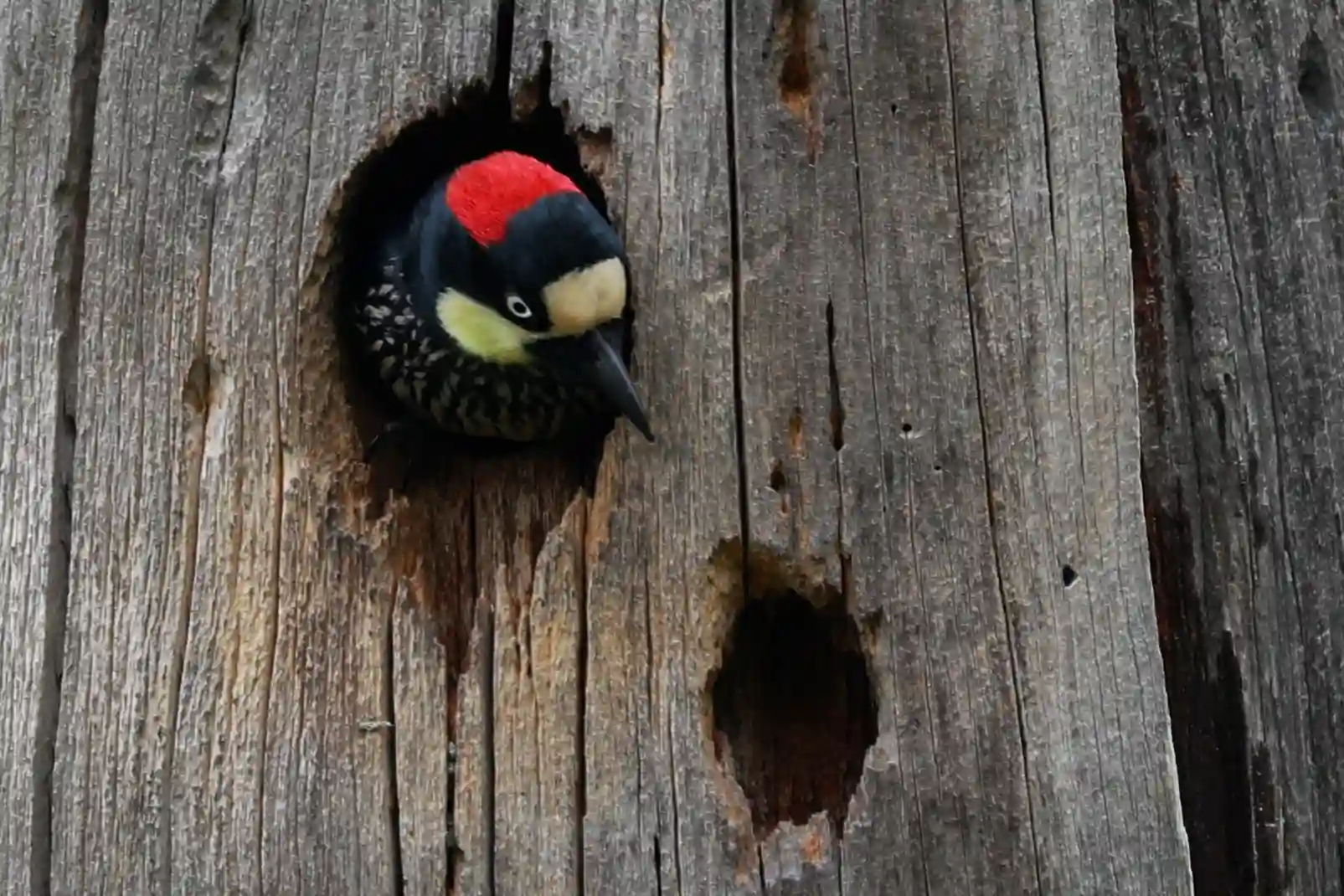
The Acorn Woodpecker is a boldly patterned, medium-sized woodpecker found in oak and mixed woodlands from the western United States through Central America to Colombia, distinguished by its clownish red, white, and black face pattern and remarkable social behavior of living in family groups that collectively store thousands of acorns in specially drilled holes in…
Melanerpes formicivorus
Scientific Name
Picidae (Woodpeckers)
Family
Piciformes
Order
M. f. striatipectus
Subspecies. From Nicaragua to western Panama
Range and Habitat of Acorn Woodpecker
Geographic Range
The Acorn Woodpecker ranges from western United States (Oregon to California) through Mexico, Central America including Guatemala, El Salvador, Honduras, Nicaragua, Costa Rica, to western Panama. There is also an isolated population in Colombia.
Migratory Patterns
The Acorn Woodpecker is strictly sedentary with no seasonal movements. Family groups maintain year-round territories centered on granary trees.
Preferred Habitat
This woodpecker requires oak forests (Quercus species) or mixed oak-pine forests. It prefers mature forests with large trees suitable for granaries, areas with multiple oak species providing staggered acorn production, forest edges and semi-open oak woodlands, and parks or pastures with scattered large oaks. The species is entirely dependent on oak trees for survival.
Altitude Range
In Costa Rica, the species occurs from 1,200-3,000 m elevation, most commonly between 1,800-2,800 m where oak forests dominate. Occasionally found as low as 1,000 m where oaks extend to lower elevations.
Costa Rica Habitat
In Costa Rica, the species is restricted to oak forests in the highlands. It occurs in the Cordillera de Talamanca including Cerro de la Muerte, San Gerardo de Dota, and surrounding peaks, Cordillera Central including upper slopes of volcanoes with oak forests, and locally in the Cordillera de Guanacaste where oaks occur.
Conservation Status
Least Concern
Conservation Status
Population Status
Costa Rican populations are healthy where oak forests remain intact. Density varies with oak forest quality, typically 2-5 groups per km².
Main threats include deforestation of oak forests for agriculture and development, and climate change affecting acorn production cycles.
Conservation efforts
The Acorn Woodpecker is protected in several Costa Rican parks containing oak forests. Conservation of oak forests benefits the species directly.
Primary Threats
Main threats include deforestation of oak forests for agriculture and development, and climate change affecting acorn production cycles.
Acorn Woodpecker Identification
How to Identify the Species
Rarity Level:
CommonBest Viewing Times:
Early Morning (Dawn - 8 AM), Afternoon (2 PM - 5 PM)
Size
20-23 cm in total length. Males weigh 75-95 g while females weigh 70-85 g.
Plumage
Adults display a striking clown-like facial pattern with a white forehead, cheeks, and throat contrasting with black around the bill and chin. The crown is red in males, extending from the white forehead to the nape. Females have a black band separating the white forehead from the red crown. The back and wings are glossy blue-black with white patches visible in flight.
Distinctive Features
The distinctive facial pattern with white forehead and cheeks is unique among Costa Rican woodpeckers. Males and females differ in crown pattern, making sex determination relatively easy.
Sexual Dimorphism
Males have red crowns touching the white forehead, while females show a black band between the white forehead and red crown.
Diet and Feeding Behavior
Primary Diet
- The Acorn Woodpecker's diet centers on acorns from various oak species, stored in granaries and consumed year-round. It also feeds on insects including beetles, ants, and flying termites, tree sap from wells drilled in bark, fruits and berries when available.
Foraging Techniques
- This species is famous for creating granaries - trees, poles, or structures with thousands of holes for storing individual acorns. It catches flying insects in aerial sallies from perches and gleans insects from bark and foliage.
Feeding Times
- Activity occurs throughout the day with peaks in early morning (6:00-9:00) and late afternoon (15:00-18:00). Granary maintenance continues year-round. Intense activity during acorn harvest season (varies by oak species).
Behavior Patterns
Acorn Woodpecker
Social Structure
These woodpeckers live in complex family groups of 2-15 individuals, typically 4-8. Groups consist of breeding adults, helpers (often previous offspring), and current young. All members cooperate in territory defense, granary maintenance, and chick rearing. Groups show remarkable coordination in daily activities.
Song and Vocalization
The primary call is a raucous “waka-waka-waka” or “jacob-jacob-jacob,” giving rise to various local names. Groups produce constant chattering while working and harsh “krrit-krrit” alarm calls. Drumming on resonant surfaces is used for communication. Groups perform “greeting ceremonies” with elaborate calling. The species is among the noisiest Costa Rican birds.
Courtship and Mating Ritual
Complex mating systems include monogamy, polygyny, and polyandry within groups. Courtship involves wing-spreading displays showing white patches, reverse mounting where females mount males, elaborate chasing through trees, and mutual preening and billing. Multiple males may mate with multiple females in some groups.
Territoriality
Groups defend territories of 5-15 hectares centered on granary trees.
Birdwatching Tips
Best Locations for Spotting Acorn Woodpecker
Prime locations include
- Cerro de la Muerte along the Pan-American Highway
- San Gerardo de Dota valley oak forests
- Savegre Mountain Lodge area
- Los Quetzales National Park
- Paraíso Quetzal Lodge surroundings
- Villa Mills area
- upper slopes of Irazú and Turrialba volcanoes
- any highland area with extensive oak forests
Best Time of the Year
Observable year-round with highest activity during breeding season (April-June) and acorn harvest (varies by location and oak species).
Common Behavior
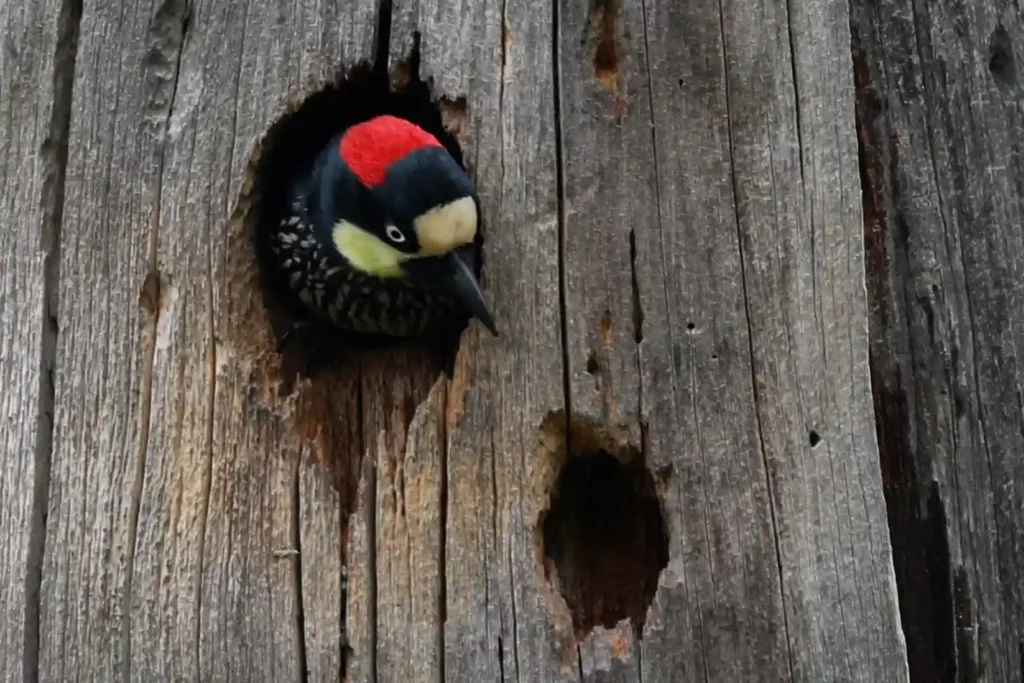
Listen for loud “waka-waka” calls of groups. Look for granary trees riddled with holes containing acorns. Watch for birds flying between oaks with undulating flight. Check dead snags for nest holes. Groups are noisy and conspicuous, making detection easy. Often allows close approach while working on granaries.
Recommended Gear
Basic equipment includes 8×42 binoculars for forest observation, a camera with telephoto lens for group behavior, and audio recording equipment for documenting calls. Look for granary trees as these indicate group presence.
Breeding and Nesting Behavior
Breeding Season
Breeding occurs from March to July in Costa Rica, with peak activity April-June during early wet season.
Nesting Sites
The nest cavity is excavated in dead trees or dead portions of living trees, typically 5-20 meters above ground. Both sexes and helpers participate in excavation over 2-4 weeks. The same tree may contain multiple cavities from different years. No lining is added except wood chips from excavation.
Clutch Size
Females lay 3-7 white eggs, typically 4-5. In groups with multiple females, eggs are often laid in the same nest.
Incubation Period
Incubation lasts 11-12 days with all group members taking turns, including at night.
Parental Care
This species shows cooperative breeding with all group members helping. Multiple individuals incubate eggs and brood young in shifts. All members bring food to nestlings, with feeding visits every 10-20 minutes. Young fledge at 30-32 days. Post-fledging care continues for several months as young learn acorn storage techniques. Young may remain with the group as helpers for several years.
Did You Know?
Interesting Behaviors
A single granary tree may contain over 50,000 holes accumulated over generations. Young woodpeckers practice making storage holes for months before creating functional ones.
Cultural Significance
Indigenous peoples recognized the importance of their granaries for forest regeneration. The complex social system has been extensively studied by scientists. Local names often reference their raucous calls or clown-like appearance.
Surprising Traits
Individual birds can remember the location of thousands of stored acorns. Groups show “voting” behavior when deciding on activities. The species can assess acorn quality by weight and sound, rejecting inferior ones.
How do I identify this bird?
Look for the distinctive clown-like face with white forehead and cheeks, black chin, and red crown. The heavily streaked breast and white rump in flight are diagnostic. The loud “waka-waka” calls and granary trees full of acorns confirm identification. No other Costa Rican woodpecker has this facial pattern.
Where is the best place to see it in Costa Rica?
The oak forests along the road through Cerro de la Muerte offer excellent viewing, particularly around KM 80-95. San Gerardo de Dota and the Savegre area are also reliable. Any highland area above 2,000 m with oak forests may host this species.
Is it endangered?
No, it’s listed as Least Concern with stable populations where oak forests remain. However, the complete dependence on oak trees makes it vulnerable to habitat loss. In Costa Rica, highland oak forests are relatively well protected.